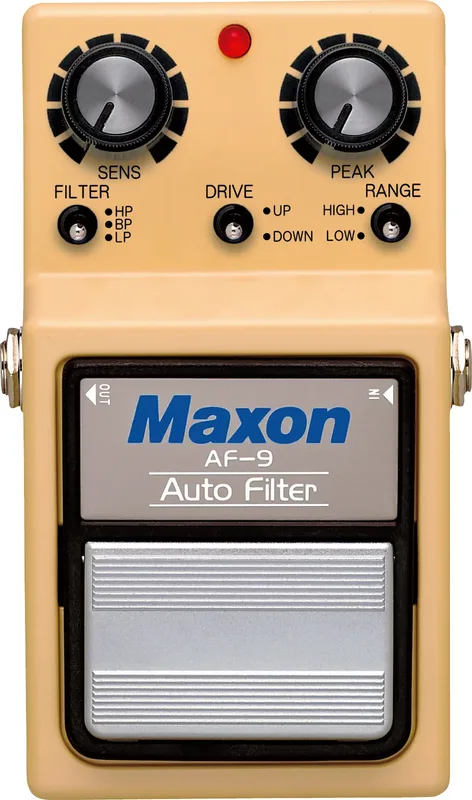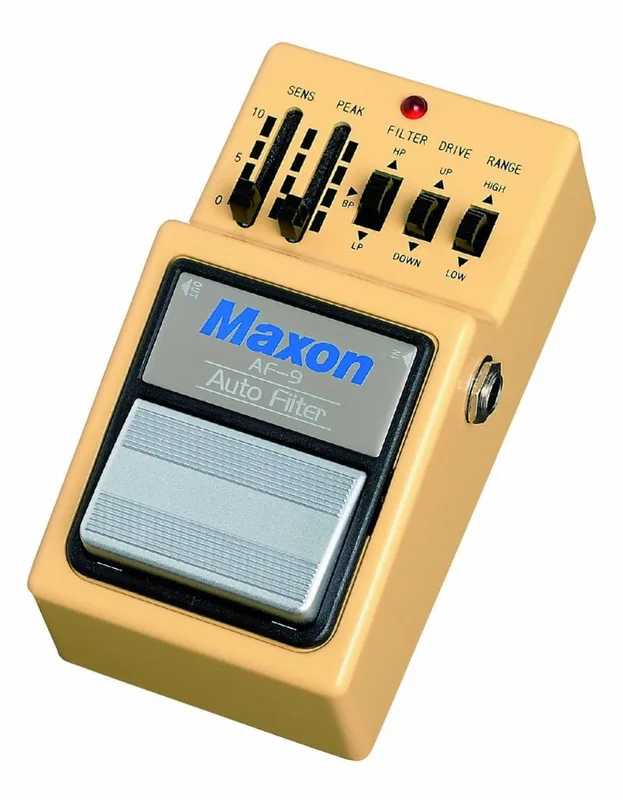


The Maxon 9-Series Auto Filter, known to players as the AF-9, is an envelope filter pedal from Maxon. It takes auto-wah and swept filter effects and puts them in a compact pedal1. Instead of rocking a foot pedal the way you would with a wah, the AF-9 listens to the dynamics of your picking and sweeps a filter across your tone in response, producing the classic, watery, three-dimensional filtering that Maxon says many players have come to count on1.
The circuit is an optical analog design: Pedal of the Day describes the AF-9 as "an optical analog envelope filter" reminiscent of the classic Musitronics Mu-Tron III2, and Maxon says its opto-coupler circuitry produces the shimmering, watery filtering of legendary vintage units1. A full product page for the AF-9 sits at Maxon AF-9 Auto Filter.
What it does
An envelope filter, or auto-wah, tracks the volume envelope of your signal and uses it to sweep a filter up or down. Play harder and the filter opens further; play softly and it stays closer to its resting state. The AF-9 gives you three selectable filter types, Low Pass, Band Pass, and Hi Pass1, which shape which part of the spectrum gets swept:
- Low Pass: the filter opens to let highs through, then closes, the most common auto-wah sound.
- Band Pass: a narrow band is swept, giving a vocal, quacking character.
- Hi Pass: the sweep works on the low end, thinning the tone as it moves.
The frequency range of 100 Hz to 4 kHz, which Maxon says allows the AF-9 to function with virtually any instrument or input signal1, matters for bass players especially. MusicRadar noted that the two range options allow both guitar and bass, or drop-tunings, to be used4.
Controls and how to set them
The AF-9's controls divide into two groups: the switches that set the shape and direction of the sweep, and the knobs that set how strongly it reacts to your playing.
| Control | What it does |
|---|---|
| Filter type switch | Selects Low Pass, Band Pass, or Hi Pass1 |
| Range switch | Sets the range of frequencies the sweep covers; low, mid, and high settings15 |
| Drive switch | Determines the direction of the filter sweep1 |
| Sensitivity | Sets how strongly your picking drives the sweep1 |
| Peak | Adjusts the pedal's response and the degree of effect15 |
In a demo video, Camilo Velandia walked through the layout: the switch on the right controls the range of frequencies, with low, mid, and high settings5, and the drive button reverses the wave, flipping the direction the filter travels5. Turning up the peak changes how pronounced the effect's response is5.
"The sliders for sensitivity and peak are wonderfully intuitive"
That comment refers to the earlier version of the pedal. The current version was redesigned out of necessity, because the fader pots used on the model for nearly 40 years were discontinued1. The Sensitivity and Peak faders have been replaced by rotary pots, and the slider switches are now toggles1. Maxon saw no reason to change the filtering itself1.
If you are comparing a used AF-9 against a new one, the control layout differs: older units use faders and sliders, the current version uses rotary pots and toggles1. The maker's own listing shows the current version sold out1.
Where it came from
The AF-9's original release date was 19811, putting it among the long-running designs in Maxon's 9 Series. Its lineage reaches back further in spirit: Pedal of the Day calls the circuit reminiscent of the classic Musitronics Mu-Tron III2, the envelope filter that defined the effect in the 1970s. The opto-coupler approach, where a light-dependent element does the filtering work, is what links it to those legendary vintage units1.
What reviewers and players said
MusicRadar's verdict on the pedal was short and positive: "An excellent pedal."4 The same review highlighted the intuitive sensitivity and peak controls4 and the two range options that make the pedal workable for bass and drop-tuned guitars4.
Among documented players, Marty Friedman, of Megadeth and Cacophony fame, is named by Maxon as a user, calling it one of his favorite go-to pedals and saying it helps give your playing a human voice1.
In the demo video, Velandia shows the range switch moving between low, mid, and high frequency ranges5, the drive button reversing the wave5, and the peak control shaping the response5.
Videos
Godlyke Inc.
Mike Hermans
Questions
What does the Maxon AF-9 Auto Filter do?
It is an optical analog envelope filter, also called an auto-wah. Instead of rocking a pedal with your foot like a wah, it sweeps a filter automatically in response to how hard you pick, producing the watery, vocal filtering associated with vintage units like the Mu-Tron III. You can choose low pass, band pass, or high pass filter types and set the range and direction of the sweep.
Can the AF-9 be used with bass?
Yes. Its frequency range runs from 100 Hz to 4 kHz, which the maker says allows it to function with virtually any instrument or input signal, and reviewers noted its two range options allow both guitar and bass, or drop-tuned guitars, to be used.
How has the AF-9 changed from the original?
The original dates back to 1981. The current version was redesigned because the fader pots used on the model for nearly 40 years were discontinued: the Sensitivity and Peak faders are now rotary pots, and the slider switches are now toggles. Maxon says the filtering itself was left unchanged.
Sources (5)
- AUTO FILTER (AF-9), Godlyke Distributing, Inc.
- Maxon AF-9 Auto Wah Optical Envelope Filter, Pedal of the Day, 2017-07-07
- Maxon 9 Series AF-9 Auto Filter Pedal, Geargas Store
- Maxon AF-9 Auto Filter review, MusicRadar, 2017-12-26
- Maxon AF-9 Auto Filter Demo Auto Wah, youtube.com, 2012-03-07