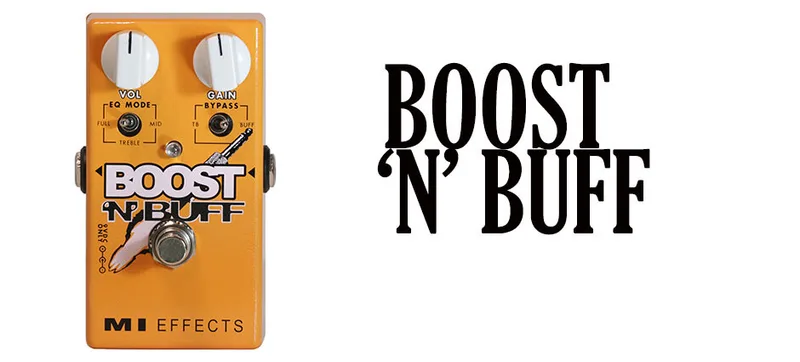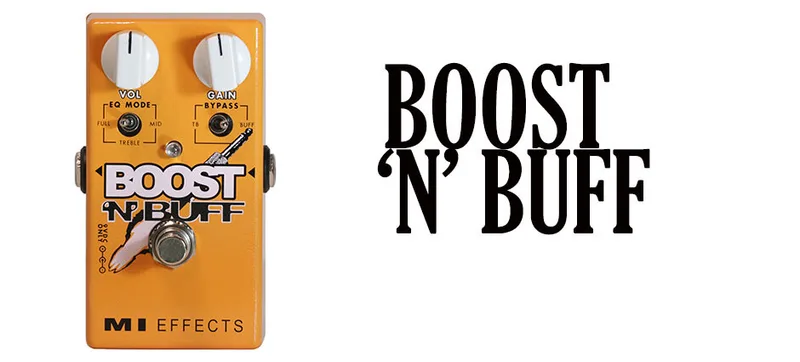


The MI Audio Boost'N'Buff is a booster and buffer pedal in one box, hand made in Sydney, Australia by MI Audio. Engaged, it provides up to 35dB of boost from its Volume control, enough to push an amp harder or lift a solo above the band. In bypass it works as a buffer with an input impedance of approximately 5MΩ, which keeps long cable runs and big pedalboards from dulling your signal. MI Audio calls it "a booster and a buffer pedal that should be an essential on every pedal board"1.
The current version, V5, uses a Class A single transistor design that MI Audio describes as super quiet, with a redesigned buffer circuit for lower noise and lower output impedance than earlier revisions. The maker's store listed it at AU$170.00 and showed it as sold out as of September 20221.
A 35dB boost and a buffer in one pedal
The Boost'N'Buff does two jobs. With the footswitch off, the buffer is in the signal path, presenting a very high input impedance to the guitar so the pickups see something close to an open circuit. That preserves treble and overall level through cables and downstream pedals. With the footswitch on, the boost circuit takes over, and the Volume control delivers up to 35dB of output1.
The Gain control adds a second dimension. MI Audio points out that you can turn the Volume down and use the pedal's built-in gain to get mild dirt sounds, so the Boost'N'Buff can work as a light overdrive as well as a clean boost1. For more on where a boost sits relative to drive pedals, see boost pedals and overdrive pedals.
The bypass is a heavy duty 3PDT footswitch with buffered bypass as standard. New for V5, a top panel switch lets you turn the buffer off and run the pedal true bypass, with no need to open up the enclosure1. That makes it usable both at the front of a long chain, where the buffer helps, and in setups where a player prefers a fully passive bypass. For the general principles, see buffer pedals.
Full, Mid and Treble boost modes
A three-position EQ Mode switch shapes what kind of boost you get: FULL, MID or TREBLE1.
| Mode | What it does |
|---|---|
| FULL | A full frequency boost regardless of the Gain and Volume settings; MI Audio calls it perfect for solo volume boosts1 |
| MID | Rolls off some of the highest frequencies and beefs up the mids, for extra gain, cut and richness without what the maker calls the "ice-pick"1 |
| TREBLE | A more dramatic treble boost than the stock Boost 'n' Buff, tuned for driving a valve amp, with 18V of headroom for a cleaner sound into the amp1 |
The Treble mode is aimed squarely at players who want the classic treble boost into a cranked valve amp behavior, while the Mid mode takes the opposite approach, trimming harshness and thickening the midrange so the boost cuts through without getting thin1.
Power: 9V in, higher voltage inside
The pedal runs on a 9V battery or a 9V DC power supply only, through a 2.1mm center negative jack, and draws 10mA1. Inside, however, the circuit does not run at 9V: the Boost'N'Buff generates a 24VDC internal supply from the 9V input1. The extra internal voltage is what gives the pedal its headroom, so a big boost stays clean instead of clipping the boost stage itself.
This internal voltage multiplication is a running theme in the Boost 'n' Buff line. The v.3 added internal voltage multiplying circuitry that raised the operating voltage from a 9V input to an 18V supply23, and MI Audio's development notes describe a voltage tripling circuit in v.3 that boosts the pedal's operating voltage to approximately 27V, with the 9V battery or DC adaptor supply tripled internally3.
Power is 9V DC only, center negative, 2.1mm jack. The higher operating voltage is generated inside the pedal, so a standard 9V supply or battery is all that is required.
Using it in an amp effects loop
MI Audio notes another application: because line level signals are not a problem for the pedal, the Boost'N'Buff can sit in the FX loop of an amplifier and act as a secondary volume control1. This is a different job from the usual front-of-amp boost. In the loop, the pedal boosts the signal after the amp's preamp, raising overall volume without further driving the preamp into distortion, which suits players who want a solo lift from an already-distorted amp.
Where the Boost'N'Buff came from
The pedal has gone through several versions. The first Boost 'n' Buff was a simple one-knob design, discontinued by 2011, and MI Audio says many players asked for that one-knobber to return4. In October 2011 the maker announced two new models: the Boost 'n' Buff v.3, a boost pedal with EQ options and a buffer, and the Boost 'n' Buff Mini, which packed the same Class A transistor design into a finger-size 1590A enclosure4.
The v.3 kept the VOLUME and GAIN layout from the v.2 and added the three-way mini toggle switch for the three tone-shaping options3. The Mini took a different approach to voicing: it works as a flat booster at the lower range of its gain control and a treble booster at the higher range, with +40dB of boost on tap and a buffer mode in bypass. It runs on 9V DC only, since the small enclosure leaves no room for a battery, and a voltage doubling circuit supplies its boost circuitry with 18V internally, which MI Audio says gives more headroom and extra top-end sparkle4.
The current V5 carries the line forward with the redesigned buffer, the switchable true bypass, and the top panel buffer switch1.
Videos
ProGuitarShopDemos
MI Audio
thegearshark
Questions
Does the MI Audio Boost'N'Buff take a battery?
Yes. The current Boost'N'Buff runs on a 9V battery or a 9V DC power supply with a 2.1mm center negative jack. Earlier versions varied: the v.3 also took a battery and internally tripled the supply voltage, while the Mini had no battery compartment because its small enclosure did not allow for one.
Can the Boost'N'Buff be switched to true bypass?
Yes, on V5. The pedal ships with buffered bypass, where it acts as a very high input impedance buffer, but a top panel switch lets you turn the buffer off and run true bypass without opening the pedal. This switchability is new for V5.
Can I use the Boost'N'Buff in an amp effects loop?
Yes. MI Audio notes that line level signals are not a problem for the pedal, so it can sit in an amp's FX loop and work as a secondary volume control, for example as a solo boost controlled from the loop rather than in front of the amp.
Where is the MI Audio Boost'N'Buff made?
MI Audio builds the Boost'N'Buff by hand in Sydney, Australia, and it carries a 5 year warranty. The maker's store page listed the current version as sold out as of September 2022.
Sources (4)
- Store | MI Audio, MI Audio, 2020-04-11
- Super Blues Pro, MI Audio
- Boost ‘n’ Buff, MI Audio
- NEW BOOST ‘n’ BUFF MINI AND NEW BOOST ‘N’ BUFF v.3, MI Audio, 2011-10-20