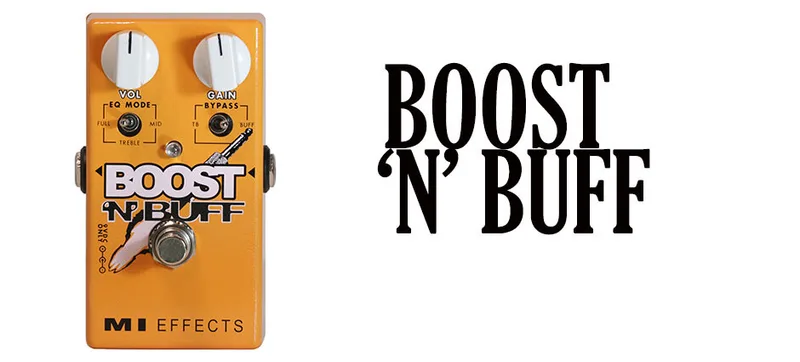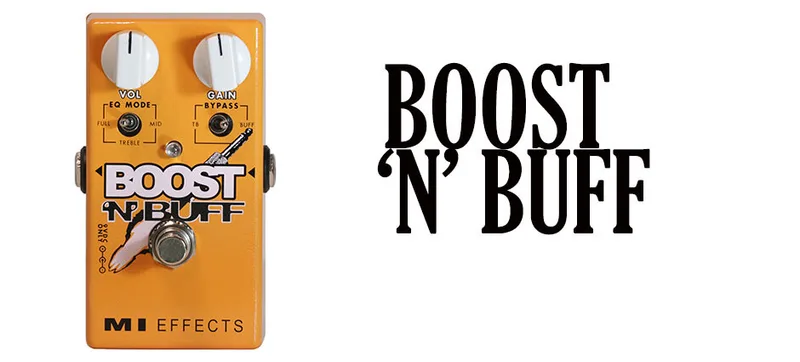


The MI Audio Boost 'n' Buff Mini is a compact boost pedal that also works as a buffer when it is bypassed. MI Audio announced it on 20 October 2011 alongside the Boost 'n' Buff v.3, describing it as the same Class A transistor design as the full-size pedal packed into a small, finger-size 1590A enclosure1. When the pedal is off, it buffers the signal; when it is on, it delivers up to 40dB of boost1.
The Mini sits in MI Audio's Boost 'n' Buff family, which you can read about on the MI Audio Boost'N'Buff page. It came about after MI Audio discontinued the first, simple one-knob version of the pedal and kept getting requests to bring it back1.
A boost with a buffer when bypassed
The Mini's two roles come from the same box. In bypass it acts as a buffer, keeping your signal strong through long cable runs and the rest of your pedalboard. Step on it and it becomes a clean boost with up to 40dB of gain on tap1.
The gain control shapes the character of the boost as you turn it1:
- Lower range: a flat booster, lifting the whole signal evenly
- Higher range: a treble booster, tilting the lift toward the top end1
That single knob is the whole design, and it is what makes the Mini a return to the original one-knob Boost 'n' Buff rather than a shrunken copy of the later versions. The v.3 announced the same day added a three-way EQ toggle for FULL, MID and TREBLE boost modes along with separate VOLUME and GAIN controls, while the Mini kept the simple layout players had asked for1.
Power: 9V DC, doubled to 18V inside
The Mini runs on a 9V DC supply through its power jack, and there is no battery option: MI Audio says the small enclosure doesn't allow for one1. Inside, a voltage doubling circuit raises that 9V supply to 18V for the boost circuitry1.
The practical effect, in MI Audio's words, is "more headroom and extra top-end sparkle to your signal"1. Extra headroom means the boost stays cleaner at high settings instead of compressing or distorting on its own, which matters if you are using the Mini for solo volume lifts rather than for dirt.
No battery means the Mini needs a spot on a power supply. If you are building a board around one, plan for a 9V DC output with the right plug for its jack.
The larger v.3 takes a different approach to the same problem: it has room for a 9V battery and internally triples the supply voltage of either a battery or a DC adaptor1. The full-size Boost'N'Buff product page lists its power as a 9V battery or 9VDC supply only, on a 2.1mm jack with negative center, and gives its internal supply as 24VDC2.
Versions compared
| Boost 'n' Buff Mini | Boost 'n' Buff v.3 | |
|---|---|---|
| Announced | 20 October 20111 | 20 October 20111 |
| Enclosure | 1590A, finger-size3 | Full size, room for a battery1 |
| Controls | One gain knob1 | VOLUME and GAIN, plus EQ toggle1 |
| Boost modes | Flat at low gain, treble at high gain1 | FULL, MID and TREBLE1 |
| Internal voltage | 18V from voltage doubling1 | Internally triples the supply1 |
| Battery | No1 | Yes, 9V1 |
Where it came from
MI Audio discontinued the first Boost 'n' Buff, a simple one-knob design, and the Mini is the answer to the requests that followed. As the announcement puts it13:
"we have had a lot of people asking for that simple one-knobber to return, and so it has, in the form of the new Boost 'n' Buff Mini"1
The v.3 released at the same time went the other way, carrying over the VOLUME and GAIN layout from the v.2 and adding the three-way tone-shaping toggle1. Between the two, MI Audio covered both the minimalist and the full-featured ends of the boost lineup in one announcement.
Availability
The first one-knob Boost 'n' Buff is discontinued1. The current Boost'N'Buff product page lists the pedal as sold out2, so anyone shopping for a Mini or its siblings is looking at the secondhand market or at whatever stock MI Audio has at the time.
Videos
Loc Lam
Lukaz Zou
Spiral
Questions
Does the MI Audio Boost 'n' Buff Mini take a battery?
No. MI Audio says the small size of the 1590A enclosure doesn't allow for a battery, so the pedal runs only on a 9V DC power supply through its power jack. Players who want a battery option would need the larger Boost 'n' Buff v.3, which has room for one.
How much boost does the Boost 'n' Buff Mini give?
MI Audio rates the Mini at up to 40dB of boost when engaged. The gain control works as a flat booster over its lower range and as a treble booster over its higher range, so the character of the boost changes as you turn it up.
What size enclosure does the Boost 'n' Buff Mini use?
The Mini uses a 1590A sized enclosure, which MI Audio describes as finger-size. It is the same Class A transistor circuit as the larger Boost 'n' Buff, packed into the smallest standard pedal enclosure.
Is the original Boost 'n' Buff still made?
The first one-knob Boost 'n' Buff was discontinued, and MI Audio later brought the design back in new versions. The current Boost'N'Buff product page lists the pedal as sold out, so availability depends on what MI Audio has in stock at any given time.
Sources (3)
- NEW BOOST ‘n’ BUFF MINI AND NEW BOOST ‘N’ BUFF v.3, MI Audio, 2011-10-20
- Store | MI Audio, MI Audio, 2020-04-11
- Boost ‘n’ Buff, MI Audio