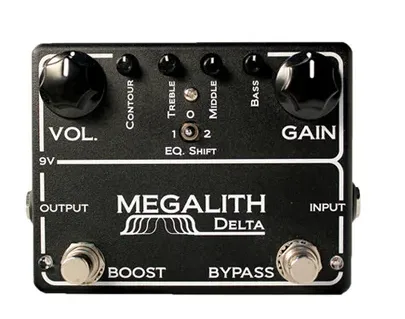


The MI Audio Megalith Delta is a high gain distortion pedal that puts the preamp of the MI Amplification Megalith Beta amplifier, a 180W high gain head, into a stompbox12. Rather than copying the amp with digital modeling, MI Audio built it as a solid state model of the Beta preamp, using JFETs to simulate the gain stages of the preamp valves1. The maker describes it as going quickly from clean, to crunch, to the heaviest of metal tones1.
The pedal was announced in June 2012 under the MI Effects name, described by Premier Guitar as distilling the tone of the Megalith Beta 180W amplifier into a pedal, with true bypass switching and a footswitchable gain boost2. Michael, the designer, states he designed every single aspect of the Megalith Beta amplifier, which is the basis for the pedal's circuit1.
A JFET model of the Megalith Beta preamp
The Megalith Delta came out of years of research and development on the MI Amplification Megalith Beta, the maker's high gain amplifier1. Premier Guitar's 2012 announcement described the Beta as "the very popular, and brutal MI Amplification Megalith Beta amplifier," a 180W amp designed to provide a sophisticated and complex high gain sound ranging from clean to extreme high gain2.
Instead of using valves, the pedal simulates the Beta preamp's gain stages with JFETs, a type of transistor often used in pedal design to mimic tube behavior1. Michael also designed an output section intended to compensate for a standard guitar amp's clean channel response, so the pedal is voiced to sit well in front of an amp's clean setting1.
The controls and the EQ-shift toggle
The pedal carries six knobs: volume and gain are the big ones, with contour, treble, middle and bass as the smaller ones, plus a 3-way EQ-shift toggle and boost and bypass footswitches4. The full control set announced at launch was Volume, Gain, Contour, EQ Switch, Bass, Middle and Treble2.
| Control | What it does |
|---|---|
| Gain | Wide sweep from low-mid gain rock tones to serious crunch to the darkest high gain1 |
| Volume | Sets the output level2 |
| Contour | Mimics the effect of the phase inverter in the Beta's power amp on the frequency response; one sweep goes from old-school fat and midrangy with a slightly rolled off top end to a modern high gain sound with scooped mids and tightened sub-bass2 |
| Bass, Middle, Treble | Three-band EQ2 |
| EQ-shift toggle, position 0 | Adds low mids and a slight increase in volume4 |
| EQ-shift toggle, position 2 | Reduces the mids and slightly lowers the volume4 |
The Contour control is the unusual one. Premier Guitar's 2012 announcement explained that it mimics the effect on the frequency response of the phase inverter in the power amp, a part of an amplifier most pedals never model2.
The BOOST footswitch
The BOOST footswitch steps the pedal up from its mid-gain base to its highest gain, the equivalent of the HIGH GAIN setting on the Megalith Beta amplifier3. Michael explains that the boost was added because the amplifier itself really steps up going from "mid" gain mode to "high" gain mode1.
MI Audio says the boost not only adds more gain but also tightens the response considerably, with more upper mid emphasis3. Premier Guitar's reviewer described it as taking you from medium gain to the extreme upper regions of the gain zone, with added treble and an extra bit of edge4. The stock, un-boosted tone is very fat in the low mids, which the maker calls the Megalith's thickest tone, suited to punchy rhythm sounds3.
Power: 9V doubled to 18V inside
The Megalith Delta runs on a 9V battery or a 9V DC adapter, through a 2.1mm center negative jack, and 9V DC only3. Inside, voltage doubling circuitry raises that 9V supply to 18V for the pedal's circuitry1. MI Audio lists the internal voltage supply as 18VDC, with a current draw of 8mA and an input impedance of 500kΩ3.
The power jack is 9V DC only, 2.1mm, center negative. Feeding it anything other than 9V DC risks damage, since the pedal generates its own 18V internally3.
Speaker simulation output on the V2
The V2 Megalith adds a speaker simulation output on the ring of the output jack3. MI Audio says a simple stereo splitter gives access to a 4x12 simulation, which the maker describes as perfect for DI recording3. That output lets the V2 feed a recording interface or PA directly, without a guitar amp in the chain.
What reviewers said
Premier Guitar's September 2026 review summed up the pedal's appeal in its pros list4:
"Nearly every possible metal sound you could want in a compact package."
The same review listed the street price as $2494. The maker's store page, dated 2022, listed the price as AU$300.00 and the pedal as sold out3.
Build, size and where it is made
The pedal is hand made in Sydney, Australia, and carries a 5 year warranty3. The enclosure has a durable powder coat and screen print, and the pedal measures 4.6 by 3.6 inches (117mm by 92mm)3.
The maker's store page lists the Megalith Delta as sold out, so new units are not currently available directly from MI Audio3.
Videos
Prymaxe
Brett Kingman
Dennis Kayzer
Questions
Does the Megalith Delta take a battery?
Yes. The pedal runs on a 9V battery or a 9V DC adapter through a 2.1mm center negative jack. Inside, voltage doubling circuitry raises the 9V supply to 18V for the circuit, so either power source feeds the same internal voltage.
Is the Megalith Delta true bypass?
Yes. MI Audio specifies a heavy duty 3PDT footswitch with true bypass, so the pedal's circuit is fully out of the signal path when it is switched off.
Can the Megalith Delta be used for direct recording?
On the V2, yes. The V2 Megalith adds a speaker simulation output on the ring of the output jack, and MI Audio says a simple stereo splitter gives access to a 4x12 simulation for DI recording.
Where is the Megalith Delta made?
It is hand made in Sydney, Australia, and carries a 5 year warranty from MI Audio. Michael, the designer, states he designed every aspect of the original Megalith Beta amplifier.
Is the MI Audio Megalith Delta discontinued?
The maker's store page lists the pedal as sold out, so new units are not currently available from MI Audio directly. The product page and its documentation remain on the maker's site.
How much current does the Megalith Delta draw?
MI Audio specifies a current draw of 8mA, which is low enough that it can share a typical pedalboard power supply with plenty of headroom to spare.
Sources (4)
- Megalith Delta, MI Audio
- MI Effects Launches Megalith Delta High Gain Pedal, Premier Guitar, 2012-06-18
- Store | MI Audio, MI Audio, 2020-04-11
- MI Audio Megalith Delta Pedal Review, Premier Guitar, 2012-09-12
 Dave Leslie