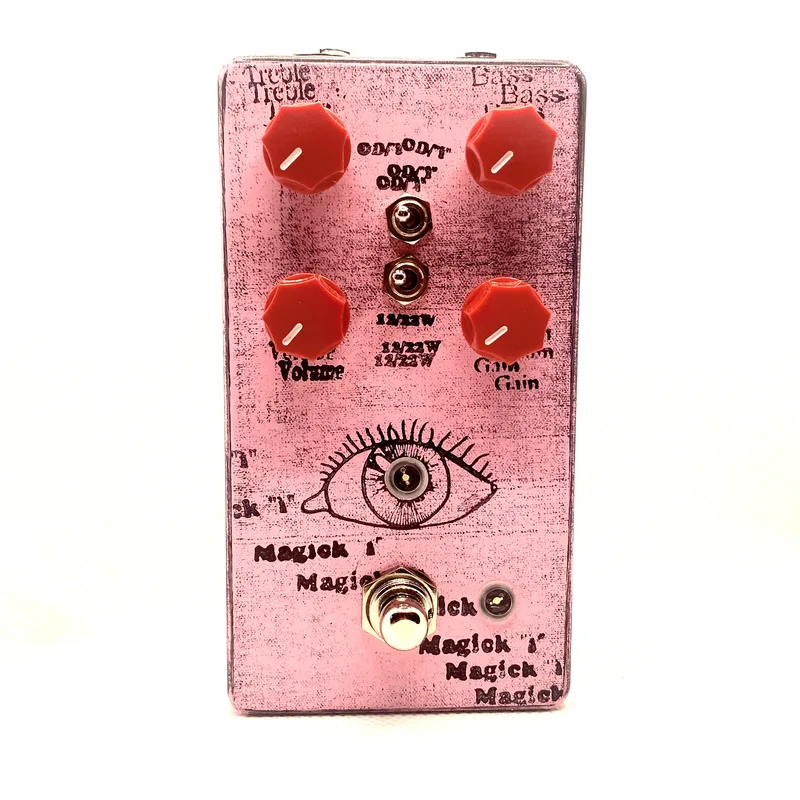


The Mid-Fi Electronics Magick i is a distortion pedal from Mid-Fi Electronics, the company of builder Doug Tuttle, who Premier Guitar notes "doesn't do clones"1. Its distinguishing feature is an optical circuit: it uses an internal LED and photoresistor (LDR), the same arrangement found in an optical compressor, but instead of setting the amount of gain reduction, the light controls the gain and distortion amount1. Premier Guitar called it "a unique distortion/compression hybrid" with a vast range of tones and a useful studio tool1.
Controls
The Magick i carries the expected gain and level controls plus three tone-sculpting controls1:
| Control | What it does |
|---|---|
| Volume | Level control2 |
| Gain | Distortion amount1 |
| Bass | Pre-clipping subtractive bass cut2 |
| Treble | Post-clipping subtractive treble cut2 |
| 12w/22w switch | Selects two different styles of clipping and levels of sag and compression2 |
The wattage switch is the pedal's other signature control. A small toggle switches between 12-watt and 22-watt operation; Premier Guitar's reviewer found the higher-wattage setting louder and more distorted, but with a nice sense of clean headroom1.
Circuit and hardware
Four medium-gain 2N3904 silicon transistors and a network of germanium and silicon diodes provide the crunch1. The jacks are top mounted, which helps on crowded boards2. Despite the variable wattage, the pedal runs on standard 9-volt power1.
The Magick i has no battery compartment1. It needs external 9-volt power from a supply or daisy chain.
Build and sound
Like all Mid-Fi pedals, the Magick i has a funky, homemade appearance, "decorated" with roughly applied spray paint and willfully inconsistent lettering1. On sound, Premier Guitar's reviewer described maximum settings as a buzzy, full-frequency blat, an "ugly" sound that can work great in the right context, while noting the pedal can also be subtle1. If you are weighing it against other dirt boxes, it sits in the territory covered by our Distortion Pedals, Overdrive Pedals and Fuzz Pedals pages, with the compression-like behavior of a Compressor Pedals circuit folded in.
"A unique distortion/compression hybrid. Vast range of tones. Useful studio tool."
Videos
Douglas Tuttle
ElcoAudio
Tri Pedal Reviews
Questions
Does the Mid-Fi Electronics Magick i take a battery?
No. Premier Guitar's review notes that it has no battery compartment, so it runs on external 9-volt power only. Plan your pedalboard power supply accordingly, since there is no fallback option of dropping a battery inside the enclosure.
Who designed the Mid-Fi Electronics Magick i?
The Magick i comes from Mid-Fi Electronics, the pedal builder Doug Tuttle. Premier Guitar's review notes that Tuttle does not build clones, and the Magick i distortion is cited as a good example of his original designs.
What does the wattage switch do on the Magick i?
A small switch toggles between 12-watt and 22-watt operation, giving two different styles of clipping and levels of sag and compression. Premier Guitar found the higher-wattage setting louder and more distorted, but with a nice sense of clean headroom.
What transistors are inside the Magick i?
According to Premier Guitar's review, four medium-gain 2N3904 silicon transistors, along with a network of germanium and silicon diodes, provide the pedal's crunch.
Sources (2)
- Mid-Fi Electronics Magick i Review, Premier Guitar, 2017-11-30
- Mid-Fi Electronics ::: Magick "i", Mid-Fi Electronics