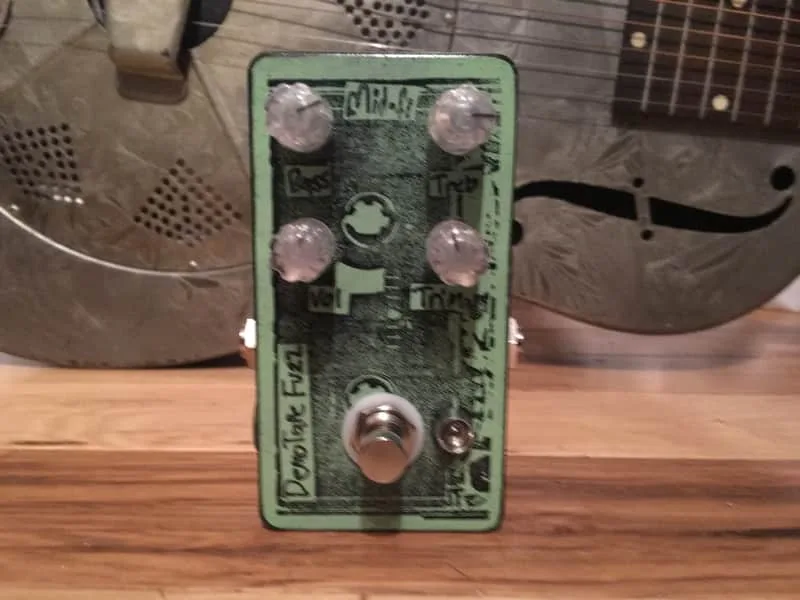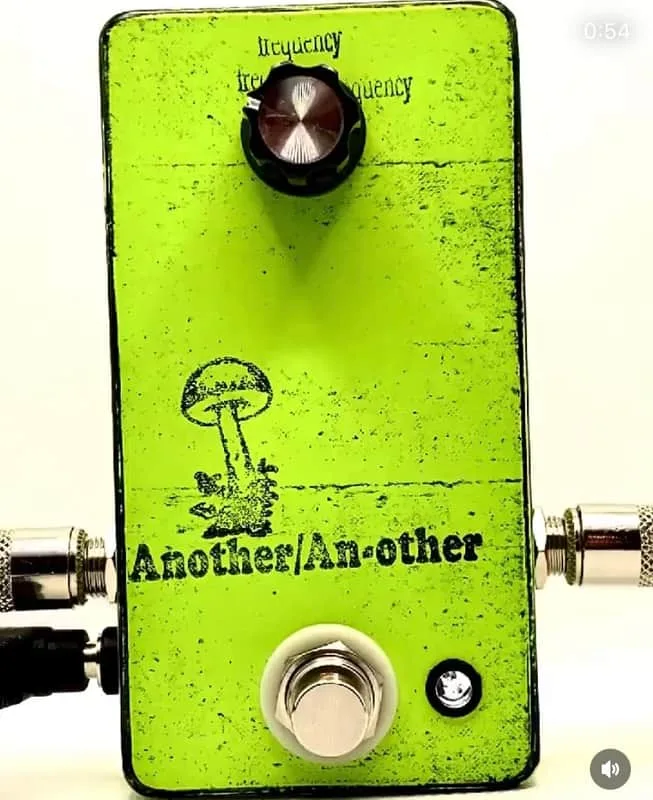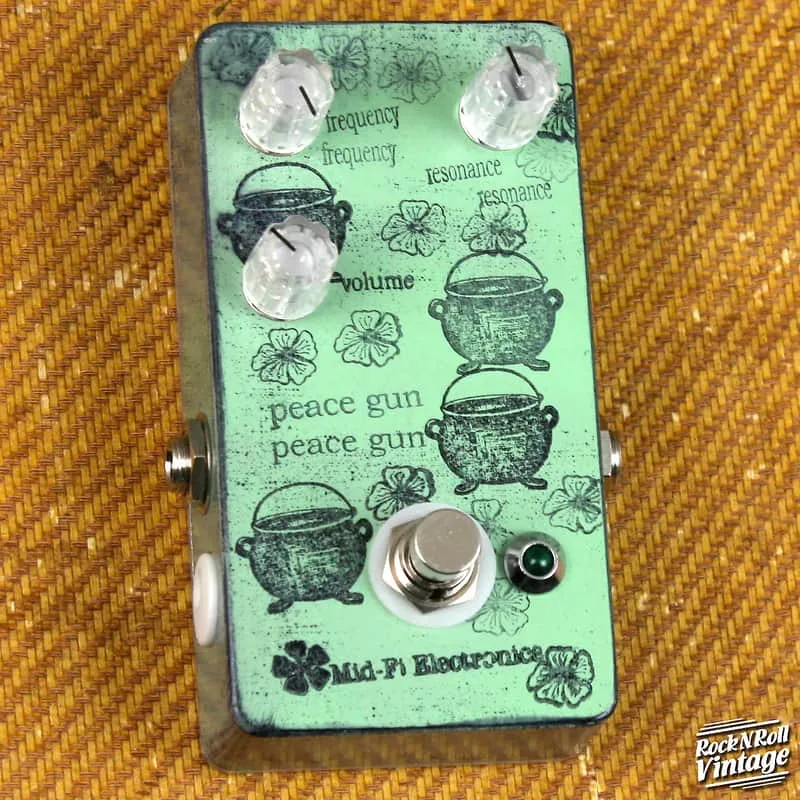

The Mid-Fi Electronics Peace Gun Fuzz is an intermodulating fuzz with a sweepable resonant filter, in the same family as the maker's Demo Tape Fuzz and Another/An-other (Fuzz Version). One builder on the Tagboard Effects circuit-sharing blog described its character this way: "It has the sound of a fuzz with a lot of gain but feels like you're playing with a clean tone which makes for a very dynamic sound."1
What the Peace Gun does
As an intermodulating fuzz, the Peace Gun pairs fuzz distortion with a resonant filter that can be swept across the frequency range. Builder Dave, who spent time with the circuit, put it like this: "Its kind of like a cocked wah and fuzz together, but a very grainy fuzz, and it never gets ear piercing like some resonant filters can."1
Not every builder found it worked as a standalone drive tone. BuzzTones described it as "a low gain fuzz which has a peak at high frequency and cuts some low-end. It works better with a cranked amp or a d[irt pedal]" than as a sole clean amp gain and frequency response. MAndrews agreed in part: "I can't get anything but a thin uninteresting sound out of it with my amp."1 In practice, that points to pairing it with a cranked amp or another dirt pedal, such as an overdrive or distortion pedal, rather than expecting it to carry a clean platform on its own.
Controls and circuit
The original pedal has four knobs, per the maker's website as quoted on Tagboard Effects.1
Builders working from the stripboard layout noted a few quirks worth knowing:
- The filter and resonance pots appear to work backwards: the highest fizz is heard when the Frequency pot is turned counterclockwise all the way.1
- The circuit uses the MPSA13 transistor, and its pinout is 180 degrees of the layout image, so orientation matters when building.1
- The power supply filter, or smoothing, cap is optional. The layout's designer left it that way because such caps "can change the character of the fuzz and tame things down," so including or omitting it is a voicing choice.1
One builder suggested a mod: adding an input gain pot, because changing the input gain changes the sound drastically. The same builder confirmed the circuit "sounds amazing" once built.1
Versions and what builders said
| Builder | Date | What they said |
|---|---|---|
| Jacob Bundren | 21 September 2012 | "uhh... ya. this thing is super badass."1 |
| Unknown (Finnish builder) | 29 September 2012 | Very "Roadrunner"-sounding1 |
| MAndrews | 20 September 2012 | Could only get a thin, uninteresting sound with their amp1 |
| Dave | 23 November 2013 | Like a cocked wah and fuzz together, grainy, never ear piercing1 |
| KG | 30 September 2018 | Sounds amazing; suggested an input gain pot1 |
| BuzzTones | 4 July 2022 | Low gain fuzz, better with a cranked amp or dirt pedal1 |
On the question of separate filter controls, one builder found that "Two pots give way more possible settings," while a dual pot "will result in tigher control that equals in more focused sound."1 That is a trade-off between flexibility and focus for anyone building the circuit with five knobs instead of four.
Videos
JetCityMusic
Questions
How many knobs does the Mid-Fi Peace Gun Fuzz have?
The original pedal has four knobs, according to the maker's website as quoted on Tagboard Effects. Builders of the stripboard layout have also wired the two filter sections to separate pots instead of a dual pot, giving a five-knob build with more possible settings, though a dual pot gives a tighter, more focused sound.
What transistor does the Peace Gun Fuzz use?
The circuit uses the MPSA13 transistor. Builders tracing the layout noted that the pinout of the MPSA13 is 180 degrees of the current image, so anyone building the circuit needs to orient the transistor accordingly.
Why does the Frequency pot work backwards on the Peace Gun?
Builders who built the circuit confirmed that the filter and resonance pots appear to work backwards, with the highest fizz heard when the Frequency pot is turned counterclockwise all the way. This is a quirk of the circuit's wiring rather than a fault, and it is worth knowing when dialing in a tone.
Is the power supply filter cap needed in the Peace Gun?
No, it is optional. The layout's designer left the power supply filter, or smoothing, cap optional because such caps can change the character of the fuzz and tame things down, so leaving it out is a legitimate voicing choice rather than a shortcut.
Does the Peace Gun sound good as a main fuzz tone?
Opinions differ. One builder described it as a low gain fuzz with a peak at high frequency that cuts some low-end, working better with a cranked amp or a dirt pedal than as a sole clean amp gain and frequency response. Another builder could only get a thin, uninteresting sound from it with their amp, while a third called it a very grainy fuzz, like a cocked wah and fuzz together.
Sources (1)
- Guitar FX Layouts: Mid-Fi Electronics Peace Gun Fuzz, tagboardeffects.blogspot.com, 2012-09-21