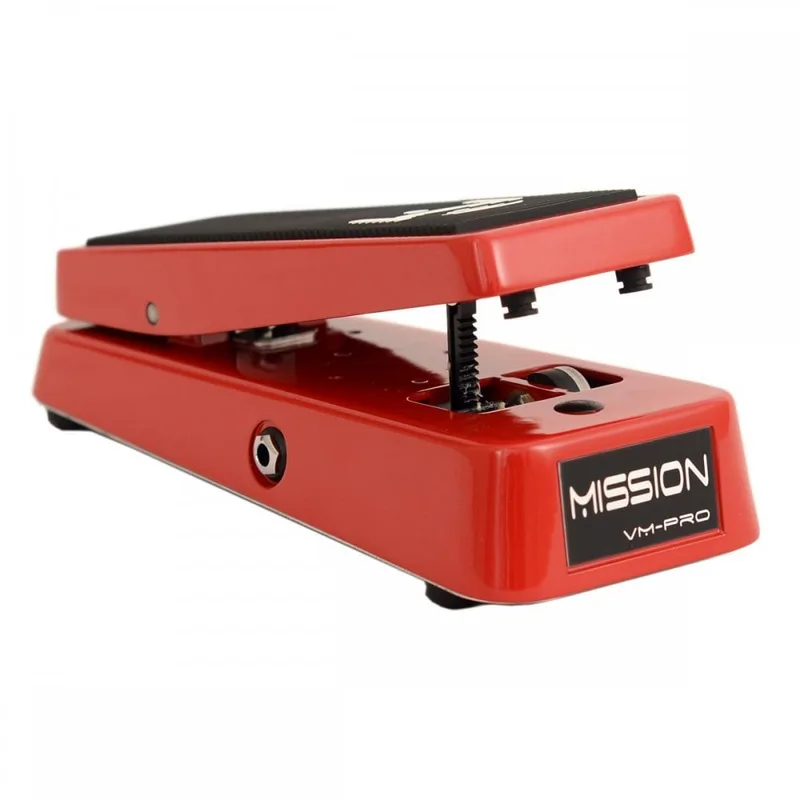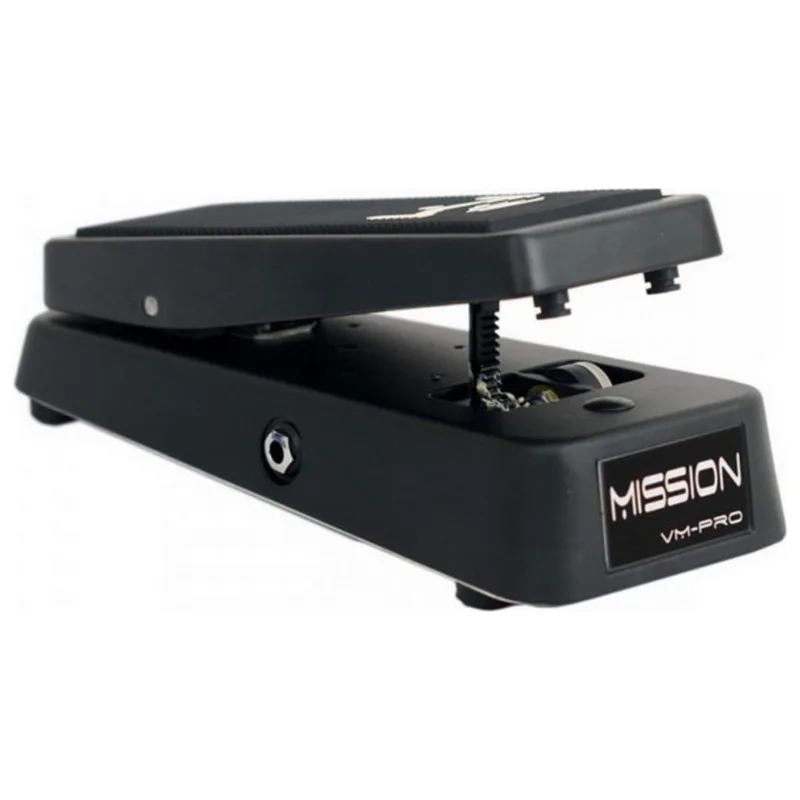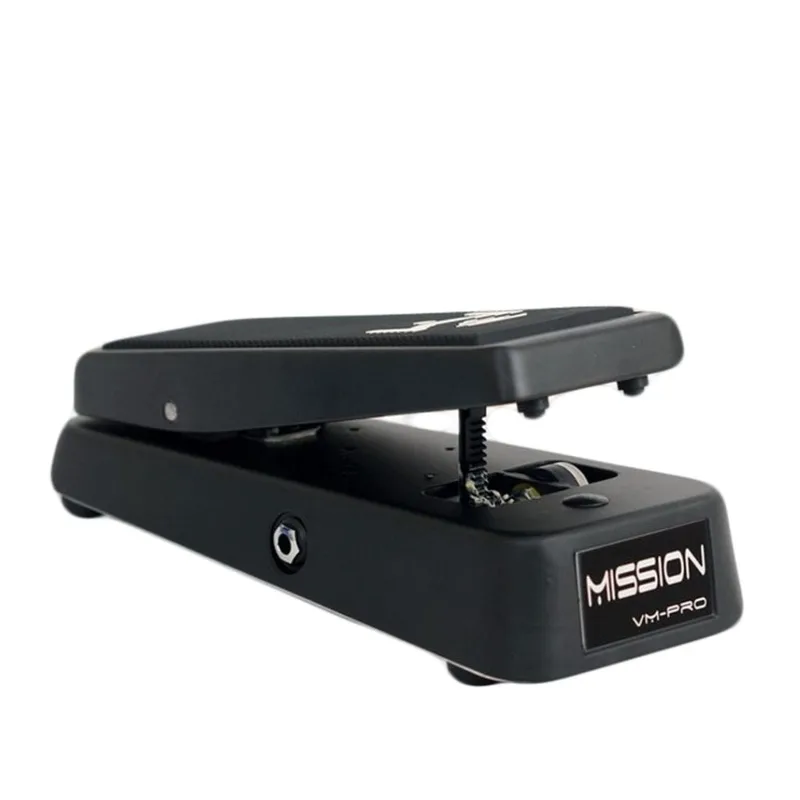


The Mission Engineering VM-Pro (Black) is a buffered volume pedal in a compact, all-metal powder-coated chassis. Its form factor is smaller than most volume pedals, closer to a wah pedal in size, but with a much extended sweep that makes it work as a volume control rather than a narrow-sweep filter1. It is one of two finishes, alongside the VM-Pro (Red), and the VM-PRO series also comes in a standard version and a PZ version voiced for piezo pickups1.
What it does
The VM-Pro is a fully buffered volume pedal. The buffer isolates the input from the output, which prevents the high-frequency loss that comes from long cable runs and their resistance and capacitance. For a player with a large pedalboard or long cables, that is the main argument for a buffered volume pedal over a passive one: the tone reaching the amp stays consistent whether the pedal is at heel or toe1.
The TRS output on the right side carries two separate channels off the buffer amplifier: the amp connection goes out on the tip, and a tuner connection goes out on the ring. Because the two sit on separate, isolated channels, plugging in a tuner does not degrade the signal heading to the amp1.
The input on the left side accepts a wide range of instruments: passive and active electric guitar pickups, bass guitars, baritones, and electroacoustic guitars1.
Controls and switches
| Control | Default | What it does |
|---|---|---|
| Active/passive switch | Passive | Switch to the active position with active pickups to avoid overdriving the pedal1 |
| Output impedance switch | Standard impedance | Alternative impedance setting for fuzz pedals that reject a buffered signal1 |
| Mission Sparkle switch | Flat | Flipped position adds high frequency as volume rolls back1 |
| Minimum volume trimmer | Muted at heel down | Internal screw trimmer; raises the minimum volume at heel down1 |
The impedance switch addresses a known pairing problem: some fuzz pedals do not get along with buffered signals, and the alternative setting presents a different impedance so the fuzz accepts the signal1. The Sparkle switch, meanwhile, counters the treble loss many players hear when rolling a volume pedal back, by adding high frequency as the volume decreases1.
Power
The pedal runs on a 9V battery through a door on the underside, or on a fairly standard 2.1 mm DC center pin negative external supply. It accepts anything from 9V to 18V DC, so common pedalboard power supplies cover it1.
Where it came from
The VM Pro comes in a standard version and a PZ version for piezo pickups, and ships in black and red1. The black finish covered here is one of those two colors1.
In use
In a demo video, the presenter walks through the pedal's layout and features, including the input on the left hand side, the battery door on the underside, the power requirements, and the three switches and internal trimmer covered above1.
For players comparing buffered volume pedals, the same maker's VM-PRO page covers the series, and the buffer pedals type page explains what a buffer does in a signal chain.
Videos
ProGuitarShopDemos
gearmanndude
Sources (1)
- Mission VM Pro Volume Pedal Tutorial, YouTube (channel: James Lebihan), 2013-05-22