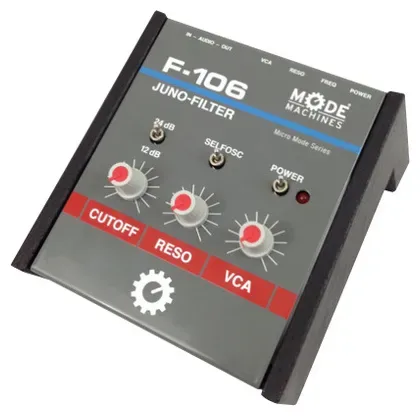


The Mode Machines F-106 is an analog filter module based on the filter section of the Roland Juno-106, the six-voice Roland synthesizer from 1986. Mode Machines describes it as a way to "run your stuff into the Juno Filter", putting the character of that synth's low-pass filter into a small desktop box that any guitarist, bassist or producer can feed an instrument or line signal into1. It belongs to the brand's classic "MICRO MODE SERIES" of desktop designs1.
A Juno-106 filter in a desktop box
The F-106 is not a foot pedal. Mode Machines describes it as "a small metal box with a sloping face that is around the size of a guitar effects pedal", with wooden sides, meant to sit on a desk or studio table rather than on a pedalboard1. The styling follows the synth it borrows from: the maker says it carries "a colour scheme and font design like that found on the Juno-106 itself", along with the wooden sides and what the maker calls impressive build quality1.
Because it is a desktop module with a 1/4" TRS input and output, it can sit in a recording chain or on a table next to an amp rig, taking whatever you send into it and shaping it with the Juno-style low-pass filter. Players interested in filtering in a foot-pedal format can compare it with the wider field of filter pedals. Mode Machines also makes other desktop gear, such as the Mode Machines OMF-11.
The controls
The F-106 keeps its face simple: three knobs, three switches and a power indicator. Mode Machines says "the knobs control the filter cut off, resonance and VCA", with the three switches handling the filter slope, self-oscillation and power1.
| Control | What it does |
|---|---|
| Cutoff knob | Sets the filter cutoff point1 |
| Resonance knob | Sets the filter resonance1 |
| VCA knob | Sets the VCA level1 |
| 12dB/24dB toggle | Selects the low-pass filter slope, 12dB or 24dB per octave1 |
| Self-oscillation toggle | Switches self-oscillation on or off1 |
| Power switch | Power on/off, with a red LED indicator1 |
The 12dB/24dB toggle changes how sharply the filter cuts frequencies above the cutoff point. Mode Machines also notes a 12dB self-oscillation mode associated with the resonance control, so the resonance knob and the self-oscillation toggle together let the filter ring on its own at settings the player chooses1.
CV inputs and connectivity
Alongside the audio input and output, the F-106 has "3 CV-Inputs for CUTOFF, RESONANCE and VCA"1. That means the three main parameters can be driven from external control voltage sources, which is unusual for guitar-oriented filtering gear and points the unit toward modular and studio setups as much as instrument rigs.
The F-106 is a compact desktop unit rather than a pedal, measuring 125 x 130 x 86 mm1. Mode Machines describes its circuit as an analog filter based on the Roland Juno-106 filter section, and a PDF manual is available in the support files section of its product page1.
A PDF manual is available in the support files section of the Mode Machines product page1.
Videos
MOGUSOBA
deepsoundproduction
Red Dog Music
Questions
Is the Mode Machines F-106 analog or digital?
It is analog. Mode Machines describes it as an analog filter based on the Roland Juno-106 filter section, so the filtering happens in analog circuitry rather than through digital processing.
What power supply does the Mode Machines F-106 use?
The F-106 runs on a 12V DC power supply, according to Mode Machines' product page. It is a desktop unit with a power on/off switch and a red LED indicator, so it is not powered from a standard 9V pedal supply.
What is the difference between the 12dB and 24dB settings on the F-106?
The 12dB/24dB toggle selects the slope of the low-pass filter, that is, how sharply frequencies above the cutoff point are reduced. Mode Machines also notes a 12dB self-oscillation mode associated with the resonance control.
Can the F-106 self-oscillate?
Yes. The F-106 has a self-oscillation on/off toggle switch, and Mode Machines describes a 12dB self-oscillation mode tied to the resonance control.
Does the F-106 have CV inputs?
Yes. It has three CV inputs, for cutoff, resonance and VCA, which let you control those three parameters from external control voltage sources.
Is the Mode Machines F-106 a pedal?
Not exactly. It is a desktop unit about the size of a guitar effects pedal: a small metal box with a sloping face and wooden sides, from Mode Machines' Micro Mode series, but it sits on a desk or table rather than on a pedalboard.
Sources (1)
- F-106 | MODE MACHINES, Mode Machines, 2014-06-08