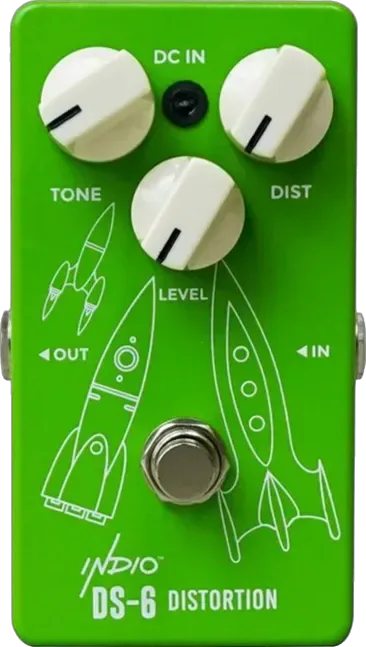


The Monoprice DS-6 Analog Vintage Distortion is a distortion pedal for electric guitar, sold by Monoprice and designed by Indio Guitars. It is an analog circuit with true bypass switching, running on a standard 9V DC center negative supply and drawing 5.4mA1.
The pedal's stated purpose is to recreate a specific piece of history. according to RockBoard's PedalPedia, "Indio™ Guitars faithfully recreated the design and vintage tone of the mid-to-late 70s distortion pedal"1. The maker goes further, saying that "the mid-to-late 70s distortion pedal has gained legendary status as possibly the best ever made" and that its tone "has yet to be improved"1. In other words, the DS-6 is pitched not as a new take on distortion but as a faithful copy of a design from the era when distortion pedals were being defined, alongside the overdrive and fuzz circuits that shared that period.
Design and intent
The DS-6 belongs to a family of pedals that aim at a vintage circuit rather than a new sound. Indio Guitars, the design house behind it, is credited by the maker with recreating both the design and the vintage tone of the original mid-to-late 70s unit1. For a player, that means the pedal is presented as a way to get a 1970s-style distortion voice from a current-production stompbox, rather than a modern reinterpretation with added features.
What the maker states about the pedal, in one place:
- Sold under the Monoprice name1
- Designed by Indio Guitars1
- Analog circuit1
- True bypass switching1
- Presented as a recreation of a mid-to-late 1970s distortion pedal1
Power and practicalities
The DS-6's electrical requirements are about as simple as a pedal gets. It takes 9V DC with center negative polarity, the convention used by the overwhelming majority of pedal power supplies, so it will sit happily on a board powered by a standard supply1.
Its current draw is 5.4mA1, which is low even by the standards of compact analog pedals. That figure matters in practice: a pedal drawing this little leaves plenty of headroom on any supply output, and it is the kind of load that a single isolated output handles without thought.
| Specification | Value |
|---|---|
| Effect type | Distortion1 |
| Circuit | Analog1 |
| Bypass | True bypass1 |
| Power | 9V DC, center negative1 |
| Current draw | 5.4mA1 |
The DS-6 is an analog, true bypass pedal running on 9V DC center negative at 5.4mA1. As with any pedal at this current draw, it can share a power setup easily, but the maker's listing specifies 9V DC center negative, so that is the supply to give it.
Videos
3J Music
mix reviews
Stevelust2024
Questions
Is the Monoprice DS-6 true bypass?
Yes. Monoprice lists the DS-6 as a true bypass distortion pedal, so when it is switched off, the guitar signal passes through without the circuit in the path.
Is the Monoprice DS-6 analog?
Yes. The DS-6 uses an analog circuit, in keeping with its aim of recreating the design and tone of a mid-to-late 1970s distortion pedal.
What voltage and polarity does the Monoprice DS-6 use?
The DS-6 runs on 9V DC with center negative polarity, the same standard used by most common pedal power supplies.
Who designed the Monoprice DS-6?
The pedal was designed by Indio Guitars, which according to the maker faithfully recreated the design and vintage tone of the mid-to-late 70s distortion pedal. It is sold under the Monoprice name.
How much current does the Monoprice DS-6 draw?
The DS-6 draws 5.4mA, a low figure that means almost any 9V DC pedal power supply can run it.
Sources (1)
- DS-6 Analog Vintage Distortion by Monoprice, RockBoard PedalPedia, 2026