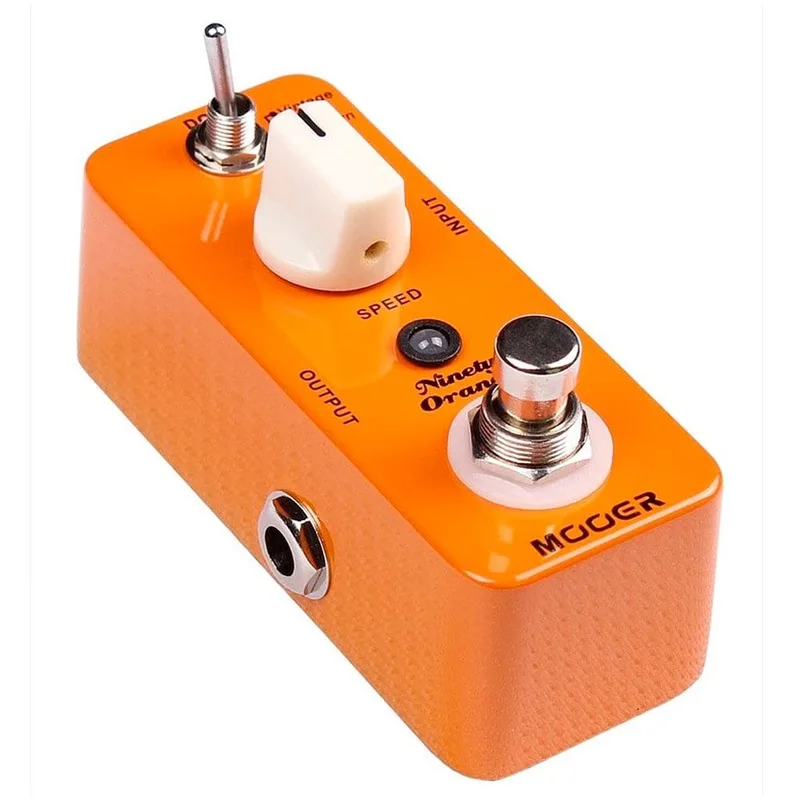


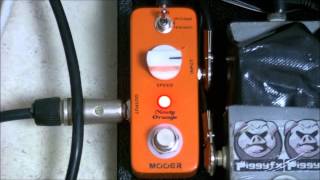
The Mooer Ninety Orange is a phaser pedal from Mooer Audio, built around what the maker calls a full analog circuit and aimed at players who want phasing in the smallest possible footprint. It offers two working modes, Vintage and Modern, in a full metal shell that Mooer describes as very small and exquisite1.
A phaser splits your signal and shifts the phase of one copy across a range of frequencies, then recombines the two. Where the shifted and unshifted waves line up they reinforce each other, and where they oppose they cancel, so you hear a moving series of peaks and notches sweep through your tone. That is the classic swirling, whooshing effect heard on countless recordings.
Vintage and Modern modes
The pedal's single control set is split across two modes, and the difference between them is the heart of the product1.
| Mode | Mooer's description |
|---|---|
| Vintage | 1974 vintage phasing tone, warm and psychedelic1 |
| Modern | Modern feeling phaser, rich and deep1 |
Mooer describes the Vintage mode as a "1974 vintage phasing tone, warm and psychedelic"1, which points at the sound of the mid-70s phasers that defined the effect on record. Modern mode is described as a "Modern feeling phaser, rich and deep"1. The maker credits the pedal's overall character, a "warm, deep, rich phasing tone", to its full analog circuit1.
"Full analog circuit, warm, deep, rich phasing tone"
Power and connections
The Ninety Orange runs on a 9V DC adapter with a center minus plug, the same standard polarity as most modern pedals, and draws only 5 mA, light enough for almost any power brick1. There is no battery option; Mooer lists DC 9V adapter power supply only1.
Connections are simple: one 1/4" monaural input jack at 470k Ohms impedance and one 1/4" monaural output jack at 10k Ohms impedance1. The pedal is true bypass, so with the effect off your signal passes through untouched1.
The Ninety Orange is adapter power only, with a 9V DC center minus plug. There is no battery compartment, so it needs a wall supply or a powered pedalboard output.
Size and build
The enclosure measures 93.5mm deep by 42mm wide by 52mm high and weighs 160g, with a full metal shell1. That footprint is the mini-pedal format Mooer is known for, small enough that several of these pedals take up the board space of one standard-sized unit.
How it differs from other Mooer phasers
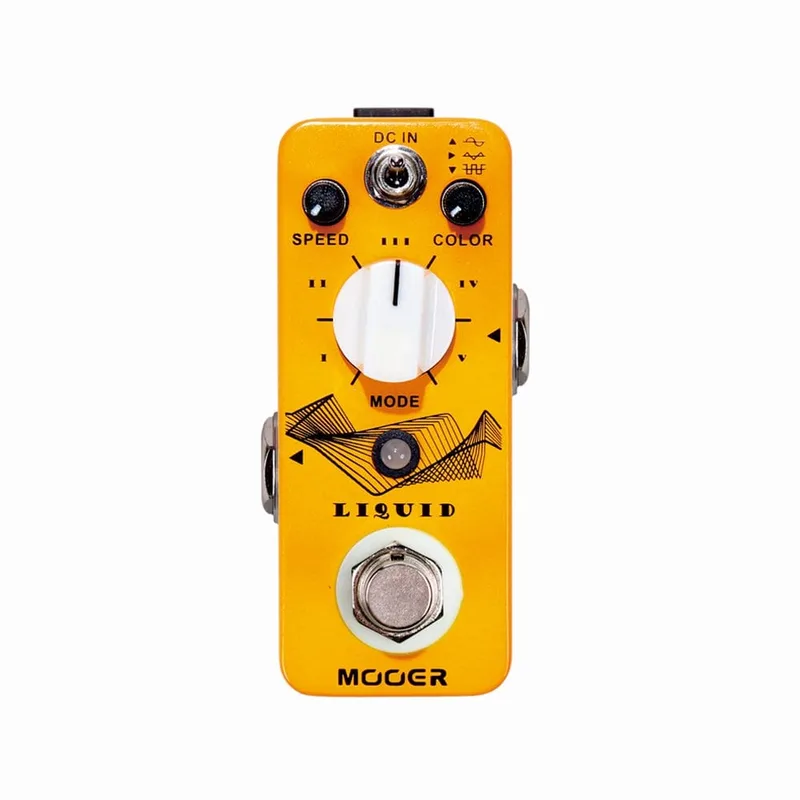
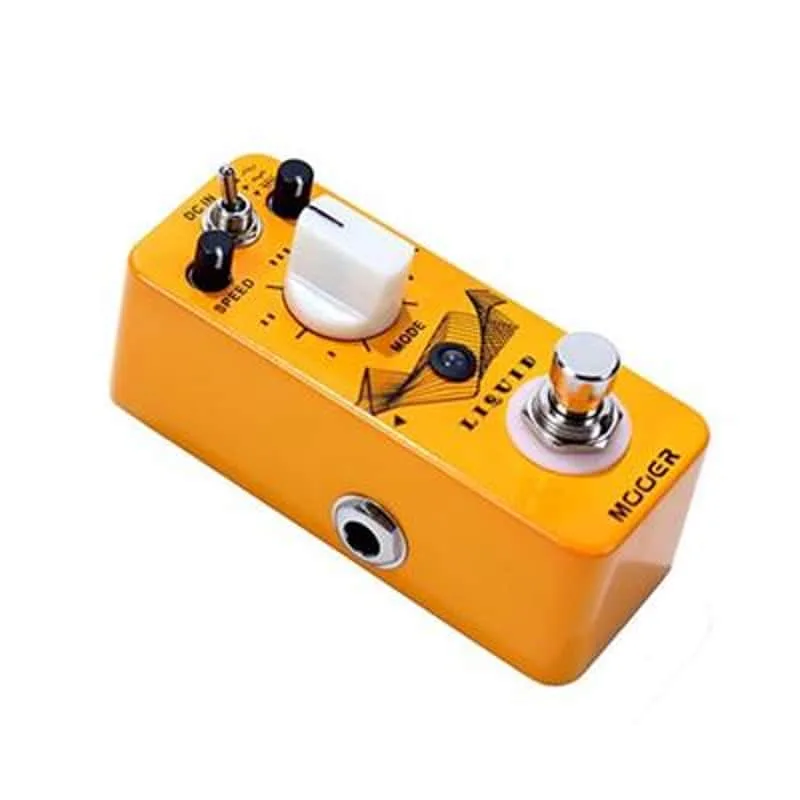
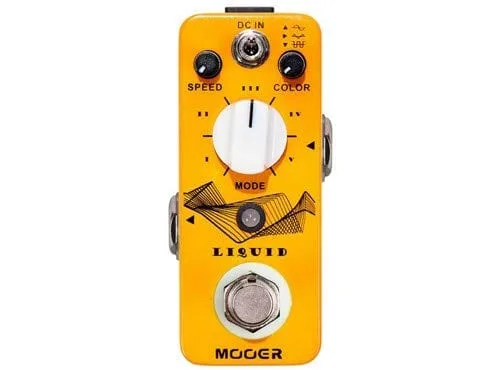
Mooer also makes other phasers in the same compact format. The MOOER Liquid is another phaser in the lineup, where the Ninety Orange is analog with two fixed modes, Vintage and Modern1. Players who want a simple analog sweep with a choice between a 1974 vintage phasing tone and a modern, rich and deep one have it here.
Videos
MOOER Audio
Prymaxe
Pertybass
Questions
Is the Mooer Ninety Orange true bypass?
Yes. Mooer lists the Ninety Orange as true bypass, so when the pedal is switched off the signal passes through without the circuit coloring it. That suits small boards where the pedal stays disengaged much of the time.
Does the Mooer Ninety Orange take a battery?
No. Mooer specifies DC 9V adapter power only, with a 9V DC center minus plug. There is no battery option mentioned, so it needs a power supply or an isolated output on a pedalboard power brick.
Is the Mooer Ninety Orange analog?
Yes. Mooer describes it as a full analog circuit and credits that with its warm, deep, rich phasing tone. It is not a digital modeling pedal like Mooer's Liquid series phaser.
Is the Mooer Ninety Orange a Phase 90 clone?
Mooer does not describe it as a clone of any pedal. Its Vintage mode is described as a 1974 vintage phasing tone, warm and psychedelic, which points at the sound of mid-70s four-stage phasers, but the maker makes no direct claim about the MXR Phase 90.
Sources (1)
- Ninety Orange_MOOER Audio, MOOER Audio