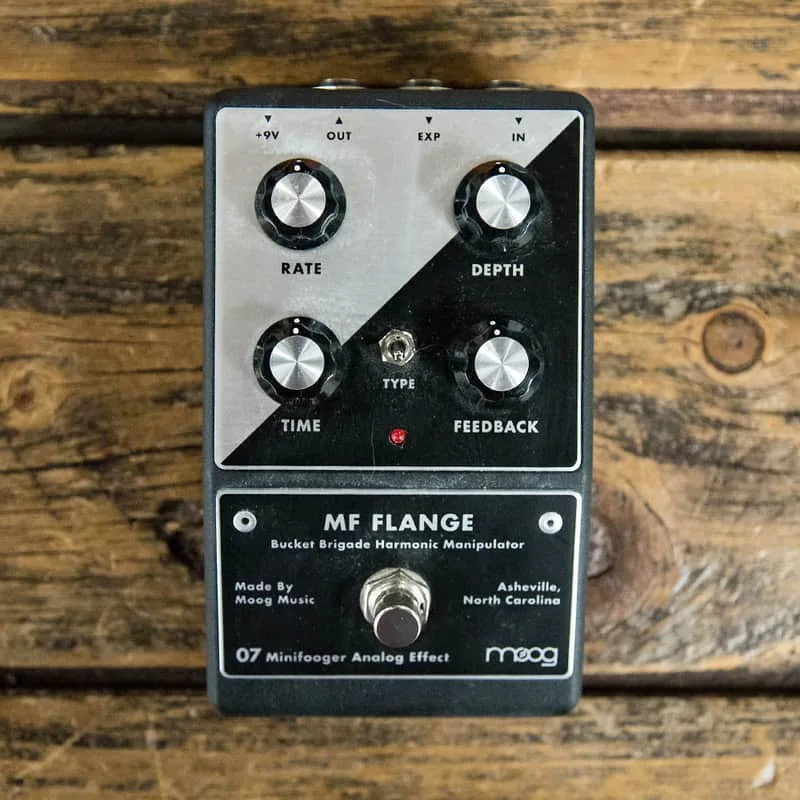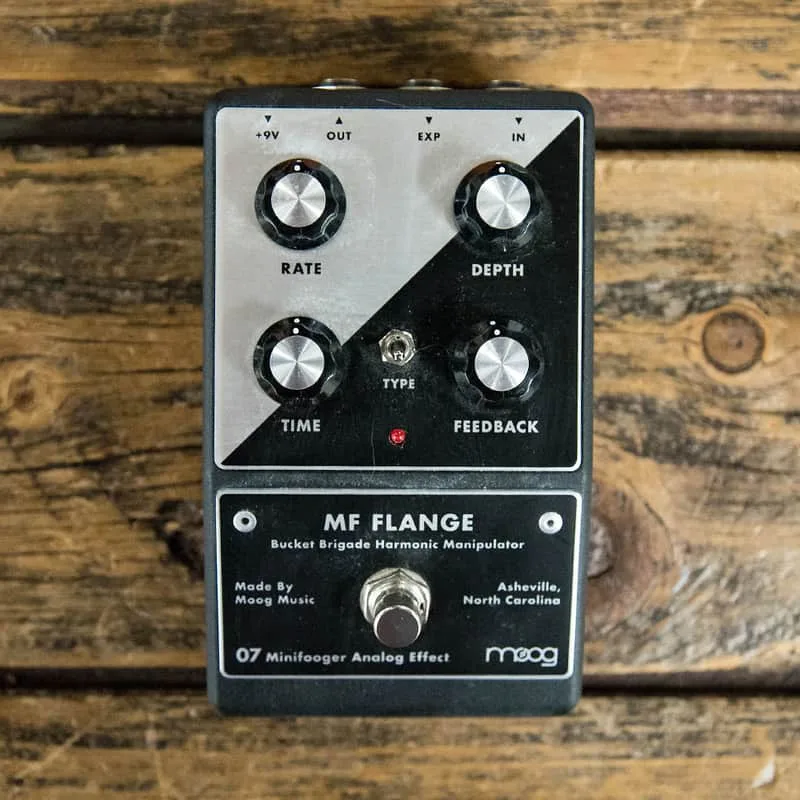


The Moog Minifooger MF Flange is an analog flanger pedal from Moog, part of the compact Minifooger range that shrinks the big Moogerfooger units down to stompbox size1. Like the rest of the range it is 100% analog, passes your signal through a high-quality path when engaged, and uses true bypass when switched off2. It is built to withstand the abuses of live performance2.
Where a typical flanger gives you one sound, MusicRadar found the MF Flange covers several: standard flanging, a tighter shimmering effect like chorusing, and notch modulations that come across as more phaser-like. With the Time control wound down, the reviewer reported a strong metallic, comb-filtered space2.
What it does to your sound
Flanging works by mixing a short, modulated delay with your dry signal, which creates moving notches in the frequency response, the classic jet-like sweep. The MF Flange can do what most flangers do within the first 20% of its control range, according to MusicRadar, but its range extends well beyond that into chorus and phaser territory2.
The sounds MusicRadar identified:
- Standard flanging, the familiar sweeping jet effect2
- A tighter shimmering effect, like chorusing2
- Notch modulations that come out as more phaser-like2
- A strong metallic, comb-filtered space with Time wound down2
For subtle use, the reviewer found that keeping the Depth and Rate knobs just off minimum does the trick2.
How it works and how it is controlled
At the heart of the pedal is a BBD, or Bucket Brigade Delay, the analog delay chip that the Time control is built around2. This is the same bucket-brigade technology Moog used elsewhere in the range: the Minifooger MF Delay is a bucket-brigade-based analog delay with up to 700ms of delay time3. In a flanger, the delay time is very short and swept by an LFO rather than set by hand.
The LFO itself is worth knowing about: it uses an exponentiated triangle wave, and MusicRadar notes that its peakiness is revealed when you turn the Depth control up2. In practice that means the character of the sweep changes with depth, from a smooth movement to something more pronounced and pointed.
| Control | What it does |
|---|---|
| Time | Sets the delay time at the heart of the BBD circuit; wound down it produces a strong metallic, comb-filtered space2 |
| Depth | Sets the depth of the effect; just off minimum for subtlety, turned up it reveals the LFO's peakiness2 |
| Rate | Sets the speed of the sweep; kept just off minimum for subtle effects2 |
Expression pedal control
Like every pedal in the Minifooger range, the MF Flange has an expression pedal/CV input at the rear for extra control2. MusicRadar's review of the range describes this as a facility for real-time parameter adjustment4. On the sibling MF Delay, the expression jack lets you control either the Time or Feedback functions3, which gives a sense of how Moog applies expression control across the line. If you want to explore this further, see expression pedals.
Where it came from
The Minifooger pedals are compact versions of the big Moogerfoogers, Moog's larger effects units1. The range launched with five pedals, offering standard 9V battery or adapter power, true bypass, and the expression pedal facility across the board4. The MF Flange sits in this line alongside delay, drive, and other effects, all sharing the same analog design philosophy and road-ready construction2.
What reviewers said
MusicRadar's verdict on the MF Flange was positive on both build and sound, concluding that it takes a standard effect and offers the user a whole range of new possibilities2:
"Yet another Minifooger that takes a standard effect and offers the user a whole range of new possibilities2."
MusicRadar2
The reviewer found no reasons to avoid it overall2. Coverage of the wider range has been similarly warm: Pedal of the Day called the MF Delay a little pedal sure to surprise you, with great features and that signature Moog sound3.
Videos
ProGuitarShopDemos
Pete Thorn
Reverb
Questions
Is the Moog Minifooger MF Flange analog?
Yes. MusicRadar describes the Minifooger pedals as 100% analog with a high-quality signal path, and the MF Flange's Time control is built around a BBD, or Bucket Brigade Delay, the classic analog approach to time-based effects.
Does the MF Flange have true bypass?
Yes. The Minifooger range provides true bypass, so with the pedal switched off your signal passes through without the circuit coloring it. MusicRadar notes the range also offers a high-quality signal path when the effect is engaged.
Can you use an expression pedal with the Moog MF Flange?
Yes. Like the other pedals in the Minifooger range, the MF Flange has an expression pedal/CV input at the rear for extra control, letting you adjust parameters in real time with your foot while you play.
What kind of delay does the MF Flange use?
The MF Flange uses a BBD, short for Bucket Brigade Delay, at the heart of its Time control. This is the same analog delay technology Moog used in the Minifooger MF Delay, which Pedal of the Day described as bucket-brigade-based analog delay.
What waveform does the MF Flange LFO use?
The LFO uses an exponentiated triangle wave. MusicRadar notes that its peakiness becomes apparent when you turn the Depth control up, which shapes how pronounced the sweep of the effect sounds.
Sources (4)
- Moog Minifooger MF Analog Delay, Pedal of the Day, 2014-11-26
- Moog Minifooger MF Flange review, MusicRadar, 2016-01-30
- Moog Minifooger MF Delay, Pedal of the Day, 2015-12-14
- Moog Minifooger Drive review, MusicRadar, 2014-07-07