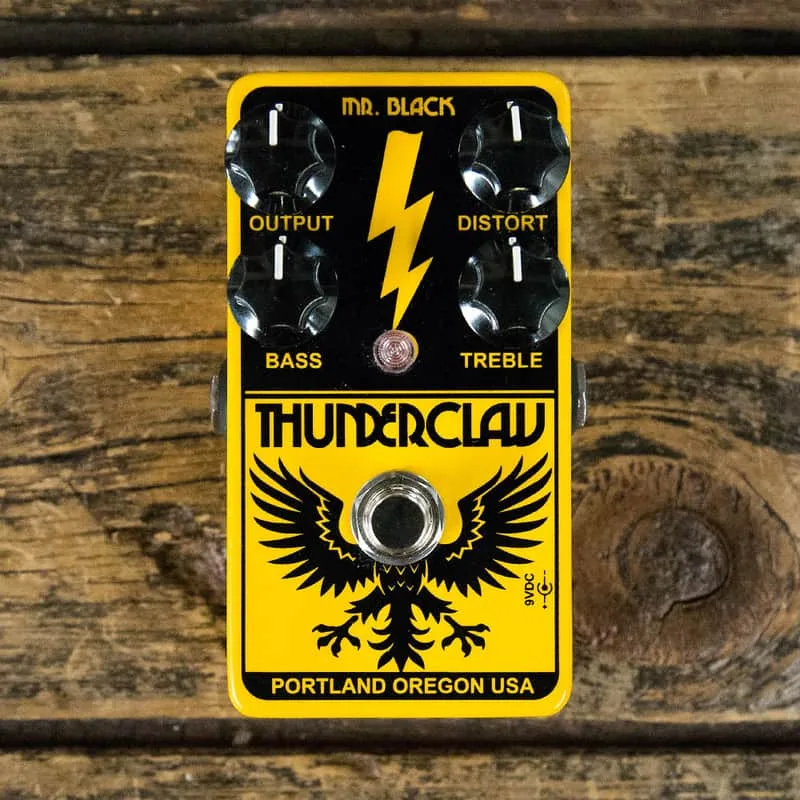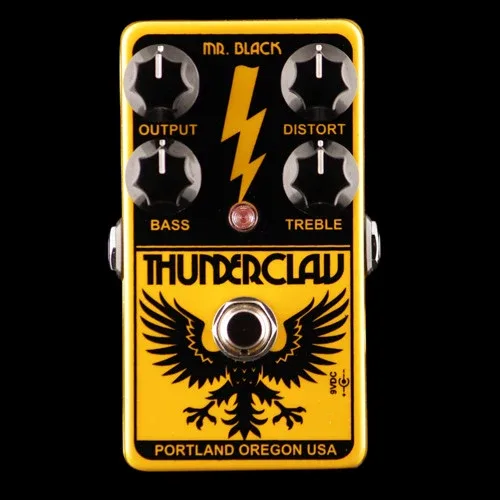


The Mr. Black ThunderClaw is a high-gain analog distortion pedal, originally released in 20141. Mr. Black describes it as "highly dynamic, aggressive, and responsive high-gain distortion" with a "100% pure-analog, high-headroom signal path"2, and sums up its character in one line:
"like a pressure washer spraying napalm."
The pedal runs on a standard 9V supply but converts it internally to a plus and minus 9V split rail, an approach Mr. Black credits for what it calls "incredible dynamic content and detail"2. It carries a list price of $199.953, and a Black Widow version with a custom powder coat and blood graphic shares the same circuit specifications4.
The controls: Volume, Treble and Bass
The ThunderClaw keeps the control set simple. The Black Widow version spells out the four knobs as Treble, Bass, Volume and distortion gain4, and the standard pedal lists the same active tone controls2.
| Control | What it does |
|---|---|
| Volume | Active output volume, which Mr. Black calls "potent" and describes as delivering a constant low-impedance output3 |
| Treble | Active boost or cut of select treble frequencies2 |
| Bass | Active boost or cut of select bass frequencies34 |
| Gain | Distortion amount4 |
The active tone controls are the notable feature here. Unlike the passive tone control on a RAT, which can only cut frequencies, the ThunderClaw's Treble and Bass knobs can push frequencies above or below a flat setting, so you can add brightness or low end rather than only trimming it23.
One quirk turned up in Aion FX's circuit trace: two resistors that limit the Treble control's range are marked 1k on the PCB silkscreen but populated with 4.7k parts. According to Aion FX, this restricts the boost and cut range by around 5% at both extremes of the knob's rotation, with the 12:00 position unchanged5.
Power: 9V in, plus and minus 9V inside
The ThunderClaw takes a normal 9V DC supply through a 2.1mm negative center-pin jack2. Inside, a charge pump splits that into a bipolar supply, running the circuit at plus 9V and minus 9V25.
Aion FX points out that this is a less common design choice than it might sound5:
"Charge pumps are common in drive pedals, but it's more often a voltage doubler (+9V to +18V), whereas bipolar supplies ("
In other words, most drive pedals that boost their internal voltage use a doubler, which shifts the whole supply up to 18V relative to ground. A bipolar supply instead creates positive and negative rails, the arrangement more often seen in preamps and professional audio gear. For a player, the practical point is that the op-amps get more headroom to work with, which is what Mr. Black ties to the pedal's dynamic response25.
Current draw is about 27mA, which is modest by modern standards and well within what a typical isolated power supply delivers per output2.
Circuit design and RAT-style clipping
Mr. Black's own claim is blunt: "topologically, it is unlike any other distortion pedal available. No sir, this is no clone, nor even a derivative"2. The independent trace by Aion FX tells a more nuanced story. Aion FX concluded that "the Thunderclaw is not strictly based on any existing pedal, though it does use several building blocks from other distortion designs"5.
The RAT connection sits in the front of the circuit. In Aion FX's words5:
"The input & clipping sections resemble a RAT with a clean op-amp boost into back-to-back diodes to ground."
That means the signal hits a clean op-amp gain stage, then gets clipped by two diodes wired back-to-back to ground, the same general arrangement a RAT uses to shape its distortion. The trace also found unpopulated diode pads in the feedback loop of the first op-amp, which Aion FX reads as evidence that Mr. Black experimented with dual-stage clipping before settling on the final design5.
So the honest answer to "is it a RAT clone?" is no, but the family resemblance in the input and clipping stages is real, and the rest of the circuit draws on other distortion designs rather than copying any one of them5.
Traces and clones of the Thunderclaw
The ThunderClaw has drawn real attention from the DIY community, which has produced both a trace and a documented adaptation:
The Taranis is the version a builder can actually document a build from, since Aion FX published it with full project documentation where the earlier Kittywampus release had none51. For a player who wants the ThunderClaw sound in a self-built pedal, the Taranis is the trace-based route; for everyone else, the original is still listed by Mr. Black at $199.953.
Mr. Black also sells B-stock ThunderClaw units at a discount. These have minor cosmetic defects but the internal components are the same as a standard pedal, and they carry the standard 1-year Mr. Black warranty. All B-stock sales are final, with no returns, exchanges or refunds2.
Videos
Lance Seymour
thegearshark
Quimper Sound Records and Guitars
Questions
Is the Mr. Black Thunderclaw a RAT clone?
No. Mr. Black describes the Thunderclaw as no clone or derivative of any other distortion pedal. Independent circuit analysis by Aion FX found that its input and clipping sections resemble a RAT, using a clean op-amp boost into back-to-back diodes to ground, but the pedal also uses building blocks from several other distortion designs.
Is the Thunderclaw true bypass?
Yes. Mr. Black lists the ThunderClaw as true bypass, and the ThunderClaw Black Widow version carries the same specification. When the pedal is off, the guitar signal passes through without active buffering.
How much current does the Thunderclaw draw?
Mr. Black lists a current draw of about 27mA for both the standard ThunderClaw and the Black Widow version. It runs on a standard 9V DC supply with a 2.1mm negative center-pin connector, and internally it converts that to a plus and minus 9V split rail.
What is the Aion FX Taranis?
The Taranis Dynamic Distortion is a DIY pedal project from Aion FX, released on 29 November 2024 as a direct adaptation of the Mr. Black Thunderclaw circuit. Aion FX traced the Thunderclaw in 2024 and offered the Taranis as its documented version of the circuit.
Sources (5)
- Taranis Dynamic Distortion / Mr. Black Thunderclaw, Aion FX, 2024-11-29
- ThunderClaw B-stock, Mr. Black
- ThunderClaw, Mr. Black
- ThunderClaw Black Widow, Mr. Black
- Tracing Journal: Mr. Black Thunderclaw, Aion FX, 2024-11-29