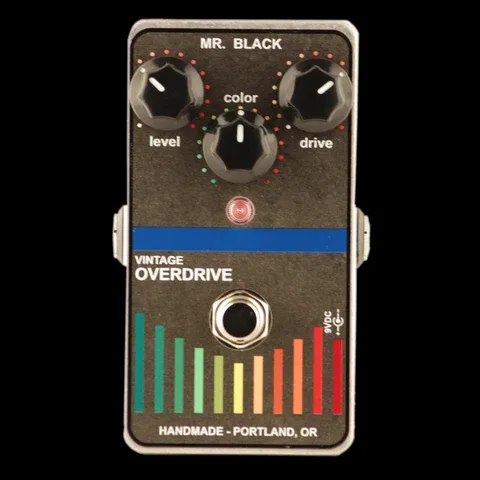


The Mr. Black Vintage Overdrive is an analog overdrive and boost pedal from Mr. Black, a pedal maker based in Portland, Oregon. Mr. Black describes its character as a "smooth, round attack, sweet singing-sustain, and gentle compression," and positions it as delivering more gain and output than the original circuit it draws on1. It is a Jack Deville original design, built around a genuine 4558 opamp, the same opamp type found in many classic overdrive circuits1.
The pedal carries a regular price of $179.95, though Mr. Black listed it at a sale price of $109.95 as of October 20261.
What it does to your sound
An overdrive pedal works by pushing the front end of your amplifier into breakup rather than generating its own fully formed distortion sound. The Vintage Overdrive follows that approach: it adds gain, sustain and a touch of compression to the signal so a clean or nearly clean amp starts to sing, and it can also fatten an amp that is already breaking up. Mr. Black's own description of the character is worth quoting directly1:
"smooth, round attack, sweet singing-sustain, and gentle compression"
That word "compression" matters for players comparing circuits. A gently compressed overdrive evens out the attack of each note, so hard picking and soft picking land closer together in level and the sustain carries a note longer. Players who want an open, dynamic feel where picking volume controls the breakup may find that quality less to their taste, while players chasing a singing, held-note lead sound often seek it out. Mr. Black frames the pedal as having more gain and output than the original circuit it builds on, so there is headroom to push an amp harder than the vintage design allowed1.
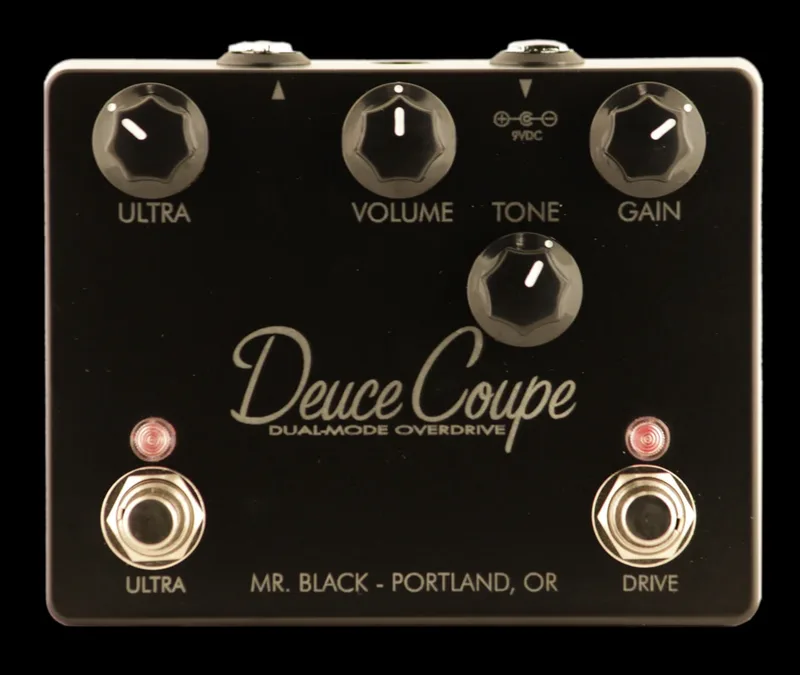
Because it is an overdrive and boost in one box, it can also serve as a mostly clean boost for driving an amp harder, the same role Mr. Black's other gain pedals such as the Deuce Coupe play in the company's lineup1.
The circuit and the 4558 opamp
The heart of the pedal is a genuine 4558 opamp1. The 4558 is a dual opamp that has appeared in overdrive circuits for decades, and it is a large part of why players associate this circuit family with a creamy, compressed feel rather than an open, cutting one. Many of the most widely copied vintage overdrives run the same part, so builders who advertise a "genuine" 4558 are signaling that they have not substituted a modern equivalent, a choice some players believe changes the feel of the clipping stage.
Mr. Black calls the result a sweet, creamy 100%-analog overdrive and boost1. The all-analog signal path means no digital conversion anywhere in the chain, which some players prefer on principle and others simply find matches the character of the vintage circuits this design descends from.
Controls
The pedal uses what Mr. Black calls a classic 3-knob layout1. The three-knob format is the standard overdrive arrangement of gain, tone and level found across the category: one knob sets how hard the circuit drives the clipping stage, one shapes the frequency balance of the output, and one sets the overall output level. With the gain low and the level high, the pedal leans toward its boost role; with the gain up, the overdrive character takes over.
Power, battery and build
Power comes from a 9VDC 2.1mm negative center-pin supply, the common pedalboard standard, or from an internal 9V battery, which is not included1. At roughly 5mA of current draw, the pedal is light on a power supply, and a battery is a realistic option for players who gig without a board1. A single 9V battery holds far more than 5mA-hours of charge, so even regular playing sessions would take a long time to drain one.
The build details Mr. Black lists:
- CNC-milled genuine Hammond enclosure1
- Compact footprint of 2.4" x 4.5" x 1.8"1
- EZ-2-C LED indicator with diffusion lens1
- Mechanical true-bypass switching1
- Handmade in Portland, OR1
The true-bypass switching means that with the pedal off, the input jack connects straight to the output jack through a mechanical switch, with no active circuitry in the path. The EZ-2-C LED with its diffusion lens is a practical stage detail: the on/off state stays readable at a glance under stage lighting or in the dark1.
The input impedance of around 470KΩ and output impedance under 25KΩ1 sit in the ranges typical of well-behaved analog pedals. A high input impedance like this preserves the top end of passive pickups, particularly with long cables or vintage-style single coils, and an output impedance under 25KΩ is low enough to drive most amps and downstream pedals without loading issues.
Mr. Black's product page states "ALL SALES FINAL! NO RETURNS/REFUNDS."1 If you are buying direct from the maker, plan on the purchase being final.
Videos
Alex Booth
Squatch Guitars
Questions
Is the Mr. Black Vintage Overdrive true bypass?
Yes. Mr. Black specifies mechanical true-bypass switching, so when the pedal is off your signal passes through without active circuitry in the path. The company also fits an EZ-2-C LED indicator with a diffusion lens so the on/off state is easy to read on a dark stage.
Does the Mr. Black Vintage Overdrive run on a battery?
Yes. It runs on a 9VDC 2.1mm negative center-pin power supply or an internal 9V battery, which is not included. Current draw is around 5mA at 9VDC, so a battery lasts a long time at typical use.
Who designed the Mr. Black Vintage Overdrive?
It is a Jack Deville original design. Deville is the designer behind Mr. Black's pedals, and his name appears on the Vintage Overdrive as well as other pedals in the company's lineup, such as the Vintage Ensemble.
Is the Mr. Black Vintage Overdrive analog?
Yes. Mr. Black describes it as a sweet, creamy 100%-analog overdrive and boost, built around a genuine 4558 opamp, the same opamp family used in many classic overdrive circuits.
Where is the Mr. Black Vintage Overdrive made?
Mr. Black builds the Vintage Overdrive by hand in Portland, Oregon, USA. The pedal sits in a CNC-milled genuine Hammond enclosure with a compact footprint of 2.4 by 4.5 by 1.8 inches.
Can I return a Mr. Black Vintage Overdrive?
No. Mr. Black's product page states that all sales are final, with no returns or refunds. If you buy one, plan on it being a keeper unless the seller you buy from has its own policy.
Sources (1)
- Vintage Overdrive, Mr. Black