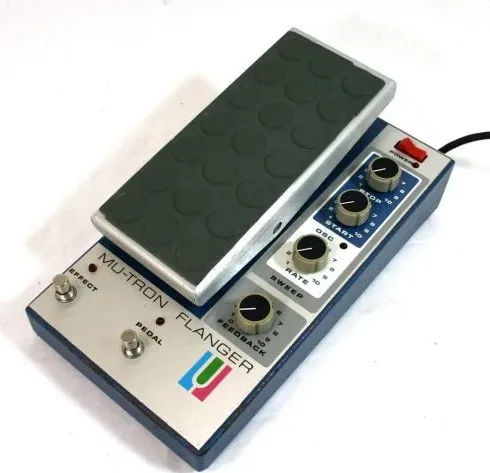


The Mu-Tron Flanger is a flanger pedal made by Musitronics in the late 1970s. Mike Beigel invented it in 1977, according to Dave Hunter's GuitarPlayer history of the company, and the production unit was manufactured in 1978 as a pedal-controlled unit123. What sets it apart from most flangers of any era is that it carries its own built-in foot control: Musitronics called it the Pedal Flanger, and its Opti-Pot treadle sweeps the effect's parameters after you dial in their initial settings24.
The pedal is long out of production, and vintage examples now change hands at high prices. GuitarPlayer's Dave Hunter wrote that Musitronics products "both of which now fetch major bucks on the collectors' market"1.
The controls and the treadle
The Flanger's Sweep Start control sets the amount of delay at the start of an LFO sweep, which determines where the flanging effect begins its travel2. The sweep rate runs from .05Hz to 20Hz, and the delay time covers 0.6 mS to 24 mS2.
The distinctive part is the treadle. Premier Guitar's history of modulation effects noted that "the Flanger has parameters that are manipulated, after their initial settings, by a treadle"4. In practice that means you set the sound with the panel controls, then rock the built-in pedal to sweep the effect live, the way a player might use a wah pedal.
"the Flanger has parameters that are manipulated, after their initial settings, by a treadle."
The Opti-Pot pedal
Musitronics built the foot control into the pedal itself rather than expecting players to attach a separate expression pedal. The maker described the Opti-Pot as "smooth and reliable," and said it "stays free of hum and noise under all types of lighting and environmental conditions"2. Optical pedal control of this kind avoids the wear and noise that a mechanical potentiometer treadle can pick up over time.
Power and specifications
The Mu-Tron Flanger is not a battery or standard pedalboard supply pedal. The maker describes it as AC powered, with low-noise circuitry, and claimed it "delivers the cleanest studio quality flanging on the market, at any price"2. The published specifications also give an input impedance of 390k ohms unbalanced, an output impedance of 600 ohms unbalanced, a dynamic range of 100db, and a sweep rate of .05Hz to 20Hz2.
| Specification | Value |
|---|---|
| Delay time | 0.6 mS to 24 mS2 |
| Sweep rate | .05Hz to 20Hz2 |
| Input impedance | 390k ohms, unbalanced2 |
| Output impedance | 600 ohms, unbalanced2 |
| Dynamic range | 100db2 |
| Power | 115V AC, 60Hz2 |
Where it came from
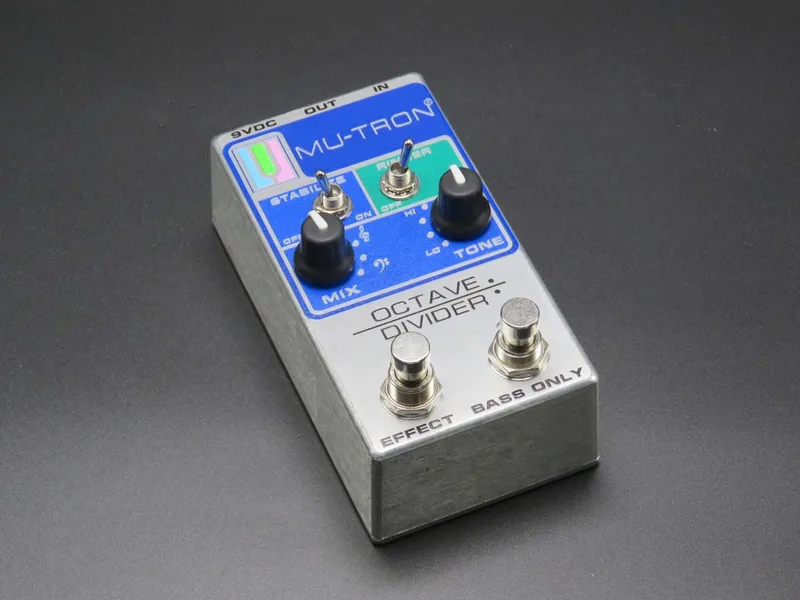
The production Flanger followed a series of Musitronics prototypes. A flanger built in an Octave Divider package dates from 1977-78, and the maker's history notes that "The Mu-Tron Flanger was manufactured in 1978 as a pedal-controlled unit, not this package style"3. The company had also experimented with flanging in earlier prototype units before settling on the pedal format3.
What it does to a sound
Musitronics advertised the Flanger as covering more than jet-style flanging alone. The maker claimed "a wide variety of effects like slap-back echo, card-board tube, hard reverb, vibrato, and double tracking"2. With 24 mS of maximum delay time available, the sweep range reaches into territory that shorter-delay flangers cannot, which is what makes effects like slap-back echo and pseudo-reverb possible from a modulation circuit.
The Mu-Tron Flanger is an AC powered unit with low-noise circuitry, not a battery-powered pedal. It is a vintage, discontinued unit, and working examples are collector items.
Videos
Southside Guitars
mrfett
Questions
Who designed the Mu-Tron Flanger?
Mike Beigel, the designer behind Musitronics' circuits, invented the Mu-Tron Flanger in 1977, according to a GuitarPlayer history by Dave Hunter. The pedal was manufactured in 1978 as a pedal-controlled unit, after earlier flanger prototypes from the company had explored other package styles.
Does the Mu-Tron Flanger run on batteries?
No. The maker's product page lists AC power requirements of 115V AC, 60Hz, so the pedal is designed to run from wall power rather than a battery. That also means it is not a candidate for a standard 9V pedalboard supply setup.
What is an Opti-Pot pedal?
The Opti-Pot is Musitronics' built-in foot pedal on the Mu-Tron Flanger. The maker describes it as smooth and reliable, and says it stays free of hum and noise under all types of lighting and environmental conditions. On the Flanger, the treadle manipulates parameters after their initial settings are dialed in.
How much delay time does the Mu-Tron Flanger have?
The maker lists a delay time range of 0.6 mS to 24 mS, with a sweep rate of .05Hz to 20Hz. That range sets where the flanging sweep starts and how far it travels, which shapes everything from subtle jet sounds to more extreme effects.
Is the Mu-Tron Flanger a pedal or a rack unit?
It is a flanger pedal. Musitronics marketed it as the Pedal Flanger, and the maker's history notes that it was manufactured in 1978 as a pedal-controlled unit rather than in the package style of an earlier prototype.
Sources (4)
- Favored by Frank Zappa and Jerry Garcia, the Musitronics Mu-Tron III Combined Wild Sonics and Creative Usability, GuitarPlayer (www.guitarplayer.com), 2023-03-03
- Mu-Tron Flanger, Musitronics Mu-Tron
- Mu-Tron Prototypes, Musitronics Mu-Tron
- Modulation Nation: Chorus, Phasing, and Flanging, Premier Guitar, 2018-09-20