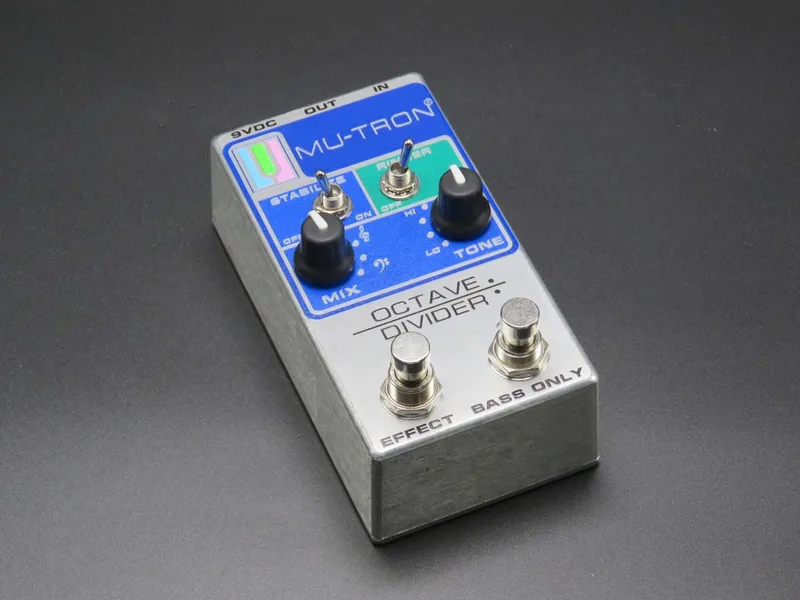


The Mu-Tron Octave Divider is an analog octave and pitch pedal that produces a thick octave-down tone from your instrument, plus a fuzzy, ring-modulated octave-up tone in the same box. Mu-Tron's own pitch for it is blunt: "Turn your instrument into a fat monophonic synthesizer."1 It dates from the 1970s, when Musitronics built the original, and it has since been reissued in modern form by Mu-Tron itself and cloned by Behringer.
The pedal works by dividing the incoming signal's frequency in half, which gives you a note one octave below what you play. Because the divider circuit follows one pitch at a time, it is a single-note effect: the "monophonic synthesizer" description is the maker telling you chords will not track cleanly. On top of the octave-down, a Green Ringer-style circuit adds the ring-modulated octave-up fuzz, which is where the pedal's edgier character comes from.2
What it does to your sound
The core of the pedal is the octave-down voice: a sub-octave that Mu-Tron's vintage literature described as having "many of the characteristics" of a sophisticated accessory, thickening a single line into something a synth player would recognize.3 The octave-up half, called the Ringer, adds a slight octave-up and fuzz tone when switched on, and on the Mu-FX reissue the RINGER knob adjusts the volume of that ring-modulated output in effect mode.52
Premier Guitar's reviewer, reviewing the Mu-FX reissue, was clear about how the effect is generated: "this is an analog effect created via waveform modulation, not a digital transposition."6 That distinction matters when comparing it to modern digital pitch shifters: the Octave Divider does not compute a new pitch, it reshapes the waveform, which is why the octave-down has a synth-like weight and why tracking depends on how cleanly you play.
Controls and jacks
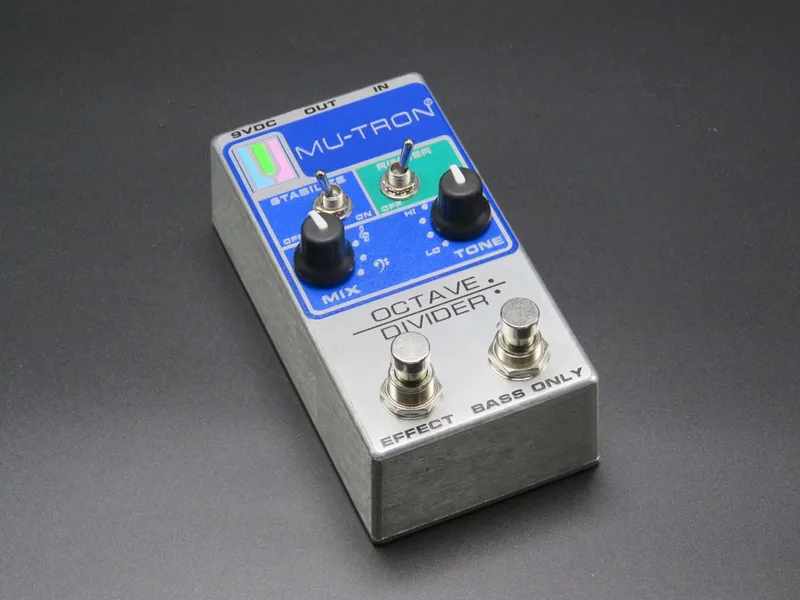
The control set is small and shared across versions:
| Control | What it does |
|---|---|
| Mix | Controls the mix between the direct signal and the effect signal1 |
| Tone (Lo-Hi) | Controls the tone; on the Mu-FX version it varies the tonal "brightness" of the octave-down effect52 |
| Ringer (On/Off) | Adds slight octave up and fuzz tone5 |
| Bass Only (On/Off) | Takes out the input signal, leaving only the effect5 |
| Stabilize (On/Off) | Provides note tracking stability; on the Mu-FX version it improves tracking reliability for guitar and other plucked instruments52 |
The Bass Only switch is the one players should notice first: it removes your dry signal entirely, so what comes out is pure sub-octave, useful for dub-style bass lines or synth-like leads. The Stabilize switch exists because analog dividers track better with a clean, sustained input, and it is aimed squarely at guitar.52
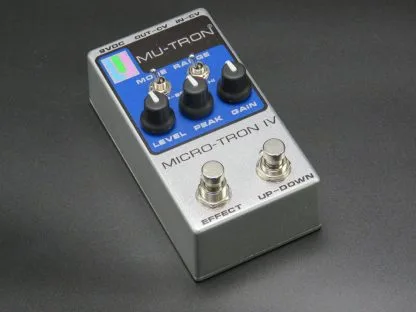
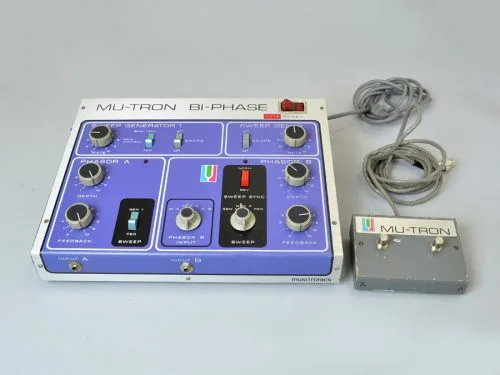
On placement, Mu-Tron is specific: the Octave Divider must be the first pedal to receive the signal from the instrument, and the maker says it is especially effective followed by a Micro-Tron IV or Mu-Tron Bi-Phase.5 The pedal also carries an auxiliary impedance-compensated output alongside the main 1/4" output jack.1
Versions and the Behringer clone
The Octave Divider's history runs through several hands:
- The 1970s original by Musitronics, now a rare vintage piece.4
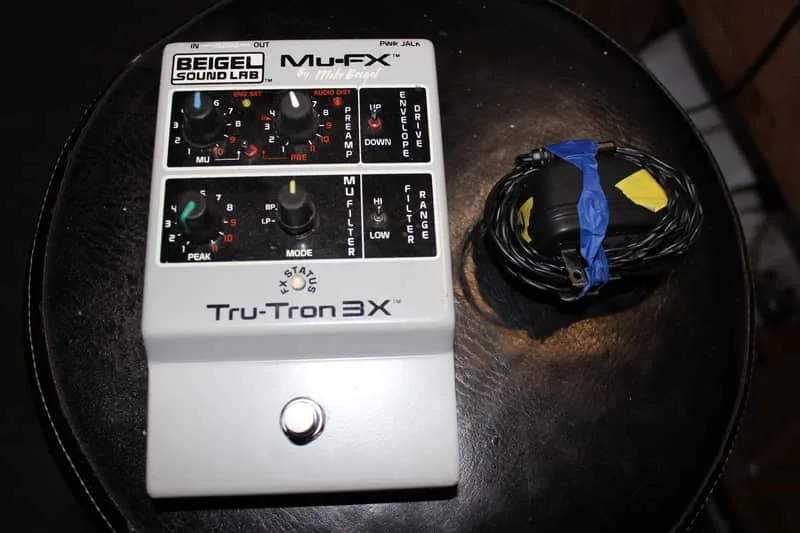
- The Mu-FX Octave Divider, Mike Beigel's reissue of his own design, which Premier Guitar reviewed at a street price of $359.97. It includes the same Octave Down effect and Green Ringer as the original, with a detachable 12VAC adapter replacing the original built-in power supply, and dedicated controls that trim treble from the bass signal and set its level.26
- The current Mu-Tron Octave Divider, the newest reincarnation of the classic, 9V DC powered in a rugged enclosure, made in the USA, listed at $279.00 for the Vintage Silver finish.15
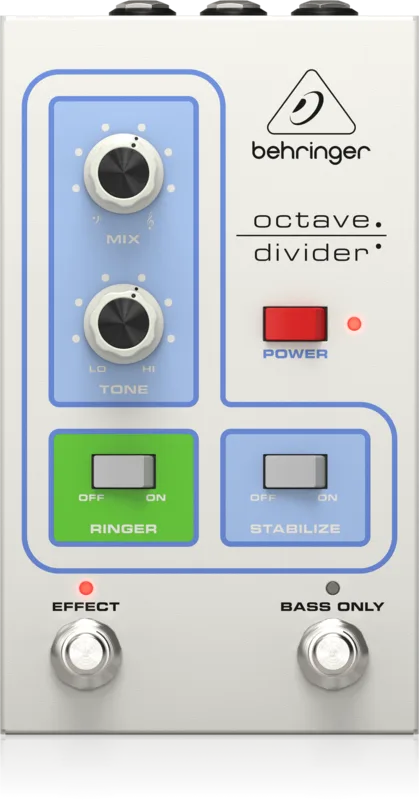
- The Behringer Octave Divider, announced in December 2021 at $99.7
The Behringer version deserves its own paragraph, but the details of that pedal belong on its own page. The Mu-Tron Octave Divider dates from the 1970s,4 and secondhand units in good condition now go for four figures in euros, if you can find one.4 See the Behringer Octave Divider page for that pedal in full.
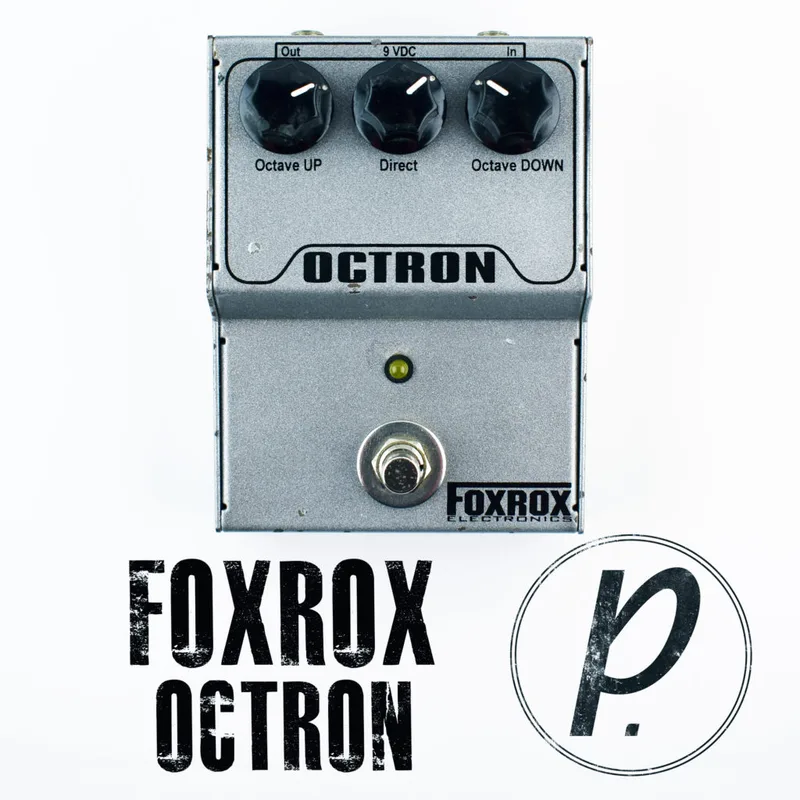
The design has echoed elsewhere too. Pedal of the Day, reviewing the Foxrox Electronics Octron, described its Octave Down section as "an octave divider based on classic Mu-Tron, OC-2 and Octaplus sounds of the past," noting it tracks dynamics and has more pre-divide gain and filtering.8 That pedal is covered on its own Foxrox Electronics Octron Octave Divider page.
Where it came from
The Octave Divider dates from the 1970s, the era that made the Mu-Tron name.4 On the secondhand market, original units in good condition go for four figures in euros, if you can find one.4 The current version is made in the USA and carries a 1 Year Limited Warranty.1
What it costs today
Vintage originals are the expensive route. Guitar World reported in 2021 that "original Octave Dividers can go for upwards of four figures, that is, if you can locate one,"7 and Gearnews the same week said a good-condition original goes for four figures.4 The modern options are cheaper: the current Mu-Tron version lists at $279.00,5 the Mu-FX reissue carried a $359.97 street price at review,6 and the Behringer clone has been listed at $42.00.596
The Vintage Silver version of the current Mu-Tron Octave Divider carries a list price of $279.00 on the maker's site.5
Videos
mikesgigtv
AtlasEffects
dravenosX
Questions
Is the Mu-Tron Octave Divider analog or digital?
Analog. Mu-Tron describes it as creating a thick analog octave-down and a fuzzy ring-modulated octave-up tone, and Premier Guitar's reviewer noted the Mu-FX reissue is an analog effect created via waveform modulation, not a digital transposition. There is no digital pitch-shifting circuit in any version.
What power does the Mu-Tron Octave Divider use?
The current Mu-Tron Octave Divider runs on 9V DC in a rugged Mu-Tron enclosure. The earlier Mu-FX Octave Divider reissue is different: it uses a 12VAC adapter, which is included in the box along with the manual. The 1970s original had a built-in power supply.
Does the Mu-Tron Octave Divider work with chords?
Not really. Mu-Tron's own description is that it turns your instrument into a fat monophonic synthesizer, which points to single-note playing. Like other analog octave dividers, its tracking circuit follows one note at a time, and the pedal includes a Stabilize switch to improve tracking reliability on guitar and other plucked instruments.
How much do original Mu-Tron Octave Dividers cost used?
A lot. Guitar World reported in 2021 that original Octave Dividers can go for upwards of four figures on the used market, if you can locate one. Mike Beigel said in a Premier Guitar interview that vintage units today get as much money as Mu-Tron IIIs.
Who made the original Mu-Tron Octave Divider?
Musitronics, the company behind the Mu-Tron line, built the original Octave Divider in the 1970s. The designer was Mike Beigel, who later returned to the design through his Mu-FX venture, reissuing classic Mu-Tron effects with modern updates.
Is the Behringer Octave Divider a copy of the Mu-Tron?
Yes. Behringer calls it an authentic recreation of the popular Octave Divider from the '70s, and Guitar World described its control layout as a like-for-like replica of the original Mu-Tron. Mu-Tron publicly stated it was a total copy of its Octavider design.
Sources (9)
- Octave Divider, Musitronics Mu-Tron
- Mu-FX Octave Divider, Musitronics Mu-Tron (mu-tron.com)
- Mu-Tron Octave Divider, Musitronics Mu-Tron
- Behringer Octave Divider: A clone of the classic 1970s Mu-Tron Octave Divider, gearnews.com, 2021-12-09
- Octave Divider Vintage Silver, Musitronics Mu-Tron (mu-tron.com)
- Mu-FX Octave Divider Review, Premier Guitar, 2015-06-09
- Behringer endeavors to emulate Mu-Tron's classic octave circuit with the faithfully spec'd Octave Divider, Guitar World, 2021-12-10
- Foxrox Electronics Octron Octave Divider, Pedal of the Day (www.pedal-of-the-day.com), 2017-02-08
- Tremu-Tron A Stock, Musitronics Mu-Tron