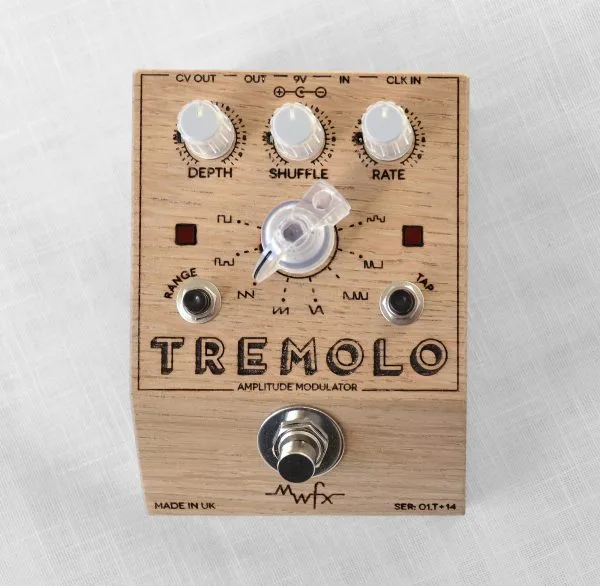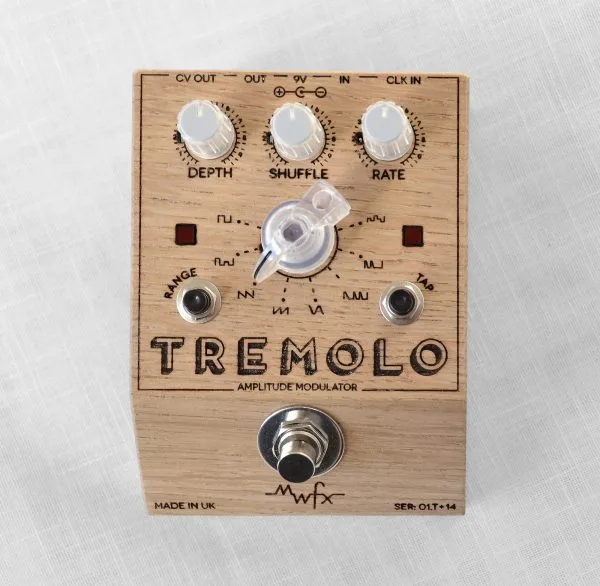

The MWFX Tremolo with Clock Input and CV Output is a tremolo pedal, the second version of the MWFX Tremolo, which MWFX describes as having tap tempo, interesting waveforms and upgraded features1. A tremolo pedal varies the volume of your signal rhythmically, and this one adds two connections beyond a standard tremolo: a CV output for communicating the pedal's various waveforms to synthesizers, and a clock input for synchronizing the LFO, the low-frequency oscillator that drives the volume modulation, to a universal clock signal1. It sits in the tremolo pedals family, alongside the original MWFX Tremolo.
What it does
At its core this is a tap-tempo tremolo. The Tap control sets the tempo by tapping, and the Depth control sets how deep the variation in volume is1. The upgraded features are the two extra connections: the clock input lets the pedal's LFO follow a universal clock signal from other equipment, and the CV output sends the pedal's waveforms out as control voltage to synthesizers1. MWFX lists the CV output at 0-5V1.
Clock input and CV output
The clock input reacts to the leading edge of a positive signal, with a maximum of 20V1. Both the clock and CV signals are accessible via 1/4-inch jack sockets located at the back of the pedal1. For a player with CV-equipped gear, that means the tremolo's LFO can be locked to an external clock and its waveform can be sent to a synthesizer as a control voltage in the 0-5V range1.
Power, connections and specifications
The pedal runs on a 2.1mm, 9V, 35mA supply with center-negative polarity, the standard pedal power supply arrangement, and MWFX notes that a supply is not included1. It measures 90 x 70 x 120mm1.
| Specification | Value |
|---|---|
| Input impedance | 500kΩ1 |
| Output impedance | 100Ω1 |
| CV output | 0-5V1 |
| Clock input | Leading edge of a positive signal, max 20V1 |
| Bypass | True bypass1 |
| Power | 2.1mm / 9V / 35mA, center negative, not supplied1 |
| Dimensions | 90 x 70 x 120mm1 |
[!NOTE] The pedal's specifications include a 2.1mm center-negative power input running at 9v with a 35mA current draw, and it measures 90 x 70 x 120mm1.
Versions
This pedal is the second version of the MWFX Tremolo. MWFX describes the second version as having tap tempo, interesting waveforms and upgraded features, and both versions share the CV output and clock input in MWFX's descriptions12.
Videos
bigcitymusic
Questions
Is the MWFX Tremolo true bypass?
Yes. MWFX lists the Tremolo with Clock Input and CV Output as true bypass, so when the pedal is off your guitar signal passes through without the circuit loading it. The pedal also has a 500kΩ input impedance and a 100Ω output impedance, figures that sit in the normal range for a pedal of this kind.
What voltage clock signal does the MWFX Tremolo accept?
The clock input reacts to the leading edge of a positive signal, and MWFX gives a maximum of 20V for that signal. Both the clock and CV connections are made through 1/4-inch jack sockets at the back of the pedal, so you can sync the tremolo's LFO to a universal clock signal from other gear.
Can the MWFX Tremolo control a synthesizer?
Yes. The pedal has a CV output that MWFX describes as communicating the pedal's various waveforms to synthesizers, running at 0 to 5V. That means the same LFO shaping your tremolo can send control voltage to a synth or other CV-equipped gear, with the clock input handling synchronisation in the other direction.
What power supply does the MWFX Tremolo need?
It runs on a 9V centre-negative supply with a 2.1mm connector, drawing 35mA. MWFX notes that a power supply is not included, so you will need a standard pedal power supply. At 35mA it is within reach of most pedalboard power supplies.
How is this version different from the original MWFX Tremolo?
This is the second version of the MWFX Tremolo pedal. MWFX describes it as having tap tempo, interesting waveforms and upgraded features, including the CV output for synthesizers and the clock input for synchronising the LFO to a universal clock signal. The original MWFX Tremolo also lists a CV output and clock input on its page.