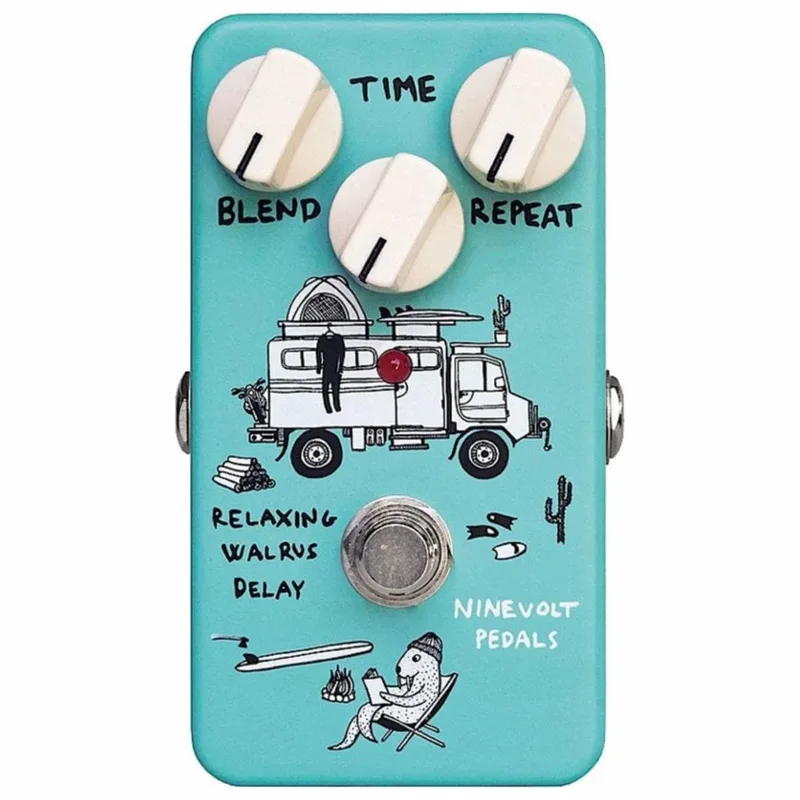


The Ninevolt Pedals Relaxing Walrus is an analog delay pedal first released on 9 April 201512. Ninevolt Pedals says it creates the Yamabiko effect, the mystical and spiritual effect of echo found in the valleys and mountains of Japan1. It is a compact three-knob delay: Time sets the delay time, Blend mixes your wet and dry signals, and Repeats controls the echoes, from a single repeat to near infinite1. Pedal of the Day reviewed it in October 2016 and found it "features some of the warmest echo sounds you'll find this side of the Pacific Ocean"1.
Ninevolt Pedals say the pedal creates the Yamabiko effect, the echo phenomenon found in the valleys and mountains of Japan, where a shout comes back from the hillsides1. The enclosure is a little blue box with artwork by Jonas Claesson1.
Controls and delay time
The three knobs on top cover everything a delay needs. Pedal of the Day described the control set as simple and complete: the Delay Time knob sets the delay time, Blend lets you mix your wet and dry signals, and Repeats controls the echoes, from one to near infinite1.
| Control | What it does |
|---|---|
| Time | Sets the delay time, from 1ms up to 1250ms1 |
| Blend | Mixes the wet (delayed) and dry signals1 |
| Repeats | Controls the echoes, from one repeat to near infinite1 |
Inside the pedal there is also an internal trim pot, which you can adjust to fine tune the self-oscillation1. Self-oscillation is the runaway feedback an analog delay falls into when the repeats are pushed past the point of stability; the trim pot lets you set where and how that behavior sits, a feature players use for ambient swells and sound-on-sound textures.
Power and connections
The Relaxing Walrus runs on a 9V battery or a standard 9V DC adapter with a negative tip1. At 35mA of current draw it is light on a power supply, and the true bypass switching means it passes your signal unchanged when switched off, which Pedal of the Day noted "make it a cinch to add to any pedalboard"1. Input impedance is 500K ohms and output impedance is 10K ohms1.
The Yamabiko effect
The name and the concept behind the pedal come from Japanese folklore and landscape. Ninevolt Pedals say the Relaxing Walrus creates the Yamabiko effect, "the mystical and spiritual effect of echo found in the valleys and mountains of Japan"1. Yamabiko is the phenomenon of a shout returning from a valley or mountainside, and the maker leans into that image for a pedal whose repeats are meant to feel like a natural echo rather than a sterile digital copy.
Pedal of the Day's reviewer put the sound in plainer terms:
"this little blue beauty features some of the warmest echo sounds you'll find this side of the Pacific Ocean"
Where it came from and where it went
The Ninevolt Pedals Relaxing Walrus Delay was released on 9 April 20152. Pedal of the Day featured the pedal in September 2016 and reviewed it that October, describing it as part of a "killer and super-affordable lineup of pedals from our friends at Ninevolt Pedals"13.
The circuit later passed to Animals Pedal, which sells its own versions of the Relaxing Walrus Delay. Animals Pedal describes the delay tone as close to a vintage analog delay while also having the clarity of a digital delay4. The Animals Pedal versions cover a delay time range of 1 to 500ms, spanning doubling, short, medium and long delay, with the same simple control set of Blend, Repeat and Relax (Time) knobs56. Animals Pedal has issued the pedal in several editions, including a Custom Illustrated version that also runs on a 9V battery or a standard 9V DC center negative adapter5, and a Charity Edition with the same 1 to 500ms range7. Players comparing the two should note the difference in maximum delay time: the original Ninevolt Pedals pedal reaches 1250ms1, while the Animals Pedal versions top out at 500ms164.
If maximum delay time matters to you, check which version you are looking at. The original Ninevolt Pedals Relaxing Walrus goes up to 1250ms1; the Animals Pedal Relaxing Walrus Delay and its editions cover 1 to 500ms164.
Videos
Jake Cloudchair
Brett Kingman
guitarguitar
Questions
Is the Relaxing Walrus true bypass?
Yes. Pedal of the Day's 2016 review lists the Ninevolt Pedals Relaxing Walrus as true bypass, and notes that true bypass plus standard 9V power makes it easy to add to any pedalboard.
How long is the Relaxing Walrus's maximum delay time?
The original Ninevolt Pedals Relaxing Walrus offers delay times from 1ms up to 1250ms, according to Pedal of the Day. The later Animals Pedal versions of the circuit cover a shorter 1 to 500ms range, from doubling up through long delay.
Where is the Relaxing Walrus designed?
The Ninevolt Pedals Relaxing Walrus is designed in Japan. Ninevolt Pedals is a Japanese effects maker whose lineup Pedal of the Day described as affordable and worth a look.
What does the internal trim pot do?
Inside the pedal there is an internal trim pot that you can adjust to fine tune the self-oscillation. Self-oscillation is the runaway feedback an analog delay falls into when repeats are pushed hard, and the trim pot lets you shape where that happens.
What is the Yamabiko effect?
Yamabiko is the Japanese word for the echo you hear back from a valley or mountain when you shout. Ninevolt Pedals say the Relaxing Walrus creates this mystical, spiritual echo effect, and Pedal of the Day found it produces some of the warmest echo sounds around.
Sources (7)
- Ninevolt Pedals Relaxing Walrus Delay, Pedal of the Day, 2016-10-17
- HISTORY - Animals Pedal, Animals Pedal, 2015-04-09
- Ninevolt Pedals Relaxing Walrus Delay, Pedal of the Day, 2016-09-18
- 【10/26(月)16:00まで10%OFF】Animals Pedal RELAXING WALRUS DELAY, Animals Pedal (animalspedal.jp)
- Custom Illustrated over print / まもる / RW DELAY #01, Animals Pedal (animalspedal.jp)
- Custom Illustrated RWD yung kai #03 wildflower, Animals Pedal
- 【完売・寄付完了】Animals Pedal CHARITY EDITION RELAXING WALRUS DELAY, Animals Pedal (animalspedal.jp)