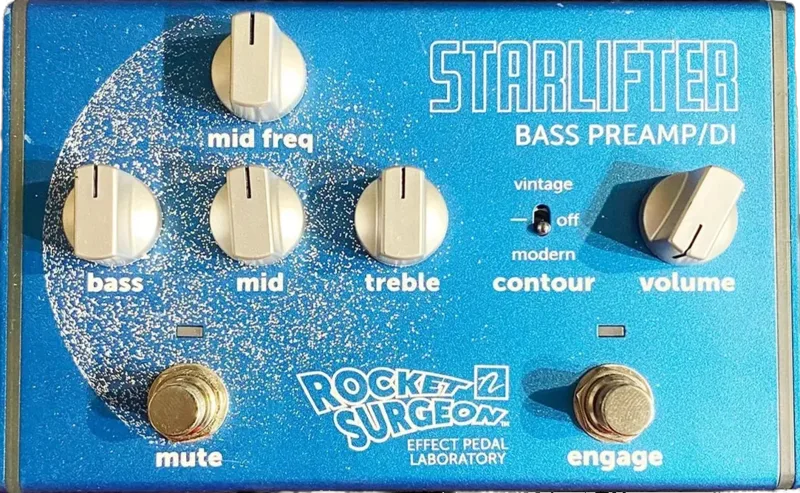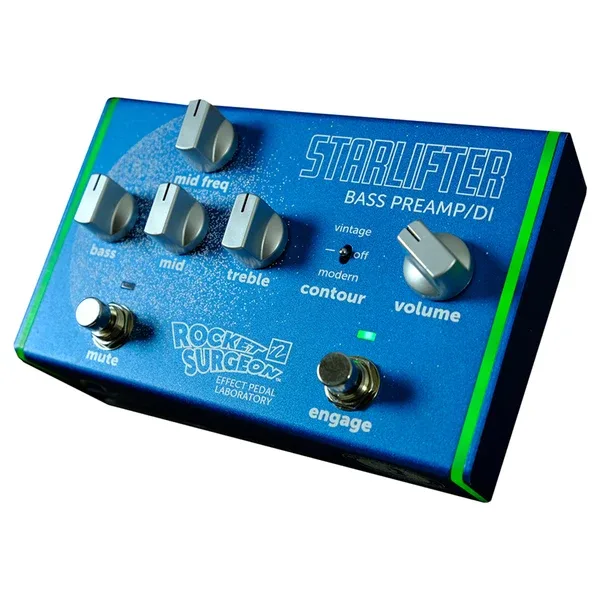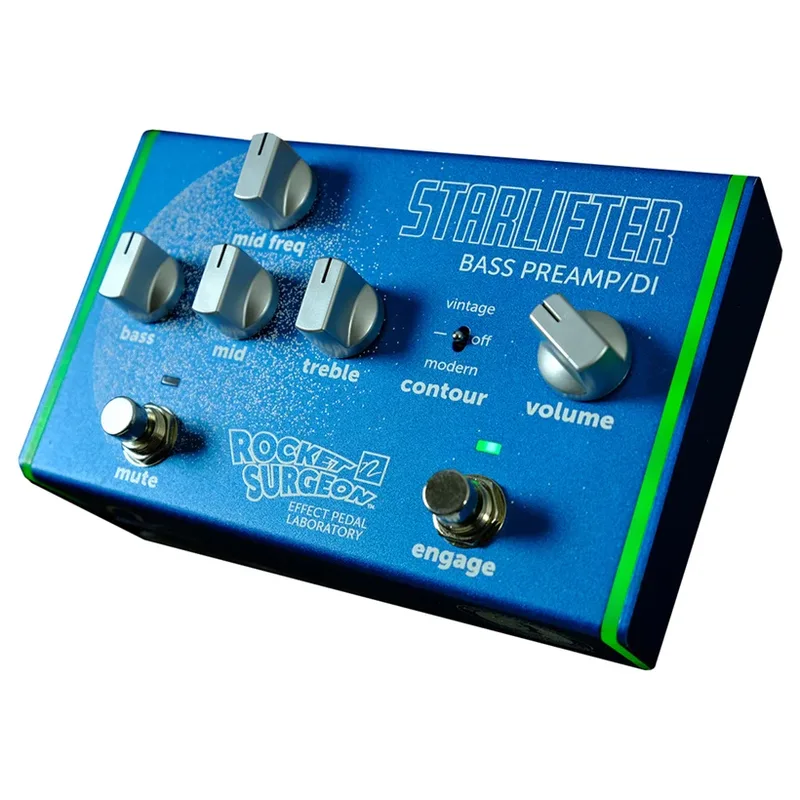


The Nordstrand Audio Starlifter is a bass preamp and DI pedal, released under Carey Nordstrand's Rocket Surgeon Effect Pedal Laboratory imprint, his series of bass and guitar effects built alongside the Nordstrand pickup business1. Its job is not to stamp a sound on your bass: it gives you a clean signal path, a 3-band EQ with a sweepable midrange, a three-position contour switch, and a DI output for the front of house or your recording interface2.
Guitar World's reviewer read the design that way too, noting that the absence of any input gain or drive control points to the pedal's intentions: clean, precise tonal control in a robust, studio-quality package, with no signature tone imprint1. Bass Musician Magazine, in a 2026 round-up of preamps and DI pedals it had reviewed, found it "impressed us with how transparently it worked across both active and passive basses, retaining the character of the instrument while still offering real tone-shaping power"3.
A preamp with no signature tone
Nordstrand describes the Starlifter as providing a clean DI signal that can either bypass the EQ entirely or use the contour switch and the 3-band EQ with sweepable midrange2. The EQ is where the tone shaping lives, and the contour switch sets the starting point:
| Contour position | What it does |
|---|---|
| Flat (off) | Passes an uncolored signal with no EQ beyond the knobs2 |
| Vintage | A "frowny-face" EQ curve: darker tone with a low-mid bump, emulating a classic heavy tube amp into an 8x10 cabinet2 |
| Modern | Mid scoop with treble and bass boost, aimed at slap, R&B and Gospel tones2 |
Premier Guitar's reviewer described the same three positions in playing terms: modern as a scooped sound with bass and treble boost, vintage as punchy and mid-friendly, and a third setting that disables the contour entirely4.
The EQ controls themselves are a bass control, a treble control, a MID knob offering +/- 15dB of boost and cut, and a MID FREQ knob that selects a center frequency between 150Hz and 2.8kHz for the midrange bell filter2. That sweepable mid is what lets you hunt down a specific frequency, whether you are cutting a honky boxiness or boosting fingerstyle growl.
Switches, inputs and outputs
The signal flow, as Nordstrand lays it out, runs: input, impedance switch, -10dB pad, tuner out, EQ and contour, then the DI and output2.
| Control or jack | What it does |
|---|---|
| INPUT | Instrument input jack2 |
| Impedance switch | Selects between 1MΩ and 10MΩ input impedance1 |
| PAD (back panel) | Decreases gain at the input by 10dB for high-output instruments; Nordstrand says use it without the pad unless unwanted distortion appears2 |
| CONTOUR | 3-way switch: flat, vintage or modern2 |
| PRE EQ | Lets the DI signal bypass the EQ section for a flat, uncolored feed to recording or front of house while the EQ'd signal still goes to your amp; leave it disengaged to send the EQ'd signal to the desk or "tape"2 |
| TUNER OUT | Parallel output for a tuner or anything else; remains active at all times2 |
| OUT | Main instrument output, into the front of an amp or a line input; Nordstrand notes a lot of gain is available and it can drive a power amp or powered cabinet2 |
| DI JACK | XLR out for a mic preamp or recording interface2 |
| PAD -20dB | Reduces the signal at the DI jack by 20dB for better interfacing with some equipment2 |
Guitar World also lists a ground lift on the XLR DI out1. The two footswitches are a mute switch and an engage switch that turns the EQ on and off1. The mute switch mutes the output while the tuner out stays on, so you can tune silently between songs1.
The impedance switch is the feature that widens the pedal's reach beyond electric bass. Guitar World notes the input switches for the -10dB pad and the 1MΩ to 10MΩ impedance range exist to accommodate magnetic pickups and piezo-style upright bass pickups1, so a double bass player with a piezo can use the same pedal an electric player does.
Premier Guitar's reviewer put the DI to work in Nashville's Lower Broadway clubs and reported that "the sound people at both clubs were impressed with StarLifter's DI, and remarked how its full and clean presentation" of the bass needed little adjustment at the desk4.
Power: 15V AC adaptor included
The Starlifter runs on a 15V AC power adaptor, which is included1. The pedal's power input jack accepts a 12-15VAC supply, and Nordstrand says to connect the included 15VAC 300mA supply there2. Premier Guitar's 2023 review likewise noted it runs on an included 12-15V AC adaptor, and listed that requirement, along with its weight, among the pedal's cons4.
The power figures conflict between sources. Nordstrand's own product page specifies a 12-15VAC input with the included 15VAC 300mA supply2, while the RockBoard PedalPedia listing gives 15V DC, center negative, at 300mA5. The maker's specification is the AC supply.
The included US adaptor is a Class 2 transformer taking 120VAC 60Hz 60mA input and putting out 15VAC 300mA2. Nordstrand sells replacement and spare adaptors in US and European versions at $27.00 each67: the US version takes 120VAC 60Hz 60mA input6, the European version takes 230VAC 50Hz 200mA input, and both output 15VAC 300mA and weigh .6 lbs7.
What reviewers made of it
Guitar World called it "a vital new addition to the ranks of the bass preamp pedal," praising its pristine, studio-quality sound1. Premier Guitar's earlier review called it "a bass preamp/DI pedal with simple features and stout tone"4, and Bass Musician Magazine's 2026 round-up highlighted its transparency across active and passive instruments3. The criticisms that surfaced were practical rather than sonic: it runs on its AC adaptor rather than a standard pedal supply, and at 2.5 lbs it is not a light box2.
Videos
Premier Guitar
Nordstrand Audio
Nordstrand Audio
Questions
Does the Nordstrand Starlifter have a DI output?
Yes. It has an XLR DI out with a ground lift and a -20dB pad, plus a pre-EQ option that sends a flat, uncolored signal to the desk or an interface while the EQ'd signal still goes to your amp. There is also a jack out for your amp or signal chain and a tuner out.
Can the Starlifter be used with an upright bass or piezo pickup?
Yes. The input has a switchable impedance between 1MΩ and 10MΩ, and Guitar World notes this is there to accommodate both magnetic pickups and piezo-style upright bass pickups. A -10dB pad on the back panel drops input gain for high-output instruments.
Does the Starlifter mute the tuner out?
No. The tuner out stays active when the mute switch is engaged, so you can tune silently on stage. Nordstrand describes the tuner out as remaining active at all times, and it can also serve as a parallel output for other purposes.
Where is the Nordstrand Starlifter made?
Guitar World lists it as made in the USA. It was released under Carey Nordstrand's Rocket Surgeon Effect Pedal Laboratory imprint, his series of bass and guitar effects built alongside Nordstrand's pickup business.
What power supply does the Starlifter use?
It runs on a 15V AC power adaptor, which is included. The pedal accepts a 12-15VAC supply; the included US adaptor takes 120VAC 60Hz input and outputs 15VAC at 300mA. Replacement US and European adaptors are sold for $27.00 each.
How much does the Starlifter weigh?
It weighs 2.5 lbs, with dimensions of 6.5 x 4 x 1.75 inches. Premier Guitar's reviewer counted the weight as a con, so it is a substantial box on a pedalboard. The power adaptor itself weighs .6 lbs.
Sources (7)
- Nordstrand Audio Starlifter review, Guitar World, 2022-01-20
- StarLifter Bass Preamp/DI, Nordstrand Audio
- Best Bass Preamps and DI Pedals We've Reviewed (So Far), Bass Musician Magazine, 2026-08-24
- Rocket Surgeon StarLifter Review, Premier Guitar, 2019-07-10
- Starlifter Bass Pre/DI by nordstrand audio, RockBoard PedalPedia, 2026
- Power Supply (US) for Starlifter, Nordstrand Audio
- Power Supply (European) for Starlifter, Nordstrand Audio