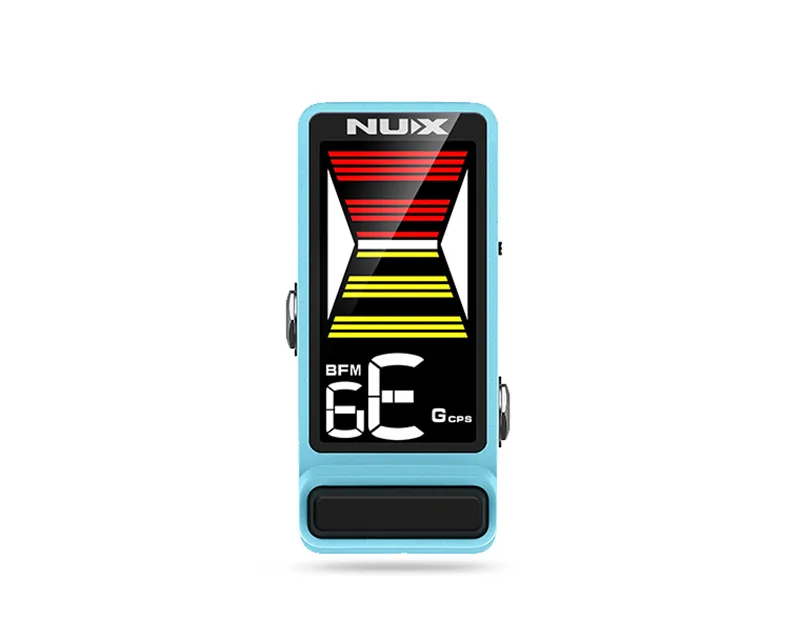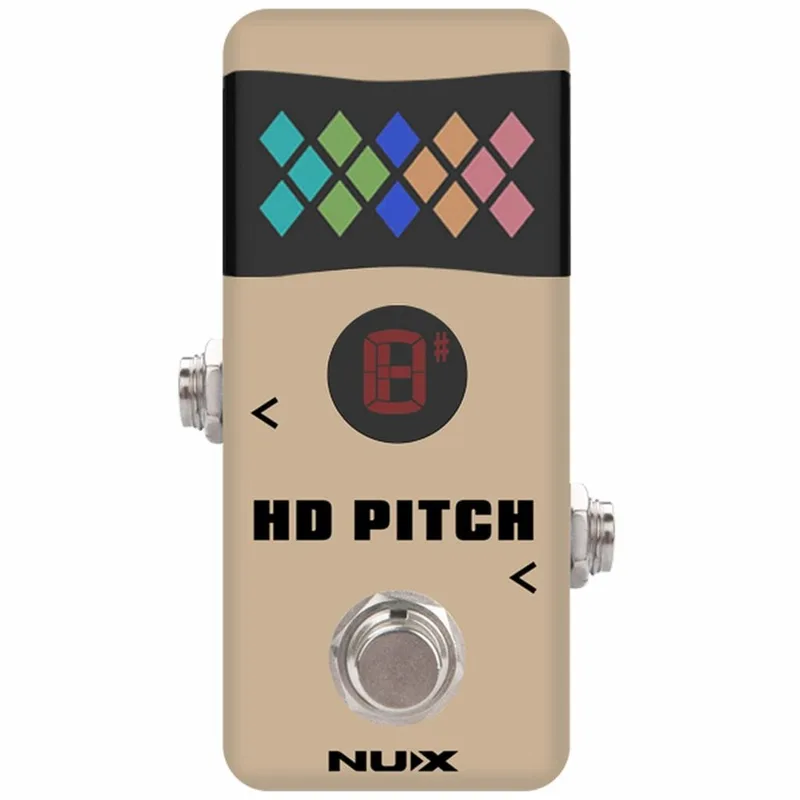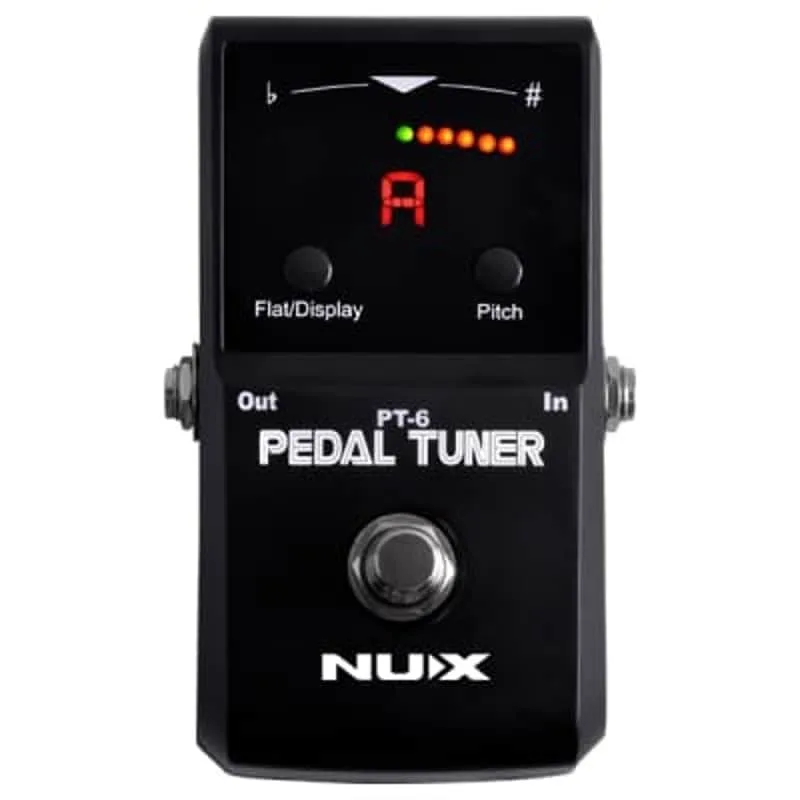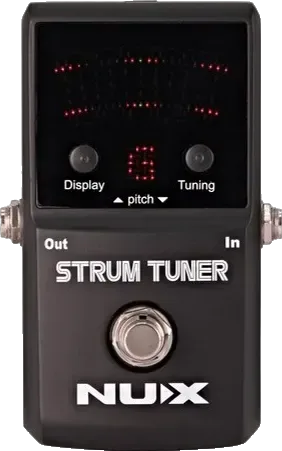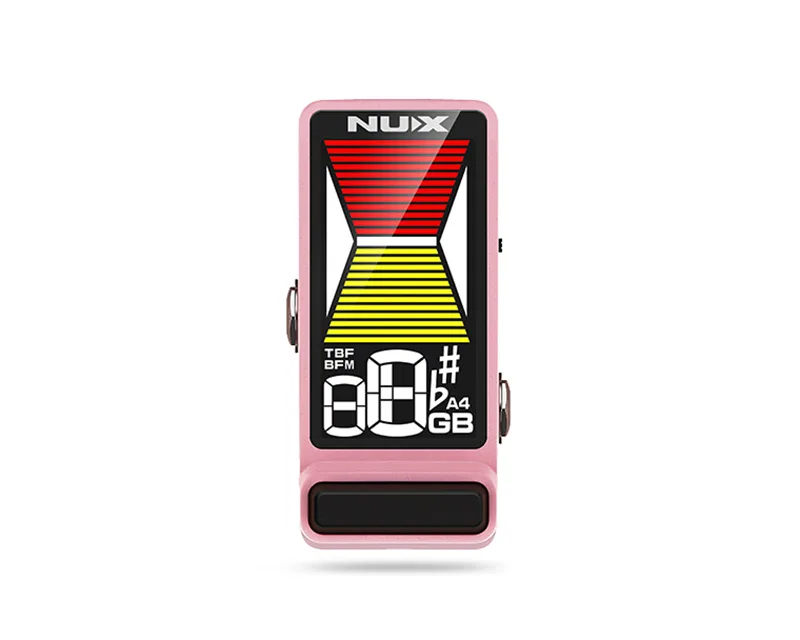


The NUX Flow Tune is a compact pedal tuner from NUX, built around a large high-definition LCD display in a small enclosure1. It is a chromatic tuner with dedicated Guitar and Bass modes, tunes across a wide range from A0 (27.5Hz) to C8 (4186Hz), and offers ±0.1 cent accuracy1. Its most distinctive feature for a pedal this size is the display: bright enough to read in sunlight and darkness, and legible at a distance on stage2.
The Flow Tune sits alongside the NUX NTU-3 Flow Tune MKII in the maker's tuner line. The two share their display modes, bypass modes, tuning range, accuracy, and impedance figures, while the MKII adds two extra guitar tuning modes and the Flow Tune ships in a pink enclosure2.
A compact tuner with a large display
NUX describes the Flow Tune as having "a compact design with a large high-definition LCD display"1. At 97.4mm long, 43.5mm wide, and 41.6mm high, and weighing 197.4g, it takes up little board space, and the maker notes the same compact size and steady weight make it easy to fit a pedalboard with Velcro12. The enclosure is pink, which NUX points out plainly: "It's PINK!"1.
The display is the selling point. NUX says the Flow Tune's screen is bright and high-definition enough to read in both sunlight and darkness, and from a distance, which addresses the two most common complaints about small-format pedal tuners: washed-out screens outdoors and dim screens on dark stages2.
Display modes
The Flow Tune offers three display modes1:
| Display mode | What it shows |
|---|---|
| Strobo Mode | A strobe-style display, the format used by high-accuracy tuners such as Peterson's pedals |
| Arrow Mode 1 | An arrow-style tuning readout |
| Arrow Mode 2 | A second arrow-style readout |
Strobe displays show pitch drift as motion rather than a needle position, which many players find faster to read at fine accuracy. The two arrow modes give simpler visual feedback for quick tuning between songs. The same three display modes appear on the NTU-3 Flow Tune MKII2.
Bypass modes
The Flow Tune gives you three ways to handle the signal when the tuner is not in use, and NUX frames the choice as one of taste and environment: "you can switch between TB(True bypass), BF(BUFFER), and BFM(BUFFER MONITOR), according to your tastes and environment"1.
- True Bypass (TB): the signal passes through untouched when the tuner is bypassed.
- Buffered Bypass (BF): a buffer stays in the signal path, which can help drive long cable runs.
- Buffered Bypass Monitor (BFM): the buffer stays active and the display keeps working. NUX says that "with the BUFFER MONITOR mode, you can even monitor all the notes you play in real time"2.
The monitor mode is the practical difference between the two buffered settings: in BFM you can monitor all the notes you play in real time. Players who want to check their pitch as they play get that in this mode2.
The 10MΩ input impedance is on the high side for a pedal, which suits passive pickups, and the 1KΩ output impedance is a standard low value for driving what comes next in the chain1.
Tuning modes, range, and calibration
The Flow Tune offers three tuning modes: Chromatic, Guitar, and Bass1. Chromatic mode detects any note, which covers alternate tunings and instruments other than guitar and bass. The dedicated Guitar and Bass modes narrow the display to the strings you expect.
The MKII version expands this to four modes: Chromatic, Guitar-Standard, Guitar Compensated, and Bass. NUX says the Guitar STD (Standard) and Guitar CPS (Compensated) modes are "enhanced for guitarists"2.
The tuning range of A0 (27.5Hz) to C8 (4186Hz) reaches well below the low E of a bass in standard tuning, so low-tuned instruments are covered1. A4 calibration runs from 430Hz to 450Hz, letting you shift the reference pitch to match other players or recordings1. Accuracy is ±0.1 cent, the same figure NUX gives for the MKII12.
Power and board fit
The Flow Tune draws under 100mA1. That figure is worth noting if you power a full board from one supply: it is low, but not the few milliamps of the smallest tuners on the market. The compact dimensions and 197.4g weight keep it easy to place at the start of a signal chain, where most players put a tuner1.
Videos
ADDICTED TO GEAR
Pair of Pandas
MusicGearz
Questions
Is the NUX Flow Tune true bypass?
It can be. The Flow Tune offers three bypass modes: True Bypass, Buffered Bypass, and Buffered Bypass Monitor, and you can switch between them to suit your setup. True bypass leaves the signal path untouched when the tuner is off, while the buffered modes keep a buffer in the chain.
What is the difference between buffered bypass and buffered bypass monitor on the Flow Tune?
Both buffered modes keep the tuner's buffer active in your signal chain. In Buffered Bypass Monitor mode, the display keeps showing the notes you play in real time, so you can watch your pitch as you play rather than only when tuning. NUX describes this as letting you monitor all the notes you play in real time.
Can the NUX Flow Tune tune a bass?
Yes. Bass is one of the Flow Tune's tuning modes, alongside Chromatic and Guitar. Its tuning range runs from A0 at 27.5Hz to C8 at 4186Hz, which reaches the low notes of a four-string bass and beyond.
What calibration range does the NUX Flow Tune offer?
The A4 reference can be calibrated from 430Hz to 450Hz, so you can match recordings or other players who do not tune to standard 440Hz. Tuning accuracy is ±0.1 cent.
How much current does the NUX Flow Tune draw?
NUX lists the Flow Tune's current draw as under 100mA. That is modest by pedal standards, though it is worth accounting for if you run many pedals from a single power supply.
Sources (2)
- Flow Tune, NUX Audio, 2025-11-25
- Flow Tune MKII, NUX Audio, 2025-10-29