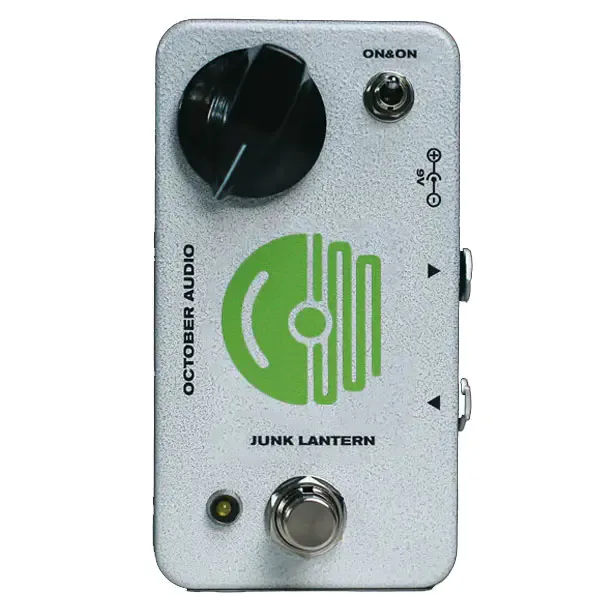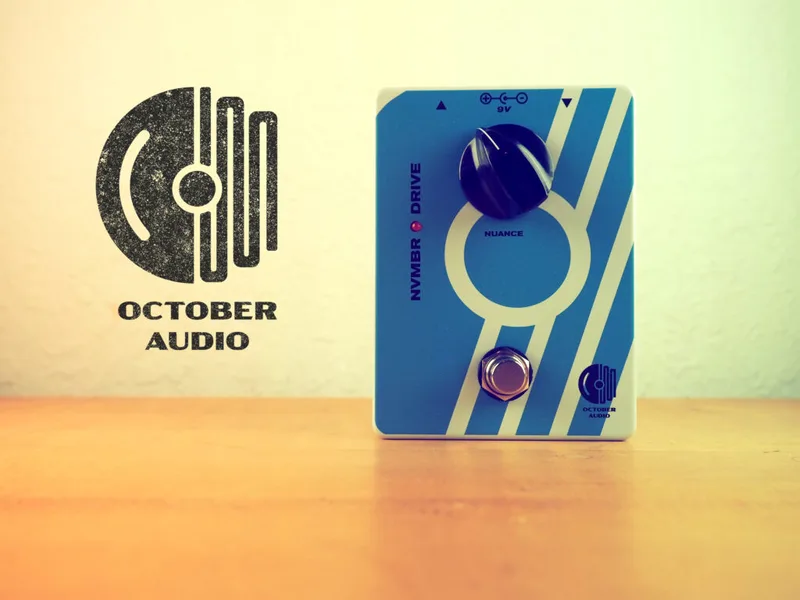
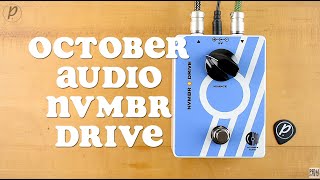


The October Audio NVMBR Drive is a one-knob pedal that covers boost, overdrive and fuzz territory in a single dial. Pedal of the Day described it as "an intense boost/overdrive/fuzz creation," and its review is the main published account of how the pedal works1. If you are after a fuzz-first take on the same idea, October Audio also makes the Junk Lantern Dirty Octave Up Fuzz, a different circuit altogether.
The one knob: Drive Nuance
The NVMBR Drive has just one control, which Pedal of the Day says "controls the Drive Nuance." Rather than a plain gain knob, it moves the pedal between two clipping behaviors at opposite ends of its travel1:
| Knob position | What happens |
|---|---|
| Counterclockwise | Increases in both gain and diode clipping, resulting in a looser, more fuzzy, compressed sound1 |
| Clockwise | The clipping comes less from the diodes and more from an overdriven silicon transistor, producing a tighter drive with more clarity for chords and lead runs alike1 |
Underneath the dial, Pedal of the Day notes that the internal gain capacitor spans a wide range of frequencies, which is part of how one knob covers that much ground1.
The knob works in both directions from its center: clockwise for tighter drive, counterclockwise for fuzzier tones. There is no separate level or tone control to set alongside it.
Clipping: asymmetrical, and it shifts
The clipping section is asymmetrical, according to Pedal of the Day1. What makes the NVMBR Drive unusual is that the source of the clipping moves with the knob. At the fuzzy end, diode clipping does the work; at the tighter end, an overdriven silicon transistor takes over. That is why the same pedal can sit on a board as a boost or overdrive one day and a fuzz the next.
Bypass, jacks and build
The pedal uses true bypass switching, with top-mounted Neutrik jacks for input and output1. Top-mounted jacks keep the pedal's footprint shallow on a board, since cables run straight up rather than out the sides.
The NVMBR family
The NVMBR Drive is part of a small family. October Audio's NVMBR Gain, reviewed by Premier Guitar in 2023, uses a similar one-dial approach: a single dial sets output level and drive character, from a 5 dB line boost at far left through clean boost to soft-clipping overdrive at far right. Premier Guitar's reviewer wrote that "From noon to floored, it unleashes a soft-clipping-style overdrive that goes from perfect for gritty controlled blues to" gnashing territory2.
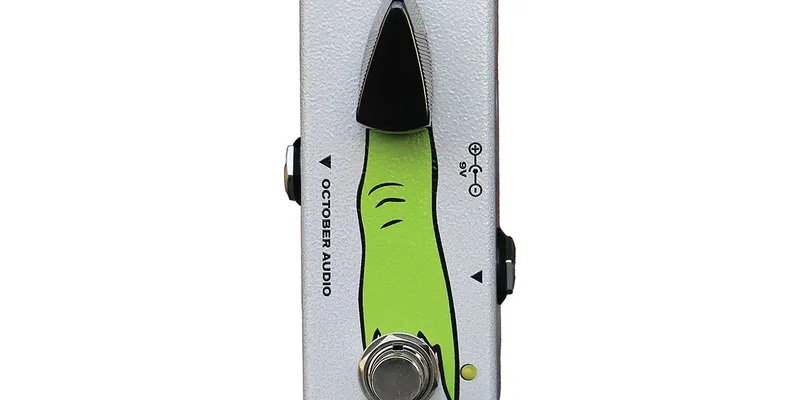
In December 2022, Premier Guitar reported on a mini version of the NVMBR Gain in two formats: switchable versions, which are true-bypass and available with classic or witch finger graphics, and an always-on version with no bypass of the effect. In both, the knob controls gain and clipping simultaneously, and the pedals carry authentic Davies knobs, including the "fingernail"3.
What reviewers said
Pedal of the Day's verdict on the NVMBR Drive was warm on both sound and simplicity: "Great sounds coming pouring out from the get-go, and you can get your amp cranking in no time flat."1
Videos
Pedal of the Day
Pedal Haven
The Pedal Platform
Questions
Is the October Audio NVMBR Drive true bypass?
Yes. Pedal of the Day's review describes the NVMBR Drive as having true bypass switching, along with top-mounted Neutrik jacks for the input and output connections.
What does the Drive knob do on the NVMBR Drive?
The lone knob controls what October Audio calls the Drive Nuance. Turned counterclockwise it increases both gain and diode clipping for a looser, more fuzzy, compressed sound. Turned clockwise, the clipping comes less from the diodes and more from an overdriven silicon transistor, giving a tighter drive with more clarity.
Is the NVMBR Drive an overdrive or a fuzz?
It is both, depending on where the knob is set. Pedal of the Day describes it as a boost/overdrive/fuzz pedal: clockwise settings behave like a tight overdrive, while counterclockwise settings lean toward a fuzz character with more compression.
What kind of clipping does the NVMBR Drive use?
The clipping section is asymmetrical, and the balance shifts with the knob. Counterclockwise settings lean on diode clipping; clockwise settings lean on an overdriven silicon transistor instead.
Sources (3)
- October Audio NVMBR Drive, Pedal of the Day, 2020-10-23
- October Audio NVMBR Gain Review, Premier Guitar, 2023-10-14
- October Audio Unveils New Mini Guitar Pedals, Premier Guitar, 2022-12-08