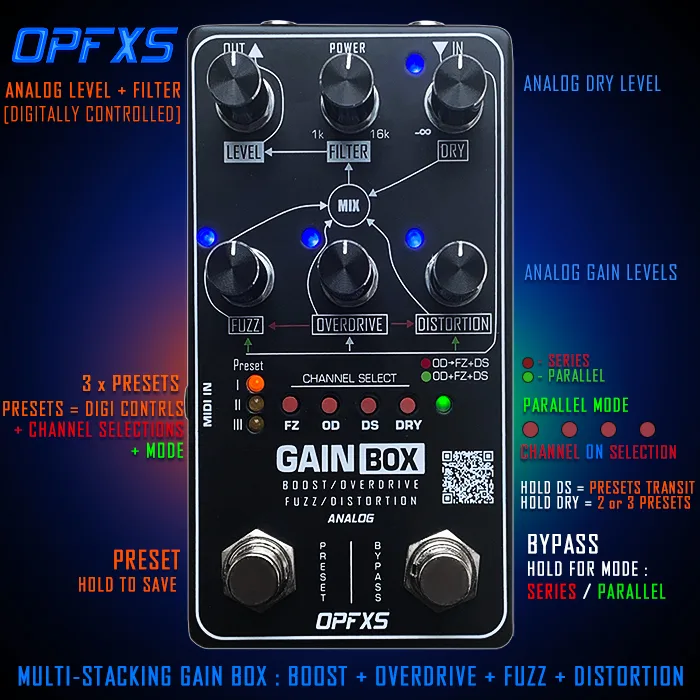


The OPFXS Gain Box is a gain-stacker and gain-shaper pedal that combines four channels, Dry, Fuzz, Overdrive and Distortion, in series or parallel, with three user-definable presets onboard1. The sound generation and signal routing are all-analog, but some of the controls are digital, including the Level control2. It is a different approach from a single-voice overdrive pedal or distortion pedal: the idea is to blend and stack gain voices rather than rely on one.
How the channels stack
The pedal can run its channels in series or in parallel. In Series Mode, Guitar Pedal X describes the arrangement as essentially Dry + Overdrive into Fuzz + Distortion2. The reviewer's own preferred presets were Dry + Fuzz + Overdrive in series, Dry + Fuzz + Distortion in series, and all four channels in parallel1.
One design point worth knowing before you buy into the concept: Guitar Pedal X's reviewer found that each individual voice is not particularly strong on its own, but gains significant potency when combined with one or two of the others1. In other words, this is a pedal built around stacking, not a box of four standalone drives.
Controls and presets
The presets preserve the Level and Filter controls, the channel selection across the Fuzz, Overdrive, Distortion and Dry channels, and the Series/Parallel mode. Mode is flipped by holding the Bypass footswitch1.
What the presets do not save is the gain side of the pedal: the Dry Level, Fuzz Gain, Overdrive Gain and Distortion Gain knobs are not preserved by presets1. A few other control notes from the review:
- Press-hold the DRY button to toggle between 2 or 3 total presets1.
- Press-hold the DS button for faster preset transitions1.
- The Filter control is an LPF-style filter; the reviewer suggested a Tilt EQ might work better in its place1.
Because the gain knobs sit outside the preset system, a preset change does not recall your Fuzz, Overdrive or Distortion gain settings. If you move between presets mid-set, you will be reaching for those knobs by hand.
What reviewers said
Guitar Pedal X's Stefan Karlsson reviewed the Gain Box in June 2026. His verdict on the tones1:
"There are some great tones to be found within the Gain Box"
On the design, he compared it to a familiar multi-gain pedal:
"It's a little reminiscent of my Empress Multidrive - but in a much neater more compact format - with overall fewer controls"
His criticisms were specific: he would like to see all knobs preserved by the presets, a little more poke on every control, and a more potent EQ or tone-stack in future versions1. On amp pairing, he was sure it would work fine into a slightly cooking, edge-of-breakup amp, where the amp does a fair amount of the output and gain shaping1, which is worth weighing if you run a fully clean pedal platform.
Videos
Mike Hermans
Philip Czarnecki and OPFXS
The Guitar Effect
Questions
Is the OPFXS Gain Box analog or digital?
The Gain Box is all-analog in its sound generation and signal routing, but it uses some digital controls and carries three presets onboard. In practice that means the fuzz, overdrive and distortion voices themselves are analog circuits, while the Level control and preset system are handled digitally. Guitar Pedal X described it as an analog gain box with digital controls and three presets when it was announced in May 2026.
How much does the OPFXS Gain Box cost in the US?
As of Guitar Pedal X's June 2026 review, the Gain Box was listed at $263 USD, alongside prices of €250 and £217 in other markets. Prices can change, so treat that figure as the reviewer's listed price at the time of the review rather than a permanent one.
Do the Gain Box presets save the gain knobs?
No. The presets preserve the Level and Filter controls, the channel selection across the Fuzz, Overdrive, Distortion and Dry channels, and the Series or Parallel mode, but they do not save the Dry Level, Fuzz Gain, Overdrive Gain or Distortion Gain knob positions. Guitar Pedal X asked for the gain knobs to be preserved by presets in future versions.
Does the Gain Box work better into a clean or an edge-of-breakup amp?
Reviewer Stefan Karlsson of Guitar Pedal X suggested it suits an edge-of-breakup amp better, where the amp does a fair amount of the output and gain shaping. Into a fully clean pedal platform he found the output limited, so pairing it with an amp that is already slightly cooking is the safer bet.
Sources (2)
- Guitar Pedal X, Guitar Pedal X, 2026-06-09
- Guitar Pedal X, Guitar Pedal X, 2026-05-20