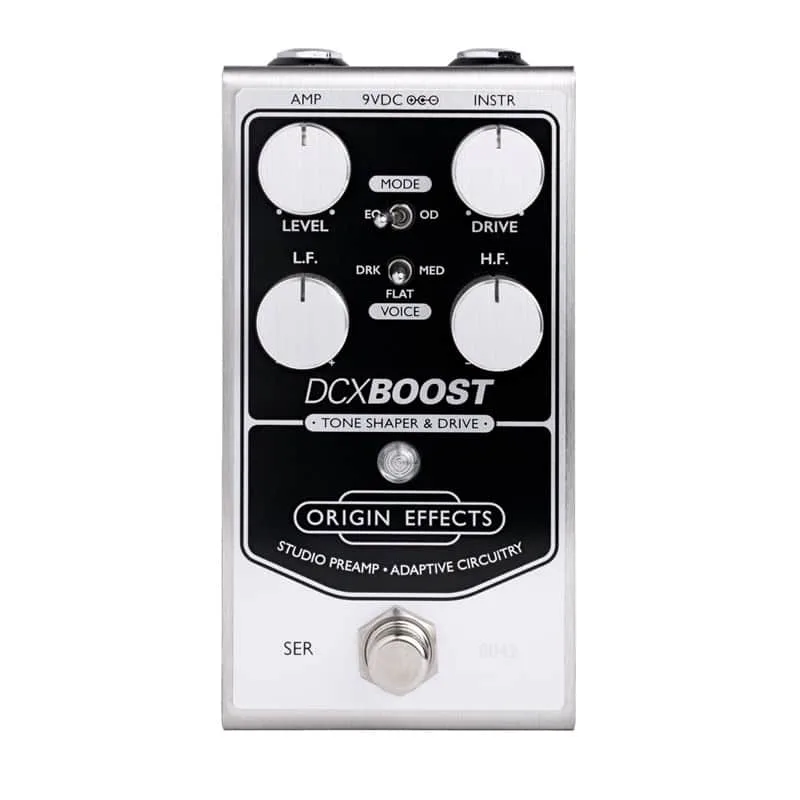


The Origin Effects DCX Boost is a boost and preamp pedal for electric guitar that recreates the circuit of the Universal Audio 610 studio preamp in stompbox form. Origin Effects launched it in April 2023 alongside a bass sibling, the DCX Bass, and both are designed and built in England12. Rather than copying one classic pedal, the DCX takes its character from a piece of studio hardware: the UA 610 preamp, used in its original form to record a long list of American musicians314.
In practice the pedal can serve as a drive section, an EQ, or a tone-sweetening boost in front of an amp5. Guitar World's reviewer Trevor Curwen called it "a really versatile boost and drive with tightly focused EQ options" and said that if restricted to just one pedal in front of an amp, "this is the one we'd choose"6.
A UA 610 preamp in pedal form
The DCX Boost is inspired by the UA 610 studio preamp, a piece of recording equipment Origin Effects describes as a classic1. The company says recreating the 610 circuit in pedal form means "you're not constrained to a certain signal chain order," so the pedal can sit anywhere on a board rather than needing a fixed position9.
The UA 610 lineage shows up in how the pedal handles gain. Origin Effects positions it as a touch-responsive low-gain drive that reacts to playing dynamics and volume knob changes, moving between clean and overdriven tones in a very natural way9. For players who want that kind of response, the company suggests running the DCX first in the chain9.
EQ mode and OD mode
A Mode switch on the pedal selects between two voicings, EQ and OD, which together cover a wide gain range6.
EQ mode is the lower-gain setting of the two and the go-to mode for clean boost, though at higher Drive settings it is capable of drive for adding grit to clean sounds and covering edge-of-breakup and beyond6. It is designed to be responsive to playing dynamics and also to the guitar's controls, sitting somewhere between clean and overdriven with a seamless transition and a treble roll-off when pushed hard10. Origin Effects recommends EQ mode for cleaner or mildly overdriven tones and tone shaping9.
OD mode is the higher-gain option. It rolls off top-end and has three distinct voicings labeled Dark, Flat and Medium, selected by the Voice switch10. Guitar World notes there is no Adaptive Circuitry in OD mode, but there is a tighter low-end and a natural treble to suit drive sounds, plus extra attenuation via the Voice switch6.
Adaptive Circuitry
In EQ mode, Origin has incorporated its Adaptive Circuitry, which keeps clean sounds bright and sparkly, reining back the treble with increasing drive6. The manual describes the feature as "adjusting the pedal's voicing in response to playing dynamics and volume knob changes"3. The practical effect is that the pedal cleans up when you back off your guitar's volume and darkens itself as you push the Drive knob, without you having to re-dial the EQ.
The controls
The DCX Boost keeps its control set compact: four knobs, two switches and one footswitch6.
| Control | What it does |
|---|---|
| Level | Sets the output level; at maximum with Drive at minimum gives unity gain9 |
| Drive | Sets the drive; at minimum with Level at maximum gives unity gain, and increasing it gives maximum clean boost9 |
| L.F. | Cuts or boosts low frequencies9 |
| H.F. | Boosts or cuts high frequencies9 |
| Mode switch | Selects EQ or OD mode6 |
| Voice switch | Selects Dark, Medium or Flat voicing in OD mode6 |
| Bypass footswitch | Engages and bypasses the pedal6 |
Origin Effects suggests a starting point of Level at maximum and Drive at minimum, which gives unity gain; from there, increasing the Drive control takes advantage of the pedal's clean boost range9. The L.F. and H.F. controls can be used against each other, for example an L.F. cut paired with a slight H.F. boost9.
Power: 9V, 90mA
The DCX Boost runs on a 9V DC adaptor that is not supplied, drawing 90mA6. Both DCX pedals take 9V DC from a pedalboard power supply5, and the DCX line dispenses with the usual 9V battery option, so the pedal cannot run without external power4.
No power supply is included and there is no battery option, so the DCX Boost needs a 9V DC output from a pedalboard supply or a separate adaptor before it will work64.
The DCX Bass
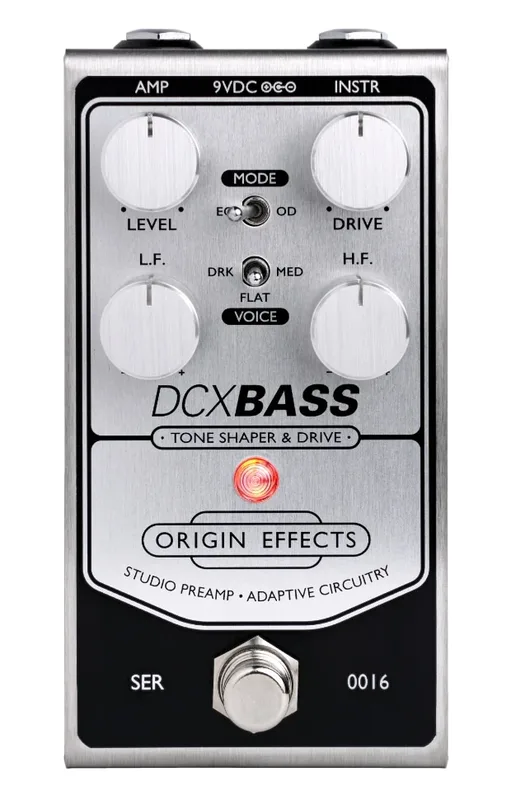
The DCX Boost has a bass sibling, the DCX Bass, which reimagines the same UA 610 preamp as a tone-shaper and drive pedal for bass guitar4. Its gain range runs from clean boosts and direct-to-console sounds, through edge-of-breakup and low gain drives, all the way to almost fuzz-like tones4. Like the guitar version, it uses a high-quality buffered bypass and 9V DC 2.1 mm center-negative power4. Players comparing the two can read more in the bass pedals category.
What reviewers said
Guitar World's review concluded that the DCX is "a really versatile boost and drive with tightly focused EQ options," and that if the reviewer were restricted to just one pedal in front of an amp, this would be the one chosen overall6. The pedal also appeared on That Pedal Show, featured in the episode "Choosing A Digital Delay For Guitar" in November 20232.
Videos
Pete Thorn
Origin Effects
Origin Effects
Questions
Is the Origin Effects DCX Boost true bypass?
No. The DCX Boost uses a high-quality buffered bypass rather than true bypass. A buffer keeps the signal strong through long cable runs and pedal chains, though players who specifically want true bypass switching should note this before buying.
Does the DCX Boost come with a power supply?
No. It runs on a 9V DC adaptor that is not supplied, drawing 90mA. There is no battery option on the DCX line, so it needs a pedalboard power supply or a separate mains adaptor before it can be used.
What is Adaptive Circuitry on the DCX Boost?
Adaptive Circuitry is an Origin Effects feature that adjusts the pedal's voicing in response to playing dynamics and volume knob changes. In EQ mode it keeps clean sounds bright and sparkly while reining back the treble as drive increases, letting the pedal move between clean and overdriven tones naturally.
Where is the Origin Effects DCX made?
The DCX Boost is designed and built in England. Origin Effects is a UK pedal maker, and the DCX pedals are part of its hand-built line rather than being produced overseas.
Is there a bass version of the DCX Boost?
Yes. The DCX Bass is a sibling pedal voiced for bass rather than electric guitar. It reimagines the same UA 610 preamp as a tone-shaper and drive pedal for bass, with a gain range running from clean boosts and direct-to-console sounds up to almost fuzz-like tones.
Sources (10)
- Tone Chasing and Matchmaking With the DCX BOOST, Origin Effects, 2023-09-15
- Choosing A Digital Delay For Guitar, That Pedal Show, 2023-11-03
- Origin Effects DCX Bass Tone Shaper & Drive review, Guitar World, 2023-12-14
- DCX BASS, Origin Effects, 2026
- Origin Effects puts the holy grail tone mojo of a UA 610 console preamp into a pair of drive/tone shaper pedals for guitar and bass, MusicRadar, 2023-04-25
- Origin Effects DCX Boost review, Guitar World, 2023-08-18
- Origin Effects debuts the DCX Boost and Bass, packing the preamp heft of a classic UA console into all-analog compact pedals, Guitar World, 2023-04-25
- Origin Effects DCX Boost, Delicious Audio, 2023-08-28
- Tech Tips: DCX and Cali76, Origin Effects, 2023-05-05
- Origin Effects DCX Boost and DCX Bass, gearnews.com, 2023-04-25