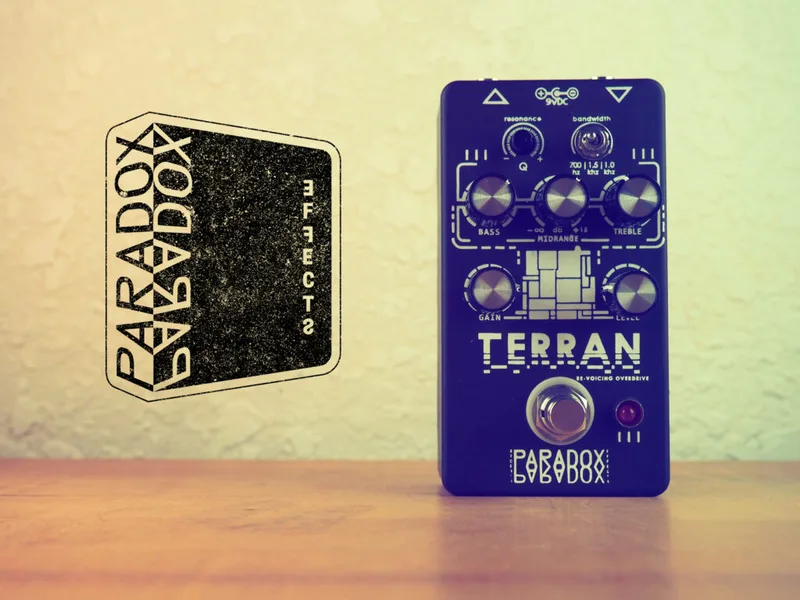


The Terran is a mid/high gain overdrive and distortion pedal from Paradox Effects, a manufacturer based in Tijuana, Mexico. What sets it apart from a conventional overdrive pedal is its tone stack, inspired by the Ampeg V4 amplifier, paired with a resonant parametric equalizer. That combination makes it as much a re-voicing tool as a gain stage: Paradox's Paolo De Gregorio suggested using it as a pre-amp to change a tube amp's voice, to change a guitar's pickup qualities, or even as a cab simulator1.
Premier Guitar's 2021 review heard it as brutal, bottom-heavy distortion, describing a monolithic, highly compressed sound, huge on the bottom but textured with complex low-mid scoops and peaks2.
The Ampeg V4 connection and the parametric EQ
The heart of the Terran is its Ampeg V4 inspired tone stack1. Premier Guitar names the same amplifier as the pedal's sonic inspiration2. The V4 was an amp with an unusually powerful EQ section for its era, and the Terran carries that idea over in pedal form: rather than fixed tone knobs, it gives you a selectable midrange frequency and a resonance control, so the EQ shapes the character of the gain itself.
Pedal of the Day called the result one of the more unique overdrives we've come across, as of late, and described this Re-Voicing drive as able to change the resonant qualities of your tone, emulating different types of guitar pick-ups and tube amp voices3.
Controls
| Control | What it does |
|---|---|
| Midrange frequency selector | Three settings: 700Hz, 1kHz, and 1.5kHz2 |
| Q | Controls the resonance of the filter, for peaks and scoops of varying width1 |
The frequency selector and Q control work together: pick the center of the midrange you want to emphasize or cut, then set how pronounced that band is. Pedal of the Day suggested three placements that make use of this: at the beginning of a pedal chain to re-voice the guitar's pickups, after a fuzz or distortion pedal for better articulated equalization, or as a pre-amp for a tube amplifier3. Players looking to go deeper on tone shaping might also compare it with dedicated equalization pedals or preamp pedals, which approach the same job without the built-in gain.
Clipping, gain stacking and power
The version Premier Guitar reviewed used germanium-diode clipping, with the review noting that future versions will feature silicon-diode clipping2. That is worth knowing when comparing units, since the two diode types give noticeably different compression and feel.
For players who stack gain stages, the news is good. Premier Guitar's reviewer found the pedal responds beautifully to upstream overdrives and boosters, and that it layers well with other gain stages2. A boost pedal or low-gain overdrive in front pushes the Terran into heavier territory without muddying the midrange the EQ is shaping.
The Terran runs off a 9V DC power supply, which is not included, so plan for a supply on your board2.
On build, Premier Guitar noted that pots, jacks, and switches are mounted to the enclosure, not the board, a construction approach associated with pedals that survive life on a road-worn board2. The same review's verdict ran: brutal, bottom-heavy distortion. Versatile tone controls. Quality build. Good price2.
Videos
Paradox Effects
Paradox Effects
Paradox Effects
Questions
What circuit is the Paradox Effects Terran based on?
The Terran's core is a tone stack inspired by the Ampeg V4 amplifier. Delicious Audio's Paolo De Gregorio described the pedal as a mid/high gain overdrive with a resonant parametric equalizer inspired by the legendary V4, and Premier Guitar's review likewise names the Ampeg V4 as the sonic inspiration. That amp heritage is what gives the pedal its re-voicing character rather than a straightforward gain stage.
What are the midrange frequency settings on the Terran?
The Terran's midrange frequency selector offers three settings: 700Hz, 1kHz, and 1.5kHz. Alongside the frequency selector, a Q control sets the resonance of the filter, so you can shape narrow peaks and scoops in the low mids or broader tonal shifts. Together these controls let the pedal re-voice pickups, change a tube amp's voice, or act as a cab simulator.
Does the Terran use germanium or silicon diodes?
The version Premier Guitar reviewed in 2021 used germanium-diode clipping, and the review noted that future versions would feature silicon-diode clipping. Germanium clipping is generally associated with a softer, more compressed feel, which matches the reviewer's description of the Terran's monolithic, highly compressed sound.
What power does the Paradox Effects Terran need?
The Terran runs off a 9V DC power supply, which is not included with the pedal. Premier Guitar also noted the build quality: pots, jacks, and switches are mounted to the enclosure rather than the circuit board, which is a mark of a sturdy construction.
Does the Terran work with an overdrive or boost in front of it?
Yes. Premier Guitar's reviewer found that the pedal responds beautifully to upstream overdrives and boosters, and that it layers well with other gain stages. Pedal of the Day also suggested running it after a fuzz or distortion for better articulated equalization, so it sits comfortably both in front of and behind other gain pedals.
Sources (3)
- Paradox Effects Terran Overdrive With Parametric EQ, Delicious Audio, 2018-02-05
- Paradox Effects Terran Review, Premier Guitar, 2018-10-29
- Paradox Effects Terran Re-Voicing Overdrive, Pedal of the Day (www.pedal-of-the-day.com), 2021-02-06