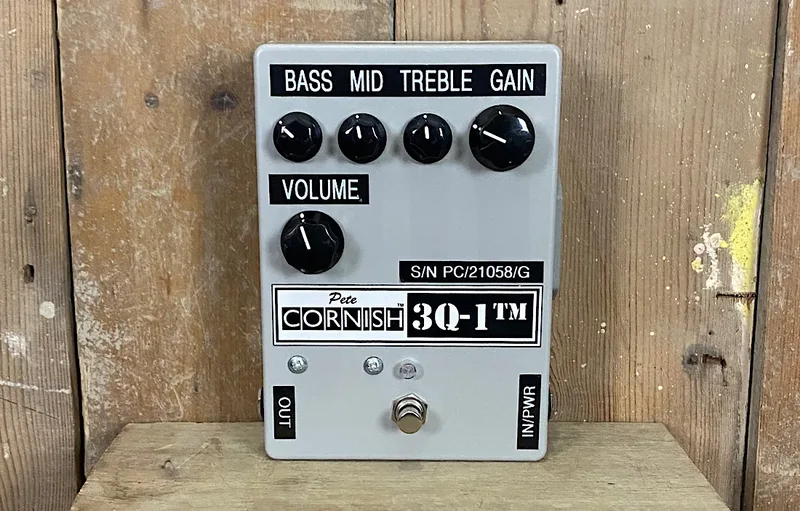
The Pete Cornish 3Q-1 is a clean boost pedal with a three band active EQ, introduced by Pete Cornish as new for 20161. It sits in the maker's Gray Series: a variable gain linear boost feeding bass, middle and treble controls whose frequencies were chosen specifically to suit guitars, with each band able to cut or boost around a neutral 12 o'clock point1. Pete Cornish describes it as a Tone and Volume Boost, and states it is not a variant of any existing product but a completely new and original design1.
Each unit is hand built, wired and tested by Pete, Lynda and Mingus Cornish in the UK, housed in a rugged die-cast box1. On the maker's Gray Series price list dated 31 March 2026 it is listed at 465.11 GBP excluding VAT, or 558.13 GBP including VAT2.
What it does to your sound
The first stage of the 3Q-1 is a variable gain linear boost with a flat frequency response, with a gain range of 0 to +20 dB, which Pete Cornish notes is ten times the input signal1. Because the boost stage is linear and flat, it raises the level without adding clipping or coloration of its own, which is what separates it from an overdrive or distortion pedal. The EQ that follows lets you reshape the boosted signal around that clean lift.
The three EQ bands work at frequencies chosen for guitar, and each can be cut or boosted from its neutral 12 o'clock position1:
With Gain and Volume both at 100% and the EQ bands at their neutral 50% positions, the overall boost is +20 dB3. Maximum signal output with Volume at 100% is +10dBm, 2.5V RMS, or 6V peak to peak1.
The controls
The 3Q-1 has five controls: Gain, Bass, Middle, Treble and a Master Volume13.
- Gain: sets the amount of clean boost from the first stage, up to +20 dB1
- Bass, Middle, Treble: cut or boost each band around the 12 o'clock neutral point1
- Master Volume: an output level control, included, as the maker puts it, "to allow for perfect matching between bypassed and boosted/EQ'd signal level"3
That Master Volume is the practical difference from a plain boost pedal: you can dial in EQ and gain, then match the bypassed level so switching the pedal on changes your tone and drive into the amp rather than just your volume3.
The pedal is switched by a heavy duty all-metal footswitch with a Hi-Brite LED, and measures 171 x 121 x 55 mm1.
Powering it
The 3Q-1 runs from a 9V DC adapter or an internal 9V battery13.
- Adapter: noise free, fully stabilised at 9V DC, capable of supplying 20mA, on a 5.5/2.1mm coax connector with the center pin negative3
- Battery: internal 9V DC battery, MN 1604 recommended1
An adapter putting out AC voltage should not be used: it will permanently damage the pedal, and such damage is not covered under warranty3.
Pete Cornish recommends isolated ground power supplies, naming the Voodoo Lab Pedal Power 2 Plus or an equivalent type as an example, and does not recommend daisy chaining. If only a single unit is being powered, a BOSS PSA series adapter is recommended13. Remove the battery when storing the pedal or when using a 9V DC supply, as an unused battery may leak and cause damage1.
Bypass and buffering
The 3Q-1 is not true bypass. Its input is fully buffered using Pete Cornish's LD-1 Class A unity gain line driver with an RF filter, and that buffer is also active in bypass mode1. For a player running long cables or a large pedalboard, that always-on buffer is the point of the design: the signal driving the chain stays consistent whether the pedal is engaged or not.
Warranty
The 3Q-1 carries a two year warranty from date of purchase, covering repairs of original manufacturing faults. The warranty is voided if the guarantee labels are damaged or removed, and it is not transferable1.
Questions
Does the Pete Cornish 3Q-1 take a battery?
Yes. The 3Q-1 runs on an internal 9V DC battery, and Pete Cornish recommends the MN 1604 type. The battery is switched on when a jack is inserted into the input. Remove the battery when storing the pedal or when powering it from a 9V DC supply, since an unused battery may leak and cause damage.
Is the Pete Cornish 3Q-1 true bypass?
No. The input is fully buffered using Pete Cornish's LD-1 Class A unity gain line driver with an RF filter, and that buffer stays active in bypass mode. The buffered input is part of the design rather than a switchable option.
How much boost does the Pete Cornish 3Q-1 give?
With the Gain and Volume controls both at 100% and the EQ bands at their neutral 50% positions, the overall boost is +20 dB. The first stage is a variable gain linear boost with a flat frequency response, with a gain range of 0 to +20 dB, about ten times the input signal.
What power supply does Pete Cornish recommend for the 3Q-1?
Pete Cornish recommends isolated ground power supplies, naming the Voodoo Lab Pedal Power 2 Plus or an equivalent as an example. If only one pedal is being powered, a BOSS PSA series adaptor is recommended, but daisy chaining is not. Never use an AC voltage adaptor, as it will permanently damage the pedal.
What is the warranty on a Pete Cornish pedal?
The 3Q-1 carries a two year warranty from date of purchase covering repairs of original manufacturing faults. The warranty is voided if the guarantee labels are damaged or removed, and it is not transferable. Damage caused by using an AC adaptor is not covered.
Sources (4)
- Pete Cornish 3Q-1, Pete Cornish, 2016
- Grey Series Effects Pedals, petecornish.co.uk, 2026-03-31
- Pete Cornish 3Q-1, Pete Cornish, 2016
- LP-2 by Pete Cornish, RockBoard PedalPedia, 2026