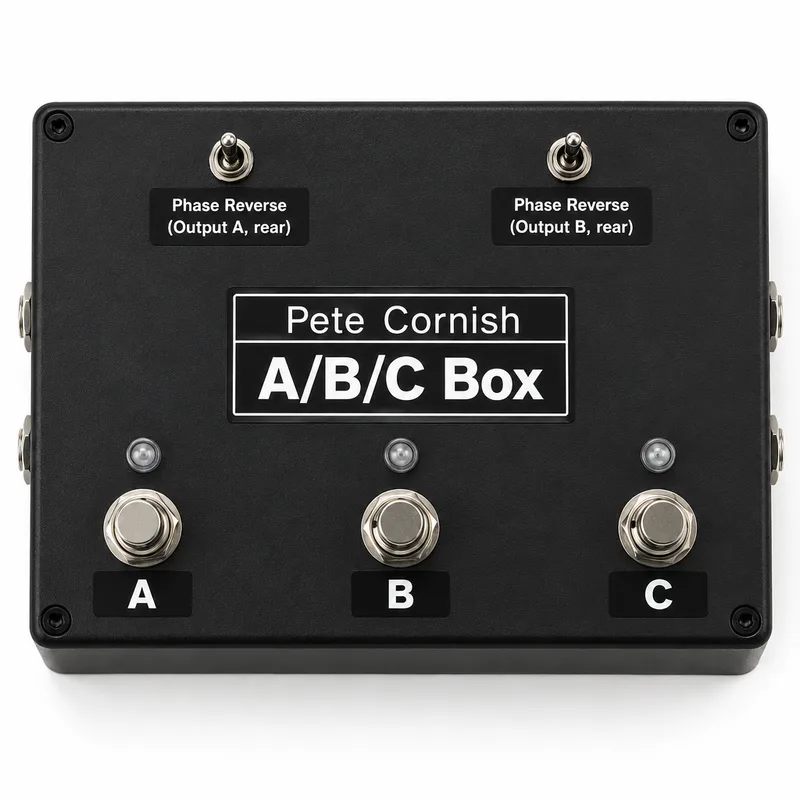
The Pete Cornish A/B/C Box is an A/B/C signal splitter with a buffer preamp, built to send one guitar signal to up to three amplifiers. Its input stage is what Pete Cornish calls a high impedance, unity gain, Class A buffer preamp, and its low impedance balanced outputs allow long cable runs without signal loss. The maker notes that all amps fed from it should be grounded to AC power1.
The box is part of a family of Cornish routing products. The A/B/Y Box provides two outputs, covering the simpler case of switching between two amps or running both at once, while the A/B/C Box offers three outputs, A, B and C, all identical in signal level, with Phase Reverse Switches fitted to Outputs A and B21.
Outputs, footswitches and phase switches
The unit has three outputs, labeled A, B and C, and Pete Cornish states that all three are identical in signal level, so there is no difference in performance from changing outputs1. Each output has its own footswitch, and the selected channel is active when its indicator light is on. That layout means you can run one amp, any pair, or all three at once by simply leaving the corresponding channels lit.
Output A uses a 1/4 inch TRS jack (or a mono jack), while Output C is a 1/4 inch mono jack only. The input is a 1/4 inch mono jack that also handles power switching1.
| Output | Jack | Phase reverse switch | Notes |
|---|---|---|---|
| A | 1/4 in. TRS (or mono) | Yes, on the rear | Floating to prevent ground loops |
| B | 1/4 in. | Yes, on the rear | Floating to prevent ground loops |
| C | 1/4 in. mono only | No | The "reference" channel |
Outputs A and B each carry a phase reverse switch on the rear of the unit, next to the output jacks. These let you flip the polarity of an output when two amps are out of phase with each other, which otherwise causes cancellations when both amps play together. Output C has no phase switch because it is the reference channel that A and B are flipped against1.
Outputs A and B are also floating, which Pete Cornish says prevents ground loops occurring; the maker advises connecting your amps to a reliable ground1. This is the same approach the company uses on its A/B/Y Box, where the phase reverse switch on Output B serves the same purpose for a two-amp setup2.
Power: battery or 9.6V to 18V DC
The A/B/C Box is a dual voltage unit. It runs on a battery housed in a removable drawer, with alkaline types recommended, and the battery switches on when you insert the INPUT+POWER jack1. Pete Cornish's A/B/Y Box uses the same drawer arrangement, with the MN1604 battery type preferred there2.
For adaptor power, the unit accepts a 9.6V DC adaptor, with the Boss PSA series or similar named as suitable, and Pete Cornish states that on 9.6V DC the performance is identical to battery power. The maximum is 18V DC, using a fully smoothed and regulated AC/DC adaptor capable of supplying 20mA. The DC connector is 2.1mm with a negative tip1.
The supply voltage affects the maximum output level:
The higher headroom of the 18V supply only matters if you need it. On the maker's own numbers, a 9.6V adaptor performs identically to the battery, so for most guitar-level signals either supply is sufficient.
Other specifications from the maker: input impedance is 1Mohm + 20pF on a 9.6V DC supply, minimum output load is 10 Kohms, output noise is -106dBm (10KHz bandwidth), frequency response is +/- 1dB from 20Hz to 32KHz, and the enclosure measures 171 x 121 x 55 mm1.
Warranty and support
Pete Cornish covers the A/B/C Box for twelve months from the date of purchase. Any original manufacturing fault is repaired if the unit is returned post paid, with normal wear, misuse, unauthorized modifications and accidental damage excepted. The warranty is not transferable and does not apply to the customer's own equipment connected to the unit1. Orders and enquiries go through Pete Cornish directly1.
Questions
Can the Pete Cornish A/B/C Box run three amps at once?
Yes. The unit feeds up to three amps from its three outputs, A, B and C, all identical in signal level. Pete Cornish advises making sure all the amps are grounded to AC power, and Outputs A and B are floating to prevent ground loops between them.
Does the A/B/C Box run on a battery?
Yes. The battery sits in a removable drawer and Pete Cornish recommends alkaline types. The battery is switched on when you insert the INPUT+POWER jack, so unplugging the input cable turns it off. The same jack also accepts a DC adaptor.
Which outputs have a phase reverse switch?
Outputs A and B. The phase reverse switches sit on the rear of the unit next to the output jacks, so you can flip the polarity of either output if two amps are out of phase with each other. Output C has no phase switch because it is the reference channel.
Does the A/B/C Box add gain?
No. Gain is unity from the input to any output, so the signal level reaching each amp matches what you feed in. The input stage is a high impedance, unity gain, Class A buffer preamp, which is there to drive long cables rather than to boost the signal.
What is the warranty on a Pete Cornish A/B/C Box?
Twelve months from the date of purchase. Pete Cornish will repair any original manufacturing fault if you return the unit post paid, with normal wear, misuse, unauthorized modifications and accidental damage excepted. The warranty is not transferable and does not cover your own equipment connected to the unit.
Sources (3)
- Pete Cornish A/B/C Box, Pete Cornish, 2014
- Pete Cornish A/B/Y Box, Pete Cornish, 2021
- Grey Series Effects Pedals, petecornish.co.uk, 2026-03-31