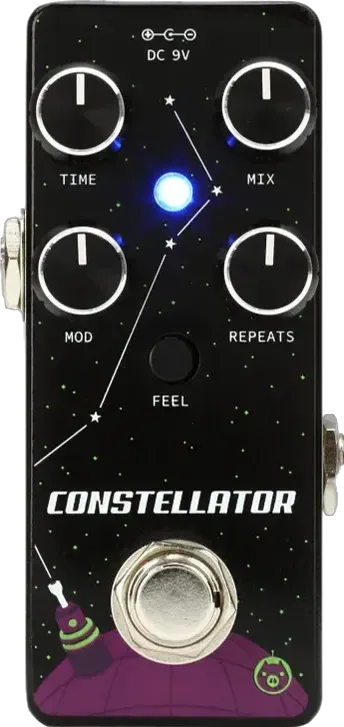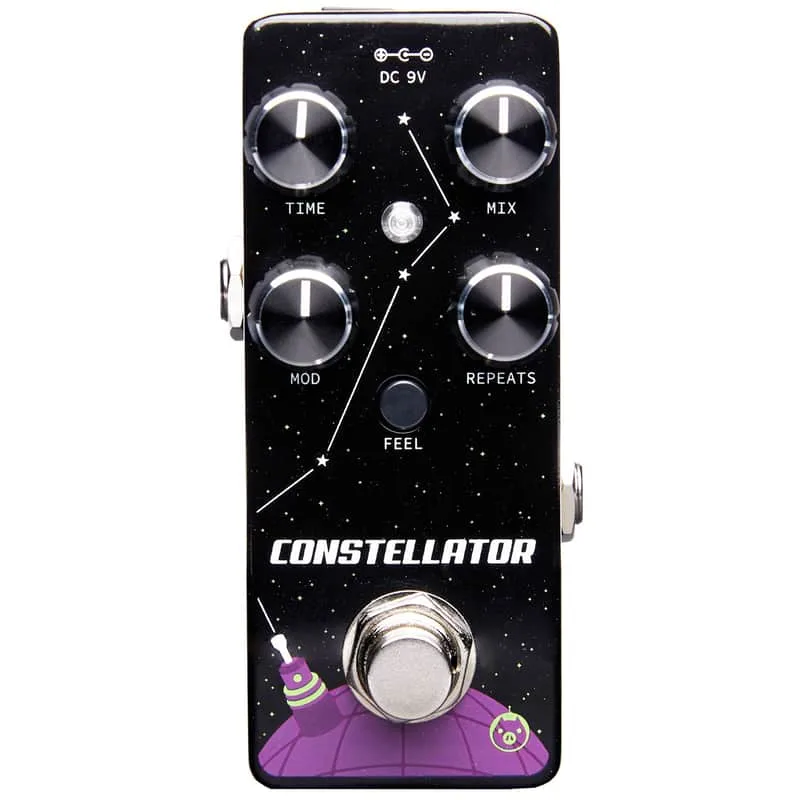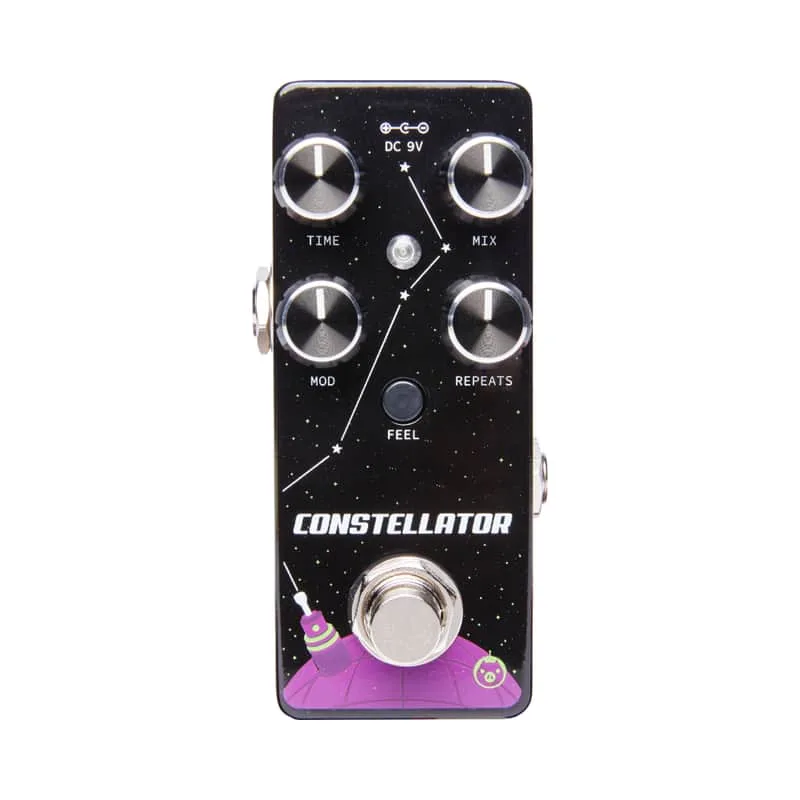


The Pigtronix Constellator is an all-analog delay pedal in a mini enclosure, made by Pigtronix. It is built around a pair of MN3005 bucket brigade device (BBD) chips, the same delay chip used in classic analog designs, and produces up to 600 ms of echo with adjustable modulation12. RockBoard's PedalPedia describes its range as running "from percussive slapback and doubler sounds to chorused-out, long delays with endless repeats"1.
It was introduced as one of a trio of analog micro pedals3. At the time of the announcement there was no official release date, with the pedals expected in 20214, and they were later reported available for $1795, a street price other reviews have also listed56.
An analog bucket brigade delay with modulation
The Constellator's sound comes from its bucket brigade chips. A BBD (bucket brigade device) passes your signal along a chain of tiny capacitors, one step at a time, and the time those steps take is the delay. Compared with digital delay, this gives the repeats a darker, more degraded character as they fade, which many players hear as warmer or more tape-like. RockBoard's PedalPedia says the MN3005 chips "provide superior overall headroom and tape-like saturation when pushed to the limit"1, and Delicious Audio's Paolo De Gregorio found it "provides tape-like saturation and it's prone to self-oscillation at maximum feedback levels"8.
The modulation side is what separates it from a plain analog echo. MusicRadar's review notes "a Mod knob for adding some woozy modulation to the repeats"2, and Guitar World's reviewer identified two modulation choices, "basically chorus or vibrato"6. Modulated repeats mimic the slight pitch wobble of a worn tape echo, where the tape never runs at a perfectly constant speed.
"From percussive slapback and doubler sounds to chorused-out, long delays with endless repeats, the Constellator's MN3005 [bucket brigade chips provide superior overall headroom and tape-like saturation when pushed to the limit]"
The controls
The Constellator keeps its control set small, fitting its enclosure. The standard triumvirate of Time, Mix and Repeats knobs handles the basics, with a Mod knob for adding some woozy modulation to the repeats and a Feel toggle switch that adjusts several parameters simultaneously for an additional coloring of LFO modulation621.
| Control | What it does |
|---|---|
| Time | Sets the delay time, up to 600 ms2 |
| Mix | Sets the balance of dry and delayed signal6 |
| Repeats | Adjusts feedback; maxed out it gets into self-oscillation9 |
| Mod | Adds woozy modulation to the repeats2 |
| Feel | Push button that adjusts several parameters simultaneously for additional coloring of the LFO modulation1 |
The Feel switch is the unusual one. Pedal of the Day describes it as toggling between two modulation modes, one chorus and one vibrato, with "several parameters automatically adjusted simultaneously when this button is pushed in or released out"9. Premier Guitar's reviewer called it "essentially a chorus that accents the colors and degradation in the repeat trails," noting it can sound "at times, like analog tape that has been stretched"7.
With the Feedback control maxed out, the Constellator is capable of self-oscillation, which can be pitched up or down by turning the Time knob1. This is the runaway-repeat behavior of vintage analog and tape delays: the pedal generates its own tones, and the Time knob becomes a pitch control. Delicious Audio highlighted the same behavior, calling the pedal "an analog delay with modulation that can get rather spacey"8.
Power and bypass
The Constellator runs on standard 9V DC, center negative, drawing 100mA1. There is no battery option; as Premier Guitar's reviewer put it, "there is zero space for a battery option" in the enclosure7. At 100mA it draws more current than many analog pedals, so it is worth budgeting a proper output on a power supply rather than assuming it shares a low-current daisy chain.
Sources disagree on the bypass type. GuitarPlayer's review lists true-bypass switching with an LED indicator5, while MusicRadar's review lists buffered bypass2. The maker's own listing does not settle it, so players who care about bypass type should confirm with current Pigtronix documentation.
Where it came from
Pigtronix introduced the Constellator as one of a trio of analog micro pedals3. At the time of the announcement there was no official release date, with the pedals expected to appear in 202110. They were subsequently reported as available for $1794. The Constellator is an analog delay in a compact stompbox enclosure, assembled in the USA3.
What reviewers said
Reviews were positive across the board. Guitar World's Trevor Curwen called it "an excellent way to easily add real analogue delay to your 'board"6. MusicRadar's review summed up its appeal as "Affordable"2. Premier Guitar's reviewer noted that what the pedal does is "harder to find in a stompbox this compact and affordable"7. Delicious Audio went further, adding the pedal to its lists of best tape delay pedals and best mini delay pedals8.
Videos
Pigtronix
Reverb
To₿ee Maguire
News
Questions
Does the Pigtronix Constellator take a battery?
No. The enclosure is too small for one, and the pedal runs on a 9V DC power supply only. It draws 100mA at 9V DC center negative, so plan on a dedicated spot on your power supply rather than a daisy chain shared with low-current pedals.
Is the Constellator true bypass?
Sources disagree. GuitarPlayer's review lists true-bypass switching with an LED indicator, while MusicRadar's review lists buffered bypass. If bypass type matters to your signal chain, it is worth confirming with the maker's current documentation before buying.
What is the maximum delay time on the Constellator?
Up to 600 ms of echo. That covers slapback and doubler sounds at the short end and long, chorused repeats at the far end, though it is shorter than digital delays that reach several seconds.
What chip does the Pigtronix Constellator use?
A pair of MN3005 bucket brigade device (BBD) chips, the classic analog delay chip also used in vintage delay designs. Pigtronix says these chips provide superior overall headroom and tape-like saturation when pushed to the limit.
Can the Constellator self-oscillate?
Yes. With the Feedback (Repeats) control maxed out, the pedal is capable of self-oscillation, and the resulting repeats can be pitched up or down by turning the Time knob, the way classic analog and tape delays behave.
Sources (10)
- Constellator by Pigtronix, RockBoard PedalPedia, 2026
- Pigtronix Constellator Modulated Analog Delay review, MusicRadar, 2022-04-16
- Pigtronix Releases All-New Trio of Micro Pedals, MusicPlayers.com, 2021-01-18
- Pigtronix Goes Cosmic with New Space Rip, Moon Pool, Constellator Mini-Pedals, GuitarPlayer, 2021-02-05
- Pigtronix Constellator and Space Rip Review, GuitarPlayer, 2021-07-22
- Pigtronix Constellator Modulated Analog Delay review, Guitar World, 2022-01-21
- Pigtronix Constellator Review, Premier Guitar, 2021-09-10
- Pigtronix Constellator Mini Analog Delay, Delicious Audio, 2023-02-16
- Pigtronix Constellator Modulated Analog Delay, Pedal of the Day, 2021-12-20
- NAMM 2021: New Pigtronix pedals: Space Rip, Constellator and Moon Pool, gearnews.com, 2021-01-18