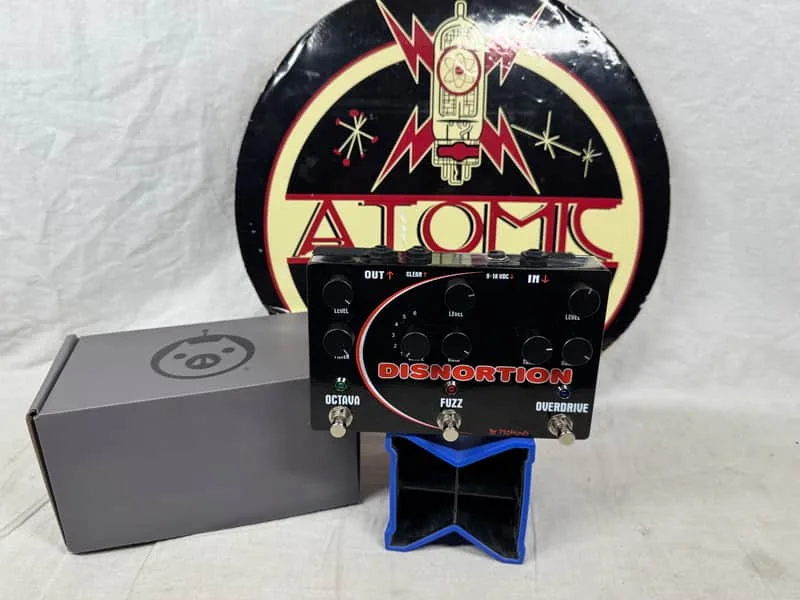


The Pigtronix OFO Disnortion is a distortion pedal that puts three effects in one box: a touch-sensitive overdrive, a fuzz with six different filters, and an octave-up circuit called the Octava. Pigtronix introduced it as new in 2006, and each of the three effects is an original design that can be used on its own or in combination with the others, giving what the maker describes as a tremendous range of sounds1.
What each section does
The three sections are separate designs that share one enclosure, and each works on its own or stacked with the others1:
| Section | What it is | What it does |
|---|---|---|
| Overdrive | Touch-sensitive drive with a proprietary 5-stage gain architecture | Follows playing dynamics, retains the instrument's natural tone and breaks up gradually as you play louder1 |
| Fuzz | Pigtronix's own diode clipping design with six filters | Plenty of compression and controllable feedback while preserving dynamics, with six voicings from one circuit1 |
| Octava | Frequency doubler, one octave up | Interval-dependent character, from stable grind to ring-modulator textures, with a Filter control for singing octave-up tones1 |
The overdrive responds to the dynamics of your playing, so the drive level follows how hard you dig in rather than sitting at a fixed amount of grit1. The fuzz uses Pigtronix's own version of diode clipping. For a sense of how these sections sit alongside dedicated units, see Fuzz Pedals and Overdrive Pedals.
The Octava makes the notes you play sound one octave up. Pigtronix describes its character as interval-dependent, with stable intervals such as 4ths and power chords producing a distinctive grind, while other intervals create ring-modulator textures in all registers. In the maker's own words1:
"knarly, tweezed out grind"
A Filter control lets you achieve singing octave up tones without adjusting your guitar's tone control1. Players mainly after the octave effect on its own may also want to look at Octave & Pitch Pedals.
How the three sections connect
The signal routing matters when you stack the effects. The order runs like this:
- The Octava sits first in the chain, wired in series before the Overdrive and Fuzz.
- The Fuzz and Overdrive run in parallel with each other.
- When the Octava is engaged, the octave-up signal always feeds the drive circuits.
- The fuzz and overdrive can be blended together rather than chained one into the other1.
Availability and price
The Disnortion was new in 2006. Pigtronix's product page, carried by dealer Analog Man, listed it at $189 in 20151.
The $189 figure comes from a 2015 listing on dealer Analog Man's site; the pedal was introduced in 2006, so the listing reflects that later point in its run, not its original price1.
Videos
JJ Tanis
ProGuitarShopDemos
Pigtronix
Sources (1)
- PIGTRONIX EP-, Analog Man (analogman.com), 2006