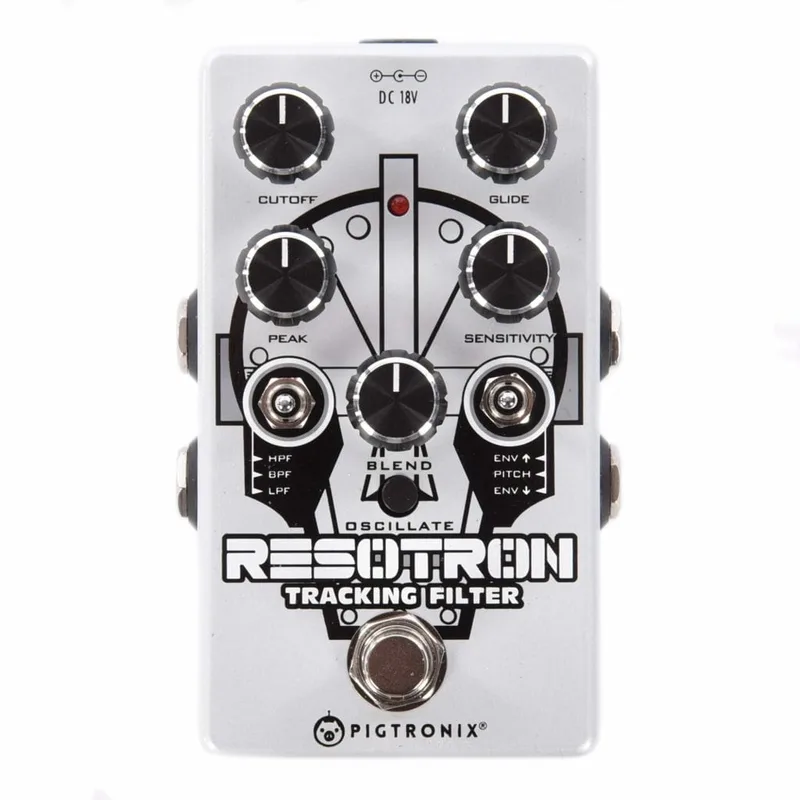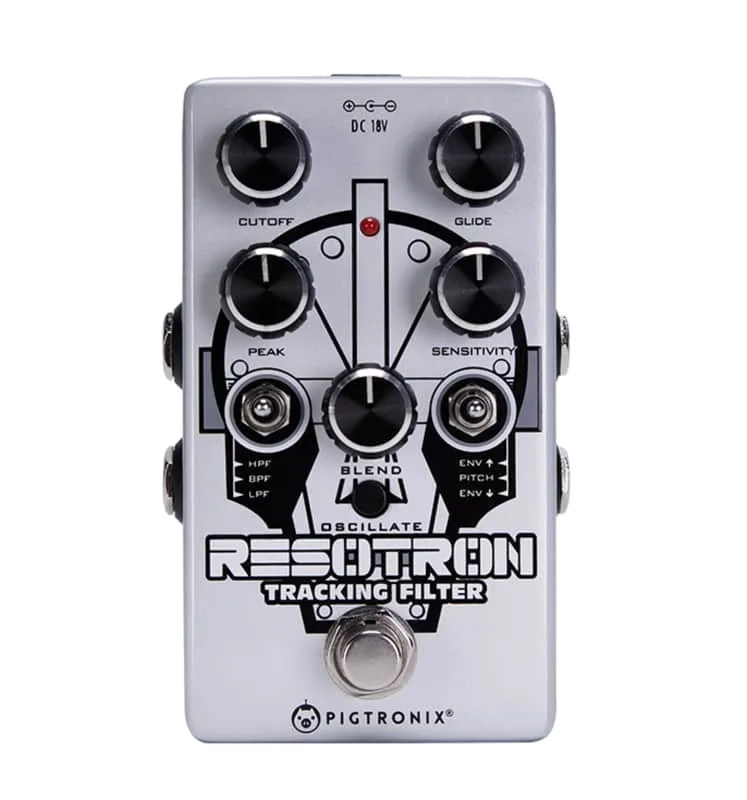


The Pigtronix Resotron is an analog filter pedal that brings the sound of 70s keyboard synthesizers to the world of envelope pedals for guitar and bass1. Announced in January 2019 ahead of NAMM, it combines three things in one box: an envelope filter, a synth voice, and a compressor1. What sets it apart from a conventional envelope pedal is its analog pitch-tracking system, which moves the cutoff frequency of the filter up and down to follow the notes you play rather than only the strength of your attack1.
The Resotron was announced on 22 January 2019 and shipped to Pigtronix dealers at a list price of $249.00 USD2.
What it does and how it is controlled
The Resotron's 24dB/octave state-variable filter provides the full gamut of familiar envelope filter sounds, with Up and Down sweeping modes so the filter can open or close as you play1. A Sensitivity control dials in the response of the effect based on how hard you play, while the Glide knob adjusts the attack time and rate of filter motion, setting how long it takes for the cutoff to travel between pitches1.
| Control | What it does |
|---|---|
| Sensitivity | Sets the envelope response based on how hard you play1 |
| Glide | Adjusts attack time and rate of filter motion, how long the cutoff takes to travel between pitches1 |
| PEAK | Progressively feeds the filter back upon itself to increase the resonance (or "Q") of the filter, right up to the point of self-oscillation2 |
| BLEND | Mixes the compressor's increased volume and punch into the signal without affecting the SENSITIVITY of the envelope2 |
The compressor side of the pedal adds volume and punch, which you can mix in with the BLEND control without changing how the envelope itself responds2.
Oscillate mode and the synth sounds
A push-button OSCILLATE function turns the Resotron into an analog synthesizer pedal that follows both the pitch and the dynamics of your playing2. This gives access to waveforms that range from subtle voice emulations to bombastic, aggressive lead sounds, as well as ultra-smooth sub bass tones2.
MusicRadar's reviewer Trevor Curwen found this side of the pedal productive:
"engaging the Oscillate switch conjures up a shedload of monophonic synth sounds"
He listed the pitch mode and Oscillate button among the pedal's plus points, offering "further sonic experiences" beyond the traditional envelope sounds3. For players shopping the synth pedal category, the Resotron's approach is filter-based synthesis driven by your own pitch and dynamics rather than a digital conversion of the guitar signal.
Expression and CV control
The Resotron accepts active CV and passive TRS expression pedal inputs for foot-controlled filter sweeps and outboard modulation, mixed in parallel with the onboard pitch-following and amplitude tracking systems2. Gearnews described the jack as an expression pedal / 0-5V CV input that can modulate the Cutoff parameter4.
Curwen found this useful in practice:
"Plugging in an expression pedal allows foot control of the filter cutoff if you'd like a more conventional wah experience"
The SSM2040 chip and the designers
The filter at the heart of the Resotron is based on the SSM2040 chip found in the legendary Prophet 5 and Octave CAT synthesizers1. Gearnews places those keyboards in the classic '70s era4, and MusicRadar's reviewer likewise noted the Resotron's 24dB/oct filter circuitry is based on the SSM2040 chip as found on some vintage synths3. For players who want that vintage synth filter character on a pedalboard, this chip is the Resotron's main claim to lineage.
The filter at the heart of the Resotron is based on the SSM2040 chip, the same chip found in the Prophet 5 and Octave CAT synthesizers1. Its 24dB/oct filter circuitry is built around this chip, the same design used on some vintage synths3.
Power
The Resotron runs on 18V DC, center negative, drawing 100mA1. That voltage has a practical consequence MusicRadar's reviewer flagged: 18-volt operation could tie up two outputs on some power distributors3. Check your power supply's output voltage and current rating before adding this pedal to a board.
The Resotron requires 18V DC, center negative, at 100mA1. On some powered pedalboards it may occupy two power outputs3.
Videos
Pigtronix
Pigtronix
Pigtronix
Questions
What power supply does the Pigtronix Resotron need?
The Resotron runs on 18V DC with a center negative plug, drawing 100mA. That voltage is higher than the standard 9V pedal supply, and MusicRadar's reviewer noted that 18-volt operation could tie up two outputs on some power distributors, so plan your pedalboard power accordingly.
Is the Pigtronix Resotron analog or digital?
It is analog. Pigtronix describes it as an analog filter pedal, and its pitch tracking system, which moves the filter cutoff up and down as you play, is analog too. The filter itself is a 24dB/octave state-variable design built around the SSM2040 chip.
Does the Pigtronix Resotron have true bypass?
Yes. Pigtronix specified hardwired true bypass switching for the Resotron, so with the pedal off your signal passes through without active buffering or processing.
Can you use an expression pedal with the Pigtronix Resotron?
Yes. The Resotron accepts active CV and passive TRS expression pedal inputs for foot-controlled filter sweeps and outboard modulation, mixed in parallel with the onboard pitch-following and amplitude tracking systems. MusicRadar's reviewer found this gives a more conventional wah experience.
Who designed the Pigtronix Resotron?
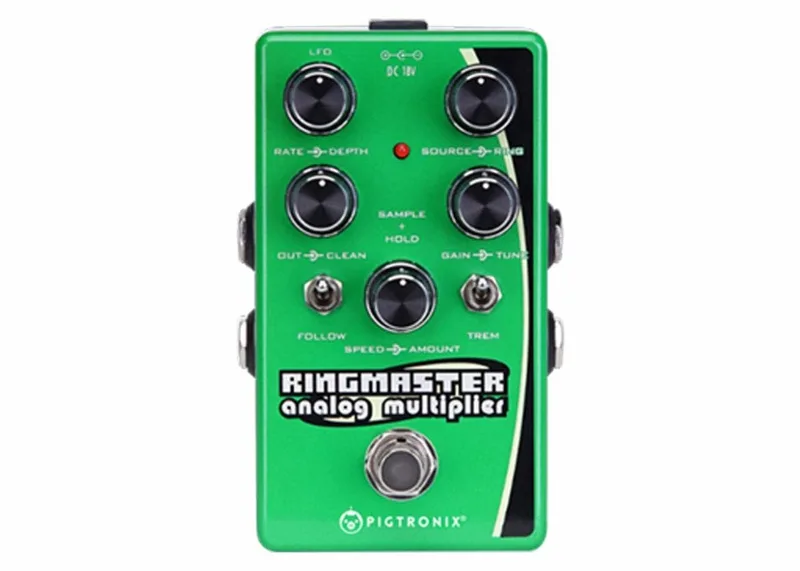
Circuit design was by Nick Cote and sound design by David Koltai, according to Pigtronix's announcement. Koltai has also presented other Pigtronix pedals such as the Ringmaster Analog Multiplier and Philosopher's Tone Germanium Gold Micro at NAMM.
Sources (4)
- Resotron by Pigtronix, RockBoard PedalPedia, 2026
- Pigtronix Announces the Resotron, Premier Guitar, 2019-01-22
- Pigtronix Resotron Tracking Filter review, MusicRadar, 2019-05-28
- NAMM 2019: Pigtronix Resotron Pitch Following Envelope Filter Synthesizer, gearnews.com, 2019-01-23