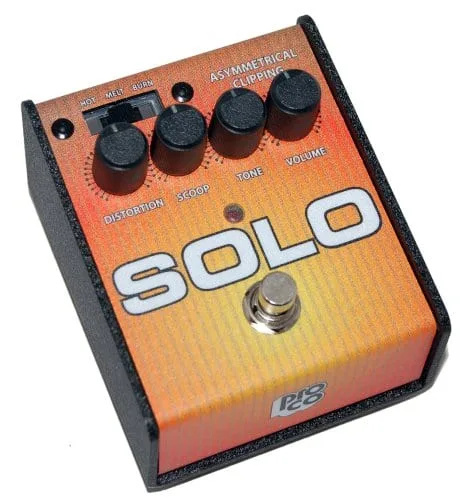


The Pro Co SOLO, sold as the Pro Co RAT Distortion SOLO, is an overdrive and distortion pedal from Pro Co, the maker of the RAT family. It arrived as the newest member of the RAT Distortion line alongside the classic RAT and RAT21. Under the hood it is a RAT-family circuit with two additions that set it apart: a three-way clipping selector labeled hot, melt and burn, and a Scoop control that reshapes the midrange2.
The pedal is fully analog, with a 100% analog signal path, and it is housed in Pro Co's classic steel enclosure with heavy-duty industrial footswitches, knobs and jacks, an on/off LED, a sloped face for easy stomping, glow in the dark graphics and a military-spec glass-epoxy circuit board1. Pedal of the Day's reviewer called it "a fun little pedal, and a welcome addition (sonically AND visually) to the pedal line from RAT Distortion"1.
What it does to your sound
The SOLO covers ground from overdrive to full distortion. Pedal of the Day's Mike B described the range plainly: the 3-way switch "offers a couple different levels of distortion, from a nice, crunchy overdrive to raging, distorted bliss"1. His take on the pedal at high settings was that you are "instantly transported to a jam session with your favorite heavy metal heroes"1.
A technical analysis of the circuit at Guitar FX Layouts put the range in circuit terms: the Solo is "capable of going from vibey, chewy, warm low gain tones, to deliciously mean and crushing high gain tones" while staying true to the sound of the guitar driving it2. The same analysis called it, with its three clipping modes and interactive scoop and tone controls, possibly "the most versatile pedal in your arsenal"2.
Controls
Four knobs sit on the face along with a 3-way selector switch1. The selector is a slider marked hot, melt and burn that chooses between three pairs of clipping diodes2.
| Control | What it does |
|---|---|
| Distortion | Adds grit and crunch to your signal as it is turned up1 |
| Tone | Adds or subtracts high frequencies from the overall output1 |
| Scoop | A mid-tone shaper, highly interactive with the Tone control12 |
| Volume | Sets the output level1 |
| 3-way switch (hot / melt / burn) | Selects between the three pairs of clipping diodes2 |
The clipping stage is the heart of the pedal. The Solo uses three pairs of carefully matched, or as the technical analysis puts it, "carefully mismatched," clipping diodes to produce asymmetrical clipping2. Asymmetrical clipping means the top and bottom halves of the waveform are clipped differently, which changes the harmonic character compared with the symmetric clipping of a standard RAT.
The Scoop knob is the other departure from the RAT formula. Pedal of the Day calls it "a nice mid-tone shaper"1, and the circuit analysis suggests it works by shifting the frequencies affected by the tone pot2. For a player, that means you can pull midrange out for a scooped heavy sound or push it forward to cut through a band, and the setting on one knob changes what the other does.
How it differs from the RAT
The SOLO is not a repackaged RAT, but it is close kin. The technical analysis concludes it "doesn't seem all that different then a standard rat," with the scoop pot and the three clipping options as the major differences2. Pro Co itself framed the pedal as "a departure from the RAT series of pedals in more ways than just the new cosmetics"2.
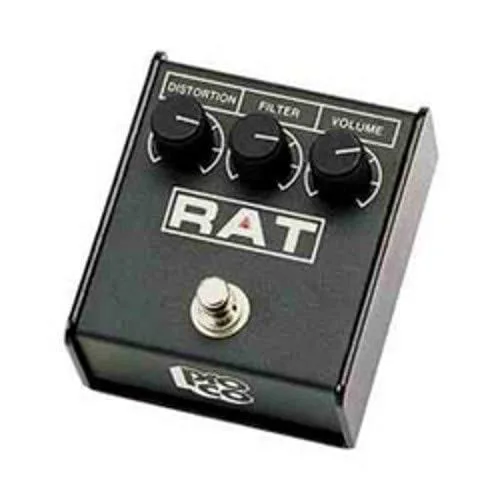
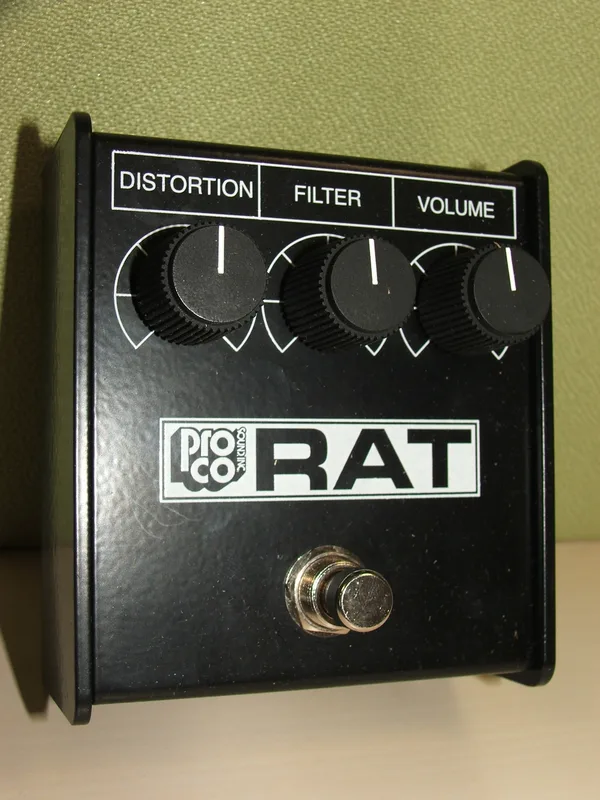
For comparison, the RAT2, which Pro Co describes as its flagship model, uses a single clipping configuration and a tone control that works as a low pass filter, attenuating the pedal's inherent brightness34. The SOLO keeps that family resemblance but adds the midrange shaping and the clipping options. The RAT line has its own history worth knowing: the 1985 RAT2 "White Face," named for the white background of the RAT logo, was reissued in 2010 with the LM308 chip5, and that chip is the one the SOLO uses.
Inside the circuit
The Solo runs on the LM308 op-amp, the chip associated with vintage RAT circuits, with the OP07 suggested as a substitute; the OP07 is the IC that current RAT pedals use2. The output stage uses a 2N5458 JFET as an output buffer with no additional gain, so builders report that just about any JFET works in that position2.
These circuit details come from independent technical analysis and DIY build documentation of the Solo circuit, not from Pro Co's own manual. Builders reproducing the circuit have noted corrections to published layouts, including that a 1uF cap on pin 3 of the IC should be a 1nF capacitor per the original schematic2.
Builders on the same thread have compared op-amp substitutions in the RAT circuit, which applies to the Solo's LM308 slot2:
- CA3130: more aggressive, modern and gainy than the LM308, needs at least a 330 pF compensation cap
- LM741 and LM301: close to the LM308
- TL071: thinner and more aggressive
- NE5534: less drive but more clarity
DIY builders have also documented switching options for the clipping section: it can be wired to a 1P3T rotary switch, a DPDT on/on/on can be wired as an SP3T alternative, and there is room on the layout to add three more clipping options with a 6 position rotary switch2. One documented build used 1N4148, BAT46 and red LED diodes across the three positions, with the LED combinations sounding "nice and crunchy" and the others grittier and fuzzier2.
Power and bypass
The SOLO runs on a 9 volt battery in a no-tools-required compartment, with the battery not included, or from an AC jack using the RPS-1 power supply, which is sold separately1. Switching is true bypass, so when the pedal is off there is no coloration of your sound2.
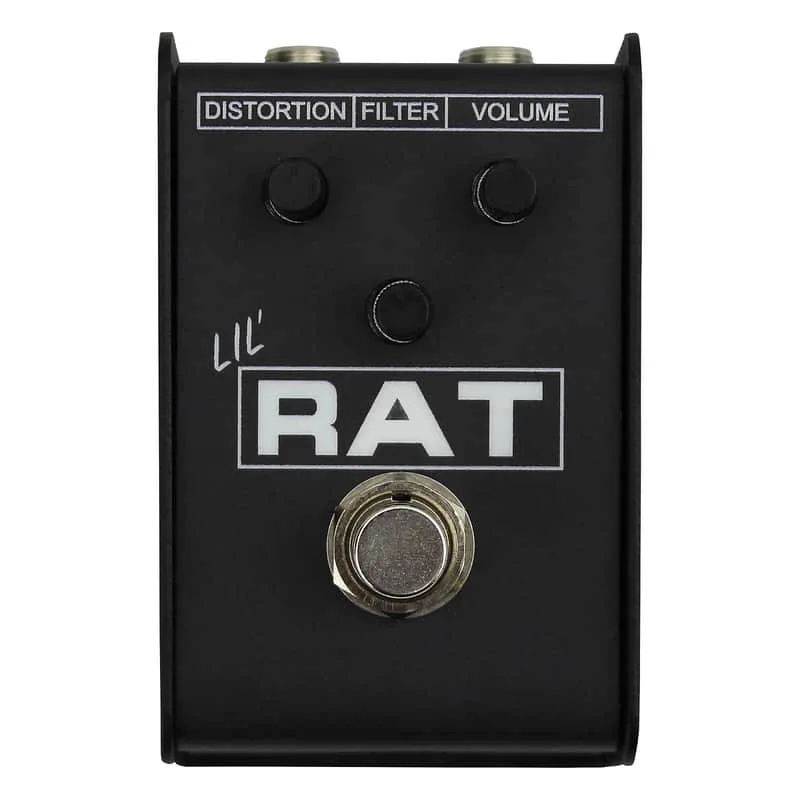
The battery compartment is a feature the SOLO shares with the RAT2. Pro Co removed it in the compact Lil' RAT, which otherwise uses the same diode and chipset as the RAT23.
What reviewers said
Published coverage of the SOLO is limited but positive. Pedal of the Day's 2015 review concluded that "the SOLO is a fun little pedal, and a welcome addition (sonically AND visually) to the pedal line from RAT Distortion"1. The independent technical community has engaged with the pedal mainly as a circuit, tracing its RAT lineage, documenting its clipping options and testing op-amp swaps2.
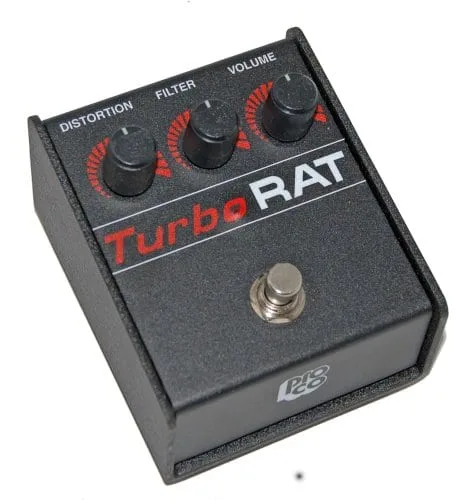
For a player choosing within the RAT family, the SOLO sits as the more flexible sibling: same analog distortion architecture and steel enclosure, plus the midrange Scoop control and three clipping voices that the RAT, RAT2 and Turbo RAT do not offer1.
Videos
fpe
fpe
Uma Sound IL
Questions
Is the Pro Co Solo the same as a RAT?
Not quite. It is built on the RAT circuit and housed in the same steel enclosure, but it departs from the RAT series in two ways: it adds a Scoop control that shifts the frequencies affected by the tone circuit, and it gives you three selectable clipping options instead of one. Technical analysts describe it as not all that different from a standard RAT underneath.
What op-amp does the Pro Co Solo use?
The Solo uses the LM308 op-amp, the chip associated with vintage RAT circuits. The OP07 is suggested as a substitute, and it is the IC that current RAT pedals use. Builders who have swapped chips report the LM741 and LM301 sound close to the LM308, while a TL071 is thinner and a CA3130 more aggressive and gainy.
Is the Pro Co Solo true bypass?
Yes. The Solo uses true-bypass switching, so when the pedal is off there is no coloration of your sound from the circuit. It also carries an on/off LED indicator so you can see its state on a dark stage.
What do the hot, melt and burn modes do?
They select between three pairs of clipping diodes in the distortion stage, producing asymmetrical clipping. Each pair clips the signal differently, which changes the character and amount of grit, from a crunchy overdrive feel at the gentler end to heavier distortion at the other.
Does the Pro Co RAT Distortion SOLO take a battery?
Yes. It has a no-tools-required battery compartment that takes a 9 volt battery, which is not included with the pedal. It also has an AC jack for the RPS-1 power supply, which is sold separately, so you can run it either way.
What does the Scoop knob do on the RAT Solo?
The Scoop knob is a mid-tone shaper. Technical analysis of the circuit suggests it shifts the frequencies affected by the tone control, letting you pull midrange out of the distorted signal or push it forward, and it interacts strongly with the Tone knob.
Sources (5)
- Pro Co RAT Distortion SOLO Overdrive/Distortion, Pedal of the Day, 2015-02-18
- Guitar FX Layouts: ProCo Solo, Guitar FX Layouts (tagboardeffects.blogspot.com), 2018-05-23
- Pro Co Lil' RAT Distortion Demo, Premier Guitar, 2023-04-16
- ProCo RAT2 Distortion, Delicious Audio, 2022-10-25
- Coda Effects, Coda Effects, 2016-01