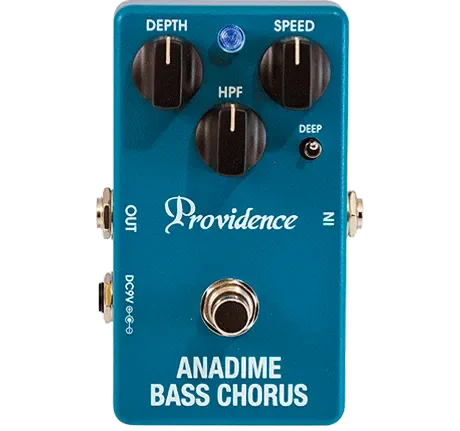


The Providence ABC-1 Anadime Bass Chorus is an analog chorus pedal built specifically for bass. Providence describes it as "an analog chorus specifically tuned for bass, using a BBD for the delay element"1. A bucket-brigade delay, or BBD, is the classic analog approach to chorus: the signal is passed along a chain of tiny capacitors, which delays it slightly, and that delayed copy is modulated and blended back against the dry signal to create the swirling, doubled sound chorus is known for.
The ABC-1 is based on the company's ADC-4 Anadime Chorus, a guitar chorus that also uses a BBD. According to Premier Guitar, the bass version "takes the best features of its predecessor"2. What sets it apart for bass players is a high-pass filter that keeps the fundamental low frequencies stable while the modulated sound does its work on top.
An analog chorus built around a bucket-brigade delay
Chorus works by splitting the signal: one copy stays dry, another is delayed by a few milliseconds and modulated in pitch, and the two are blended. In the ABC-1 that delay comes from a bucket-brigade device rather than a digital processor, which is what makes it an analog chorus. Providence says the same of the guitar-oriented ADC-4, calling it "an analog chorus effect that uses a BBD (Bucket Brigade Delay) device"31.
Premier Guitar's reviewer took the build seriously, citing its "rugged build, tidy form factor, and a bucket-brigade delay circuit"2, and described the pedal's construction in detail:
"The ABC-1 screams quality from the get-go from its powder-coat chassis to its heavy-duty footswitch and easy-access pointer knobs."
The pedal also carries Providence's D.C.G. circuit, which Premier Guitar describes as "a double-contact grounding mechanism that promises durability and improved sound"2. When the effect is off, the pedal uses Single Contact True Bypass, meaning the signal passes through only one switch contact, minimizing what sits in the signal path1.
The controls: speed, HPF and the deep switch
The ABC-1 has four controls: DEPTH, SPEED, HPF and DEEP1. A basic chorus pedal needs a rate control and a depth control, and those are the SPEED and DEPTH knobs here. The bright blue LED pulses at the tempo set by the speed control, so you can see the modulation rate as well as hear it, and it doubles as a battery indicator, dimming when the charge sags below 7 volts2.
| Control | What it does |
|---|---|
| DEPTH | Sets how deep the modulation goes1 |
| SPEED | Sets the rate of the chorus; the LED pulses at this tempo12 |
| HPF | High-pass filter controlling the chorus in the lower frequencies, keeping pitch stable in the low end even with a deep chorus applied1 |
| DEEP | 3-position switch providing variations in the perceived dimensional depth1 |
The HPF knob is the control that matters most to bass players. Providence explains that it "provides extra control over the chorus effect in the lower frequencies, allowing stable pitch to be maintained in the low-frequency range even when a deep chorus effect is applied"1. Premier Guitar's reviewer put it more plainly, calling it "a high-pass filter (HPF) knob that offers tremendous control over the low-end character"2. In practice, you can push the effect hard without the low end of the bass wobbling underneath.
The DEEP switch works by controlling the effect's delay response, and it provides three distinct settings2. Premier Guitar's reviewer mapped them out:
- Down position: presence and immediacy, as if plunged into the music
- Middle position: a more airy character
- High position: submerged and spacious2
How it differs from the ADC-4 Anadime Chorus
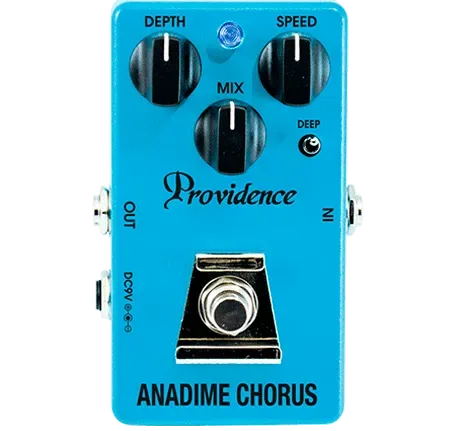
The ABC-1 grew directly out of the ADC-4 Anadime Chorus, Providence's analog guitar chorus. Both are analog BBD-based chorus pedals, but the control sets differ in one key way: the ADC-4 has DEPTH, SPEED, MIX and DEEP, while the ABC-1 replaces the MIX control with the HPF knob13. On the ADC-4, the MIX control "adjusts the mix ratio between the direct and modulated sound"3; on the bass version, Providence instead gives you a filter that manages where in the frequency range the modulated sound sits.
| ABC-1 Anadime Bass Chorus | ADC-4 Anadime Chorus | |
|---|---|---|
| Tuned for | Bass1 | Guitar |
| Circuit | Analog, BBD delay element1 | Analog, BBD device3 |
| Controls | DEPTH, SPEED, HPF, DEEP1 | DEPTH, SPEED, MIX, DEEP3 |
| Distinctive control | HPF for low-end stability1 | MIX for dry/wet balance3 |
Providence describes the Anadime sound as delivering "a spacious sense of width and depth as well as warmth and thickness that only an analog chorus can achieve"3, and Pedal of the Day found the ADC-4 produced "a warm, lush effect" with spacious sounds from a mono pedal4.
What reviewers said
Premier Guitar reviewed the ABC-1 at a street price of $2492. The reviewer's summary verdict:
"Solid build with an eye out for low-end preservation and projection."
That verdict lines up with the pedal's design brief: the HPF knob and the deep switch both exist to keep a bass sounding like a bass while the chorus runs on top of it. RockBoard's PedalPedia entry lists the pedal as a chorus effect running on 9V DC, center negative, and points to an English-language demo by BassTheWorld.com for players who want to hear it5.
Videos
BassTheWorld.com
MrExcane
Rodney McG
Questions
Is the Providence ABC-1 analog?
Yes. Providence describes the Anadime Bass Chorus as an analog chorus specifically tuned for bass, using a BBD (bucket-brigade delay) device as the delay element. Premier Guitar's review also identifies a bucket-brigade delay circuit at the heart of the pedal.
What does the HPF knob do on the ABC-1?
HPF stands for high-pass filter. Providence says it provides extra control over the chorus effect in the lower frequencies, allowing stable pitch to be maintained in the low-frequency range even when a deep chorus effect is applied. Premier Guitar's reviewer found it offers tremendous control over the low-end character.
What are the three deep-mode settings on the Anadime Bass Chorus?
The three-position DEEP switch varies the perceived dimensional depth by controlling the effect's delay response. In Premier Guitar's review, the down position gave the chorus presence and immediacy, the middle position sounded more airy, and the high position felt submerged and spacious.
Does the Providence ABC-1 run on a battery?
Yes. Providence lists power as a 9V battery or an AC adaptor, with power consumption of approximately 17mA at 9V DC with the effect on. Premier Guitar notes the LED doubles as a battery indicator, dimming when the charge sags below 7 volts.
What is the D.C.G. circuit in the ABC-1?
D.C.G. stands for double-contact grounding, a circuit Providence places in the pedal. Premier Guitar describes it as a double-contact grounding mechanism that promises durability and improved sound.
How is the ABC-1 different from the ADC-4 Anadime Chorus?
The ABC-1 is the bass version, based on the company's ADC-4 Anadime Chorus. The ABC-1 swaps the ADC-4's MIX control for an HPF knob that manages the low end, and it is tuned specifically for bass rather than guitar.
Sources (5)
- PROVIDENCE, Providence, 2026
- Providence ABC-1 Anadime Bass Chorus Review, Premier Guitar, 2014-09-16
- PROVIDENCE, Providence, 2026
- Providence Anadime ADC-4 Chorus, Pedal of the Day, 2017-05-05
- Anadime Bass Chorus ABC-1 by Providence, RockBoard PedalPedia, 2026