

The Radial Texas-Pro is a dual-function pedal that puts an overdrive circuit and a clean boost in one box. Radial Engineering describes it as a true-bypass, dual-function pedal with a versatile overdrive circuit and a Class-A power booster, and the two can be used independently or in combination for what the company calls a wide array of tonal options, from slight break-up on up1. It launched in March 2017 at $169.99 in the US2.
Radial states that the Texas-Pro has been discontinued and is no longer shipping1. It is a used-market pedal now.
What it is and what it does
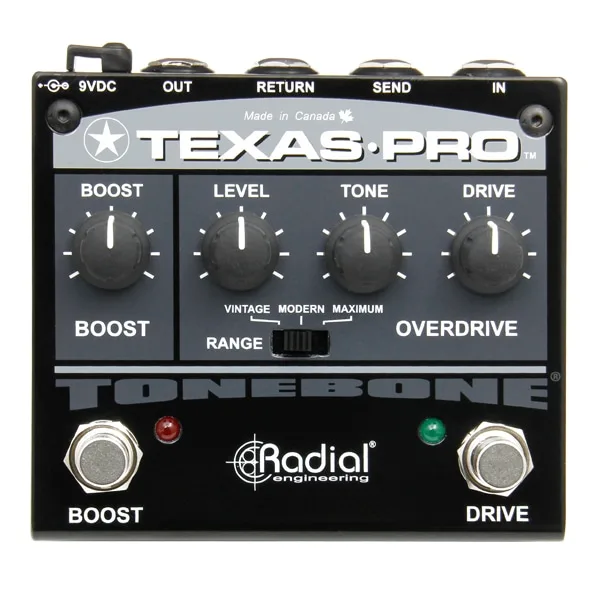
The Texas-Pro pairs two circuits. The overdrive side has Drive, Tone and Level controls plus a three-position Range switch that Radial says tailors the response to produce vintage, modern and high-gain overdrive tones15. The boost side is what Radial calls a variable Class-A power booster, 100% discrete, delivering up to +22dB of clean gain53. MusicRadar's launch coverage described it as "a boost circuit capable of delivering up to 22dB of extra gain"2.
Because the two sections work independently or together, a player can set a light overdrive for rhythm and bring the boost in for a solo, run the boost alone as a clean volume lift, or stack both for a bigger lead sound. Radial says the combination is what gives the pedal its range of tonal options1. Delicious Audio's write-up put it the same way: the overdrive and boost "can be used on their own or in combination, giving you a wide range of tonal options"6.
The pedal also carries Radial's Class-A buffer circuit, which MusicRadar noted at launch2.
The controls
| Control | What it does |
|---|---|
| Drive | Adjusts the overall amount of distortion introduced in the overdrive circuit3 |
| Tone | Shapes the overdrive's tone26 |
| Level | Sets the output volume level for the overdrive3 |
| Range | 3-position switch that tailors the overdrive output to suit your guitar and amp setup: vintage, modern or high-gain3 |
| Boost footswitch | Activates the power booster and the effects loop3 |
The Range switch is the main tonal shaper. Radial describes it as a way to match the overdrive to your guitar and amp, with the three positions moving from vintage through modern to high-gain responses15. Delicious Audio called out the same three-positions, noting the switch "tailors the response to produce vintage, modern, and high-gain overdrive tones"6. Drive, Tone and Level then fine-tune within whichever range you pick.
Power and connections
The Texas-Pro runs on a standard 9V DC power supply with a center-pin negative connector52. Radial's FAQ adds that the pedal should be given 9 to 12V and a minimum of 60mA of current4, so it fits a typical pedalboard supply as long as the output meets that draw.
Connections are straightforward: a standard 1/4" instrument input for your guitar, a 1/4" output to your amp, and a 1/4" send and return pair for the effects loop52.
The effects loop
The send and return jacks are for connecting other pedals, and the loop is activated by the Boost footswitch. Radial positions this as a way to add effects when soloing: whatever sits in the loop stays out of your sound until you step on the boost, and then it comes in along with the volume lift3. A delay pedal in the loop, for example, would appear only on boosted lead lines. Radial's spec sheet lists the loop as quarter-inch send and return jacks5.
Specifications
| Specification | Value |
|---|---|
| Gain (Boost) | Variable from 0dB to +22dB2 |
| Gain (Overdrive) | Variable from +2dB to +30dB5 |
| Audio circuit type | Class-A discrete5 |
| Maximum input | +20dBu5 |
| Noise floor | -85dBu5 |
| Input impedance | 220kΩ5 |
| Output impedance | 1kΩ5 |
| Frequency response | Shaped for guitar use5 |
| Size (L x W x D) | 4.25" x 4.06" x 2" (108mm x 103mm x 50mm)5 |
| Weight | 1.45lb (0.66kg)5 |
| Warranty | Radial 3-year, transferable5 |
Where it came from
Radial announced the Texas-Pro in early 2017. MusicRadar reported the launch on March 6, 2017, describing an overdrive and clean booster pedal with an effects loop and Class-A buffer, available at $169.992. Radial has since discontinued the Texas-Pro1.
Videos
ProGuitarShopDemos
SoundCorners
Questions
Is the Radial Texas-Pro discontinued?
Yes. Radial Engineering states that the Texas-Pro has been discontinued and is no longer shipping. It was launched in March 2017 at $169.99 in the US, so it remains available on the used market, but it is not a current product in Radial's line.
Is the Radial Texas-Pro true bypass?
Yes. Radial describes the Texas-Pro as a true-bypass pedal, and the company says the true-bypass switching is there to retain your tone when the pedal is off. Both the overdrive and the boost sections use true-bypass switching.
Can you use the boost and overdrive on the Texas-Pro at the same time?
Yes. Radial states that the overdrive and the power booster can be used independently or in combination, which the company says opens up a wide array of tonal options ranging from slight break-up to heavier sounds. Each section has its own footswitch.
How much boost does the Radial Texas-Pro give?
The Class-A power booster delivers up to +22dB of clean gain, variable from 0dB at the bottom of the control's range. Radial describes the booster as 100% discrete Class-A, with a variable level control for setting the amount.
What is the effects loop on the Radial Texas-Pro for?
The Texas-Pro has quarter-inch send and return jacks for connecting other pedals. The loop is activated by the Boost footswitch, so whatever you connect comes in only when you hit the boost, which Radial positions as a way to add effects when soloing.
What power supply does the Radial Texas-Pro need?
It runs on a standard 9V DC supply with a center-pin negative connector, drawing a minimum of 60mA. Radial's FAQ notes the pedal accepts 9 to 12V, so a typical pedalboard power supply works, but the current requirement should be met.
Sources (6)
- Texas-Pro, Radial Engineering, 2021-03-17
- Radial launches Texas-Pro overdrive and clean booster pedal, MusicRadar, 2017-03-06
- Texas-Pro Features, Radial Engineering, 2018-06-19
- Texas-Pro FAQ, Radial Engineering, 2018-06-11
- Texas-Pro Specifications, Radial Engineering, 2018-04-25
- Tonebone Texas-Pro Overdrive And Boost, Delicious Audio, 2017-08-28