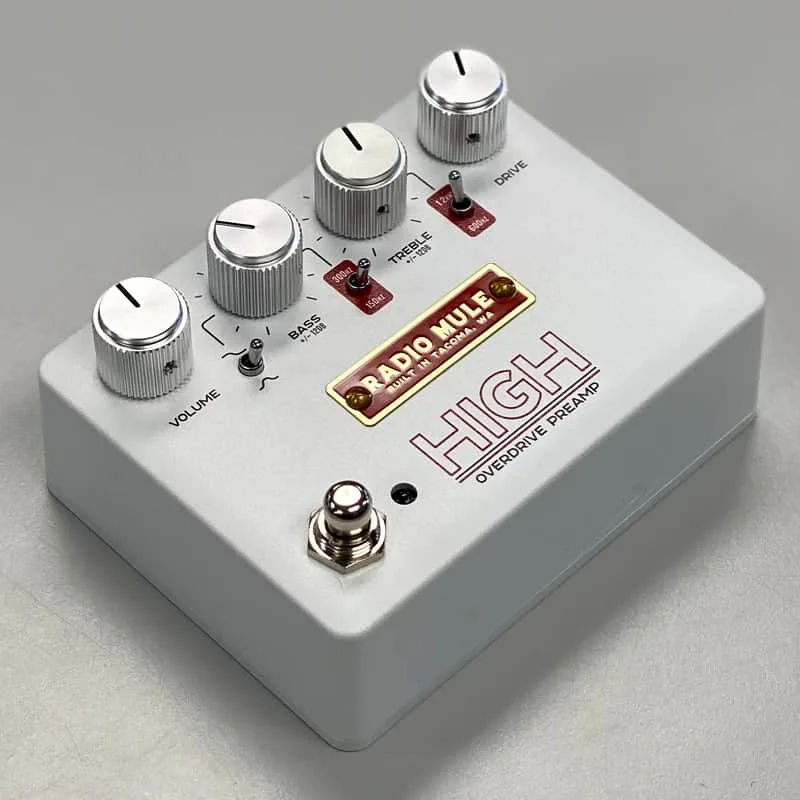


The Radio Mule HIGH Overdrive Preamp is a low-to-mid gain overdrive built as a preamp, aimed at players who want more control over their dirt than a standard overdrive pedal offers. Pedal of the Day, reviewing it in November 2021, describes it as combining internal voltage doubling, asymmetric diode clipping, a two-band active EQ and an active volume control, and says the design is inspired by hi-fi and studio preamp designs along with some of the most popular overdrive circuits in history1.
Controls
The HIGH gives you four main controls plus internal switches, which is where the preamp part of the name shows up: the EQ is active, meaning it can cut as well as boost, and the volume stage can lift your signal above unity1.
| Control | What it does |
|---|---|
| Drive | Increases gain to the clipping circuit, adding grit and compression1 |
| Treble | Active hi-shelf filter, boosts or attenuates high frequencies by up to 12 dB1 |
| Bass | Boosts or attenuates low frequencies by up to 12 dB1 |
| Volume | Active volume control, ranging from full attenuation to +15 dB of boost1 |
Two switches refine how the EQ works:
- Bass cutoff switch: sets the Bass control's cutoff frequency between 150 Hz and 300 Hz1
- Bass EQ shape switch: toggles the Bass control's EQ curve between a low-shelf filter, which boosts or cuts everything below the cutoff, and a peaking, bell-shaped filter1
The active EQ sets the HIGH apart from most drives in this gain range, which usually carry a single tone control. With separate hi-shelf Treble and Bass bands, each swinging up to 12 dB either way, the pedal can be tuned to sit in a mix or to correct for a bright or dark amp, and it puts the pedal closer to the territory of dedicated preamp pedals and equalization pedals than a typical boost pedal1.
Clipping and voltage doubling
The clipping is asymmetric diode clipping, where the signal's positive and negative halves are clipped by different amounts, a trait shared with several well-known overdrive designs. Internal voltage doubling runs the audio circuit at a higher voltage than the supply alone would give, which Pedal of the Day names as one of the four elements behind the pedal's approach to clarity and tone shaping1.
What reviewers said
Pedal of the Day's verdict was positive, particularly on how the pedal behaves alongside other drives. The reviewer wrote that the HIGH Overdrive Preamp sounds incredible on its own and plays well with others, for all day long stacking1.
For players who stack drives, that matters: a low-to-mid gain preamp with an active EQ can sit under a higher gain pedal, or push one, without the two circuits piling up into mud. If you are comparing it against simpler single-knob-tone drives, see our Boss SD-1 vs Ibanez TS9 Tube Screamer comparison for how the classic two-control format differs.
Videos
Radio Mule Effects
Radio Mule Effects
Radio Mule Effects
Questions
Is the Radio Mule HIGH Overdrive Preamp a boost or an overdrive?
It is both, in one box. Pedal of the Day describes it as a low-to-mid gain dirt pedal, so it can push an amp or add grit on its own, but it is also built as a preamp with an active volume control that ranges from full attenuation to +15 dB of boost. That volume stage lets it act as a clean-ish boost or level lift as well as a drive pedal.
What kind of clipping does the Radio Mule HIGH use?
The HIGH uses asymmetric diode clipping, the arrangement that clips the positive and negative halves of the waveform differently. Pedal of the Day lists it alongside internal voltage doubling and the two-band active EQ as the core of the circuit, and it is one of the traits the design borrows from popular overdrive circuits.
What does internal voltage doubling do in an overdrive pedal?
Internal voltage doubling raises the voltage the circuit works with beyond what the supply alone provides. In the HIGH, Pedal of the Day names it as one of the four design elements, combined with asymmetric diode clipping, a two-band active EQ and an active volume control, that shape the pedal's headroom and clarity.
Can the Radio Mule HIGH be stacked with other overdrive pedals?
Pedal of the Day's reviewer thought so. The review says the HIGH Overdrive Preamp sounds incredible on its own and plays well with others, for all day long stacking, meaning it can sit under or over another drive pedal in the chain without the two circuits fighting each other.
Sources (1)
- Radio Mule HIGH Overdrive Preamp, Pedal of the Day, 2021-11-06