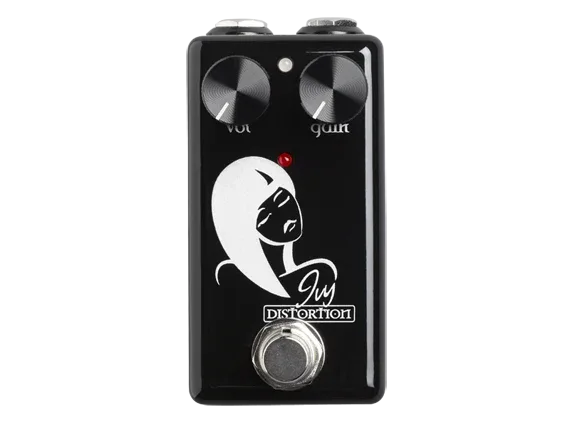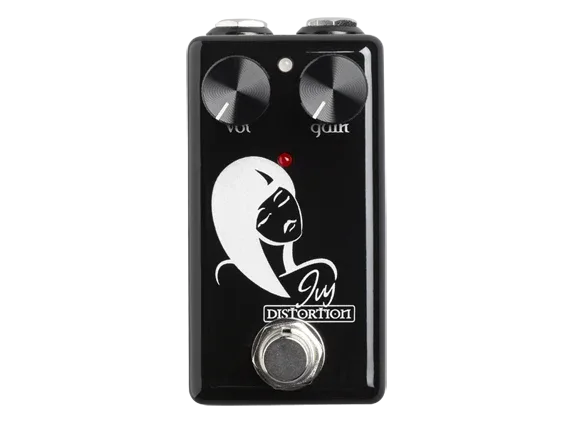


The Red Witch Seven Sisters Ivy Distortion is a high-gain distortion pedal, part of Red Witch Pedals' Seven Sisters series. Red Witch describes it as capable of recreating the saturated, amplifier distortion tones of artists such as Slayer and Metallica, and the maker's page calls it simply a "High Gain Distortion"1. When the Seven Sisters line debuted at NAMM in 2011, MusicRadar introduced Ivy as "A high-gain Metal priestess of the first order"2. The pedal is all analog, and it is currently listed as Sold Out on the maker's site13.
A mid-centric all-analog distortion
MusicRadar's review places the Seven Sisters among "all-analogue pedals"3. What sets the Ivy's voicing apart, according to Premier Guitar's review, is a mid-focused character: "Ivy's overall character is fairly mid-centric, and you'll hear small cuts in both bass and treble when you engage the effect"4. That means the pedal sits in the middle of the frequency range rather than scooping it, which is a different approach from many metal-oriented distortions that cut mids for a scooped sound.
Premier Guitar's reviewer found the pedal flexible in most settings, with a limit at the extremes: "Almost all of her configurations are highly usable, and only those that need really piercing high-end lead or a bloated" low end fall outside what it does well4. For a player, that reads as a distortion that covers a wide range of usable gain tones but is not voiced for either glassy treble-heavy leads or oversized low-end rhythm crunch.
The gain knob
The Ivy keeps things simple with two controls, and Red Witch's own descriptions of them are characteristically brief1:
Premier Guitar's review gives a more practical picture of how the Gain knob behaves across its travel. Around 9 o'clock, the reviewer found it gave guitars "a little more treble bite and clarity" suited to percussive rhythm playing, while pushing it past 12 o'clock produced a glassy lead tone4. With only Gain and Volume to set, dialing in a sound is a matter of finding the point on that one knob where the character suits the part.
Trim pot and layout
Unlike some of the other Seven Sisters pedals, the Ivy does not have an internal trim pot for a third adjustment, so everything the player can change is on the outside of the box4. The jack sockets are mounted on the top side of the pedal, which matters for pedalboard layout: top-mounted jacks let cables run upward rather than out the back, saving space on tight boards1.
Red Witch lists the Seven Sisters Ivy Distortion as Sold Out on its product page1. The maker also notes that all pedals in the series shipped with 100% recycled packaging1.
Videos
Red Witch Pedals
Red Witch Pedals
Guitar Mastery Method
Questions
Is the Red Witch Ivy Distortion all analog?
Yes. MusicRadar's review describes the Seven Sisters series, which Ivy belongs to, as all-analogue pedals. The Ivy is a high-gain distortion with no digital processing, and its controls are simply Gain and Volume.
How much does the Red Witch Ivy Distortion cost?
Red Witch Pedals lists the Seven Sisters Ivy Distortion at 119 USD on its product page. Premier Guitar's review gave a street price of $129, so the two figures differ slightly depending on where you look.
Does the Red Witch Ivy have an internal trim pot?
No. Premier Guitar notes that unlike some of the other Seven Sisters pedals, the Ivy does not have an internal trim pot for a third adjustment. Its only controls are the external Gain and Volume knobs.
Is the Red Witch Seven Sisters Ivy sold out?
Yes. Red Witch Pedals' own product page for the Seven Sisters Ivy Distortion lists it as Sold Out as of late October 2026.
Sources (4)
- Seven Sisters Ivy Distortion, Red Witch Pedals
- NAMM 2011: Red Witch debut Seven Sisters pedals, MusicRadar, 2011-01-17
- Red Witch Ivy Distortion review, MusicRadar, 2012-03-26
- Red Witch Lily, Grace & Ivy Pedals Review, Premier Guitar, 2011-12-27