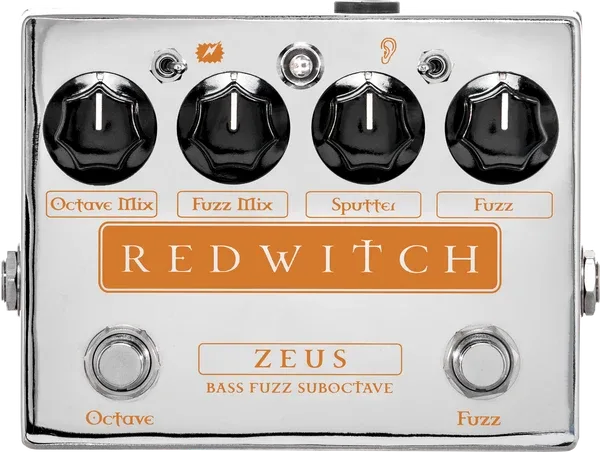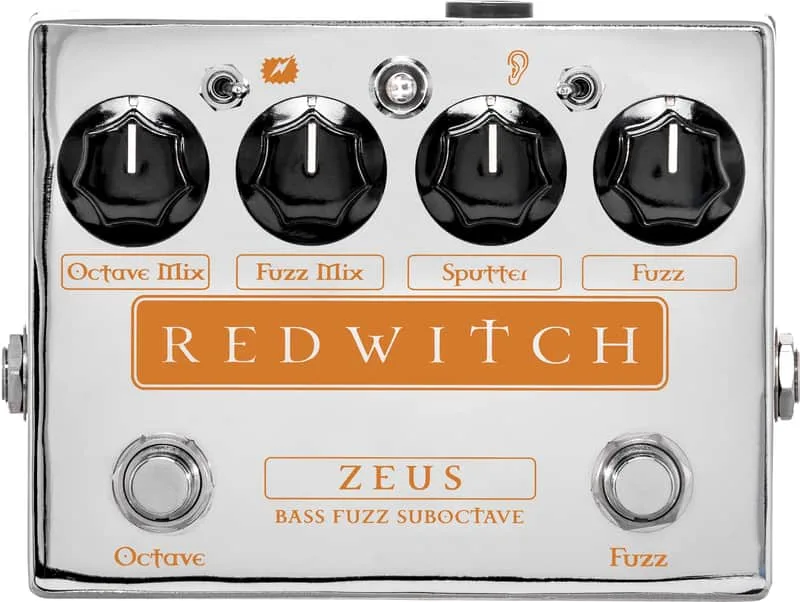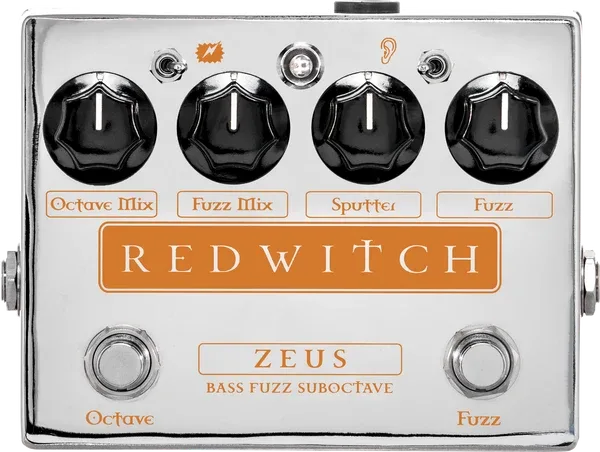


The Red Witch Zeus is a bass fuzz and suboctave pedal from Red Witch Pedals, a two-in-one box that puts a silicon fuzz and an analog suboctave under separate footswitches. You can run either effect on its own, or stack them for a fuzz tone with an octave below your note added underneath. Red Witch describes the pedal as "capable of generating anything from a distant rumble to an all out subterranean cataclysm"1.
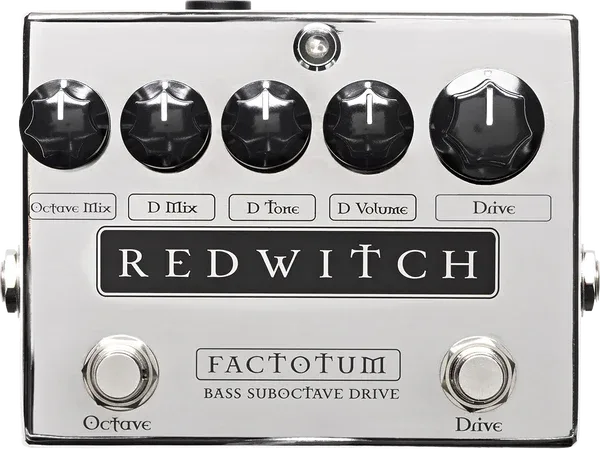
The Zeus arrived in 2015 as the second addition to Red Witch's bass pedal range, following the Factotum, and was designed by company founder Ben Fulton2. On Red Witch's product page it is currently listed as sold out1.
Two pedals in one: silicon fuzz and analog suboctave
The core idea of the Zeus is that the fuzz and the suboctave are independent. Each effect has its own true bypass stomp switch, so the left and right footswitches activate the Octave or Fuzz side respectively, and both can be engaged at the same time23. That makes it usable as a straight fuzz pedal, a straight octave pedal, or both together, without one effect dragging the other into the signal chain.
Both sections are analog. Red Witch bills the fuzz and the suboctave each as 100% analog2, and the maker's page emphasizes that the suboctave, "as a result of being analog rather than digital, has a fantastic, tactile springyness with extremely good tracking"1. MusicRadar's launch coverage called it "an all-analogue silicon fuzz with lower octave" and noted that "the suboctave utilises gnarly analogue tracking"4.
For bass players, the other headline feature is that the pedal keeps the low end intact. Red Witch's announcement promised "full frequency response" with no low-end roll off2, which matters because fuzz circuits adapted from guitar pedals often thin out the bottom end.
Controls and setup
The Zeus keeps its control set small, with two mix knobs doing most of the blending work and a couple of trimmers inside the case21.
| Control | What it does |
|---|---|
| Fuzz mix knob | Dials in how much of the fuzz effect is in the output4 |
| Octave mix knob | Dials in how much of the suboctave is in the output4 |
| Fuzz knob | Adjusts the tone; adds or takes away fuzz from the output, and works in conjunction with the instrument's volume knob43 |
| Internal fuzz master volume trimmer | Sets the master volume of the fuzz side2 |
| Internal octave master volume trimmer | Sets the master volume of the octave side2 |
The two mix controls let you dial in as little or as much of each effect as you want1, so the fuzz and octave can sit subtly under your clean tone or dominate it. Pedal of the Day's reviewers noted that the knobs "only come into play when the designated side is activated via the left or right footswitch, but you can use them both" at once3. The Fuzz control also interacts with your bass's volume knob, the classic fuzz behavior where rolling back the instrument's volume cleans the effect up3.
The internal trimmers mean the overall level of each side is set once with a screwdriver rather than from the top of the pedal, keeping the external panel to the mix and fuzz controls24.
Where the circuit came from
The fuzz side is not a vintage fuzz clone. It is a silicon fuzz built from Red Witch's own earlier design, comprising key features of the Fuzz God II12. MusicRadar described the fuzz side as serving up "features culled from the Fuzz God II"4. The pedal itself was the second in the company's bass range, which MusicRadar noted "building on the success of Red Witch's Factotum"4.
What reviewers said
Pedal of the Day reviewed the Zeus in December 2015 and was positive about its range, concluding:
"you'll be hard-pressed to find a more versatile, accessible and sonically pleasing octave pedal out there"3
Pedal of the Day, 20153
The same review highlighted the independent analog fuzz and suboctave sections and the true bypass switching as the pedal's working strengths3.
Power and practical details
The Zeus draws 43mA1, low enough for most isolated power supplies but worth noting if you run a very small unit. It measures 118mm x 38mm x 94mm and weighs 385 grams1. Red Witch ships all of its pedals in 100% recycled packaging1.
The Zeus is listed as sold out on Red Witch's product page as of October 20261. Players looking for one may need to search the secondhand market.
Videos
Premier Guitar
Red Witch Pedals
Red Witch Pedals
Questions
Can you use the fuzz and suboctave on the Red Witch Zeus separately?
Yes. The Zeus has two footswitches, one for the fuzz side and one for the octave side, and each effect has its own true bypass stomp switch. You can run either effect on its own, or engage both at the same time, and the two mix knobs let you set how much of each effect is in the output.
Is the Red Witch Zeus true bypass?
Yes. Red Witch lists true bypass switching for the Zeus, and each of the two effects has its own true bypass stomp switch, so an unused side is out of the signal path entirely.
Is the Zeus suboctave analog or digital?
It is analog. Red Witch describes the suboctave as analog rather than digital, with what the maker calls a tactile springiness and extremely good tracking. The fuzz section is also 100% analog, making the whole pedal an analog design.
How much current does the Red Witch Zeus draw?
Red Witch lists the Zeus current draw as 43mA. That is modest by modern standards, but it is worth checking against a small power supply's per-output limit before building it into a board.
What circuit is the Zeus fuzz based on?
The fuzz side is a silicon fuzz built from key features of Red Witch's earlier Fuzz God II pedal. It is not a copy of a vintage fuzz circuit; it draws on the company's own previous design, adapted for bass.
Sources (4)
- Zeus - Bass Fuzz Suboctave - Red Witch Pedals, Red Witch Pedals
- Red Witch Unveils the Zeus Bass Fuzz Suboctave, Premier Guitar, 2015-10-01
- Red Witch Pedals Zeus Bass Fuzz Suboctave, Pedal of the Day, 2015-12-06
- Red Witch launches Zeus Bass Fuzz and Suboctave pedal, MusicRadar, 2015-09-30