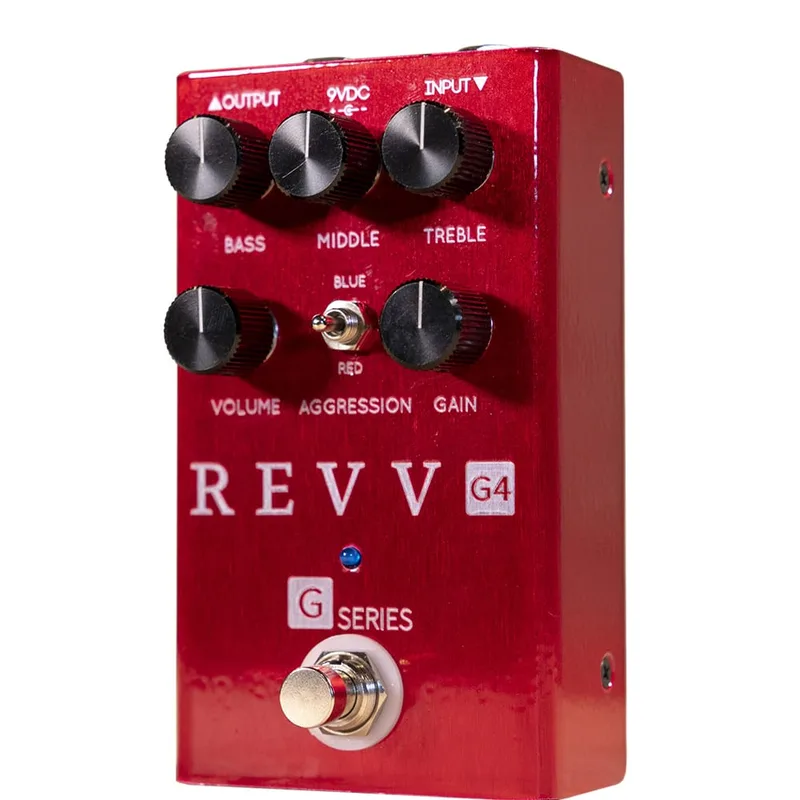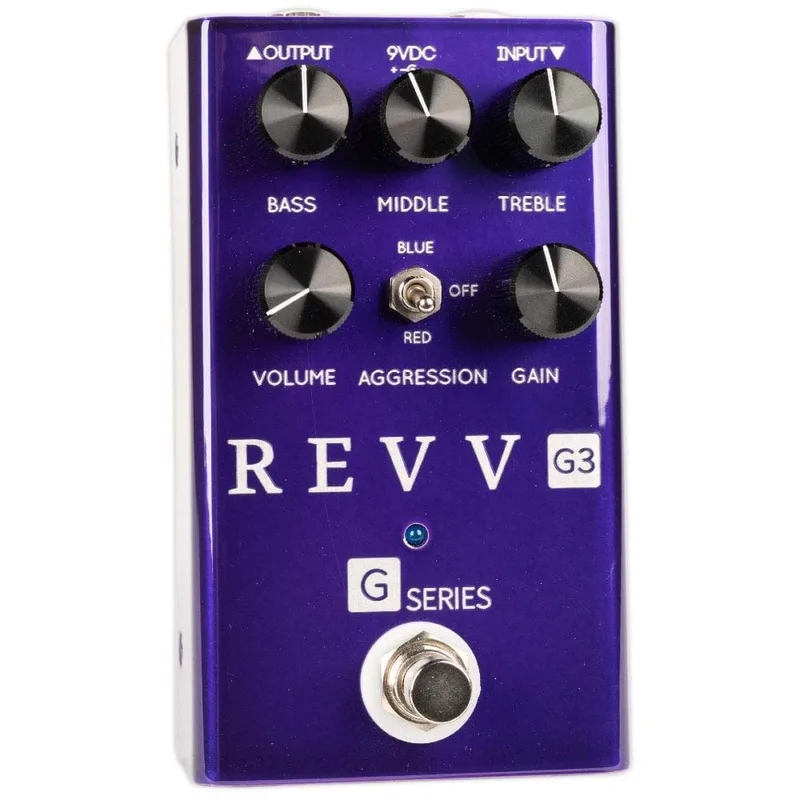


The REVV G3 is a high-gain distortion pedal from REVV, the Canadian amp builder whose G-Series pedals (the G2, G3 and G4) put the channels of its Generator amplifiers into stompbox form1. The G3 is the pedal version of the Purple channel: REVV describes it as an organic "amp-in-a-box" pedal based on the G120's Purple channel, delivering aggressive, tight-midrange, high-gain tones with what the maker calls amazing clarity2. Guitar.com's Michael Watts put it more directly in his 2018 review: the G3 is directly inspired by the Purple channel on the Revv 120 and 100 amps, "only this time in transistor form"3.
The pedal launched in spring 2018 and quickly found an audience among pedal videographers4. Delicious Audio calls the G3 a tight and clear distortion pedal, presented as the third channel of the Generator 100 amplifier5, and Pedal of the Day notes it went through over 16 circuit revisions before release6. A V2 with circuit updates arrived in May 20255.
The Purple channel in a pedal
The G3 exists because REVV's Purple channel had a reputation of its own. Delicious Audio calls Purple Channel 3 "one of the most unique tones in modern amps. Extremely tight & clear with the right amount of saturation for any situation"5. The pedal translates that channel into a box that works in several places in a rig: REVV says it sounds great in front of an amp or in the FX loop as a preamp7, and the V2 page adds that it is built for any workflow, including direct-to-console work and power amp integration, not just the front of an amp7.
In Sweetwater's demo video, Don Carr ran it into the front end of a clean amp at roughly unity gain, and noted the output level is high enough to drive the return of an amp's effects loop, bypassing the preamp entirely, or to pair with a modeler8. Smart filtering circuitry keeps the lows tight and the high end present, with no low-end muddiness or shrill highs65.
The controls
The control set is straightforward: a three-band EQ up top (Bass, Middle and Treble), then Volume, the Aggression switch and Gain1. Guitar.com's hardware list matches: bass, middle, treble, volume and gain knobs plus a three-way Aggression mini toggle1.
| Control | What it does |
|---|---|
| Gain | Range runs from slight boost to dirty and gritty when maxed out6 |
| Volume | Sets output level, with plenty of output on tap6 |
| Bass / Middle / Treble | Three-band EQ; really wide ranging with lots of boost and cut on tap9 |
| Aggression | Three-position toggle: Blue I / Off / Red II1 |
In Pete Thorn's demo video for the channel, he highlighted the EQ's range: "we've got a three band EQ here that's really really wide ranging so base middle and treble with lots of boost and cut uh on tap so you can really dial it in for different sounds"9. He also noted the volume on tap, saying you can boost into the front end of an amp with it9.
The Aggression switch: off, blue and red
The Aggression toggle is the G3's signature control. REVV says the three-position toggle physically alters the pedal's internal compression, saturation and low-end response, giving you three distinct amplifier channels in a single enclosure7. Delicious Audio describes the Blue and Red modes as delivering a slightly different character in the mids, with red the most aggressive and off the least105.
| Position | Character |
|---|---|
| Off | Gain is low and smooth6 |
| Blue I | Gain tightens and becomes defined111; more saturation111 |
| Red II | Most saturation1119; gobs of sustain and oodles of gain9 |
Pete Thorn found the red position the most saturated: "there's just gobs of sustain and oodles and oodles of gain when it's in that position"9. Guitar Pedal X notes that the G3 and its sibling the G4 are very much high gain metal pedals, although their 3-way Aggression switches along with 3-band EQ yield a wide range of tonal possibilities12.
What reviewers said
Reviewers have been consistent about the G3's strengths and honest about its limits. GuitarPlayer's buying guide calls it a pedal that "delivers a sucker punch of gain, making this ideal for players looking for metal distortion," rating it four stars, and praises the onboard three-band EQ for making dialing in a tone easy while the aggression modes shape the character of the gain13. Pedal of the Day found it versatile beyond metal: "Metal, classic rock, fusion and more are easily achievable here, without much coaxing or time spent"6.
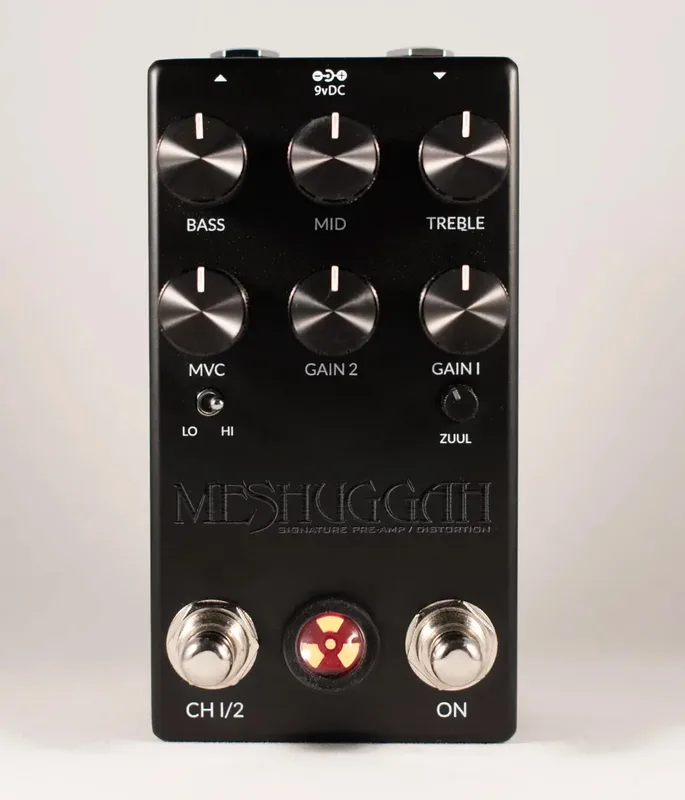
On the critical side, Delicious Audio's buying guide lists "doesn't do clean" among the cons10. Guitar Pedal X's Stefan Karlsson, comparing it with the Fortin Meshuggah, wrote that the G3 "does produce a fantastic sound also - but not quite as 'Metal' and high octane as the Fortin," while noting that many players looking for the ultimate tight metal pedal would advocate the G31. In the site's 2024 high-gain roundup he called it "still many players favourite High Gain Metal Distortion Pedal," particularly for the more modern side of contemporary percussive metal14.
"A genuine improvement over its predecessor - this one is even tighter and more focused now"
That same review adds the caveat that the V2 "sounds really good, but is somewhat out-muscled by the Fortin equivalent"11. Delicious Audio also notes that Ryan from 60 Cycle Hum and Ola Englund have been particularly enthusiastic about the pedal in their demos5.
Pete Thorn's demo walks through the controls and solos guitar parts so you can hear each knob's effect:
Sweetwater's demo with Don Carr shows the pedal with a Strat into a Fender Deluxe reissue, covering unity-gain use and running it into an effects loop return:
Versions and editions
The G3's history breaks into a few distinct versions:
- Original G3 (2018): The spring 2018 release, based on the Purple channel of the Generator 120 and 100P amplifiers64.
- Anniversary edition (2024): A black edition with textural graphics, released in 20245.
- G3 V2 (May 2025): Circuit updates over V1 that Delicious Audio says make it sound more open and amp-like, with a wider tone range also usable for lead parts5.
- Anniversary editions (2025): Mostly black editions carrying the exact same V2 circuit, offered at a discount of £169 versus £219 for the Full Color Editions1. Guitar Pedal X found the updated G3 punchier, more cutting, tighter and a notch or two louder than the previous version, and the more appealing of the two G-Series pedals115.
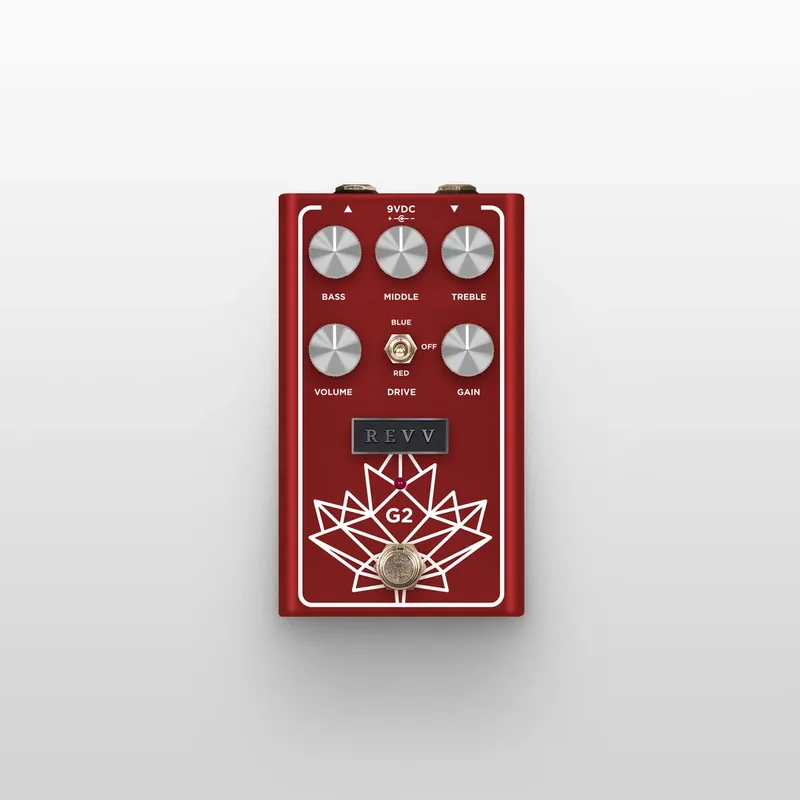
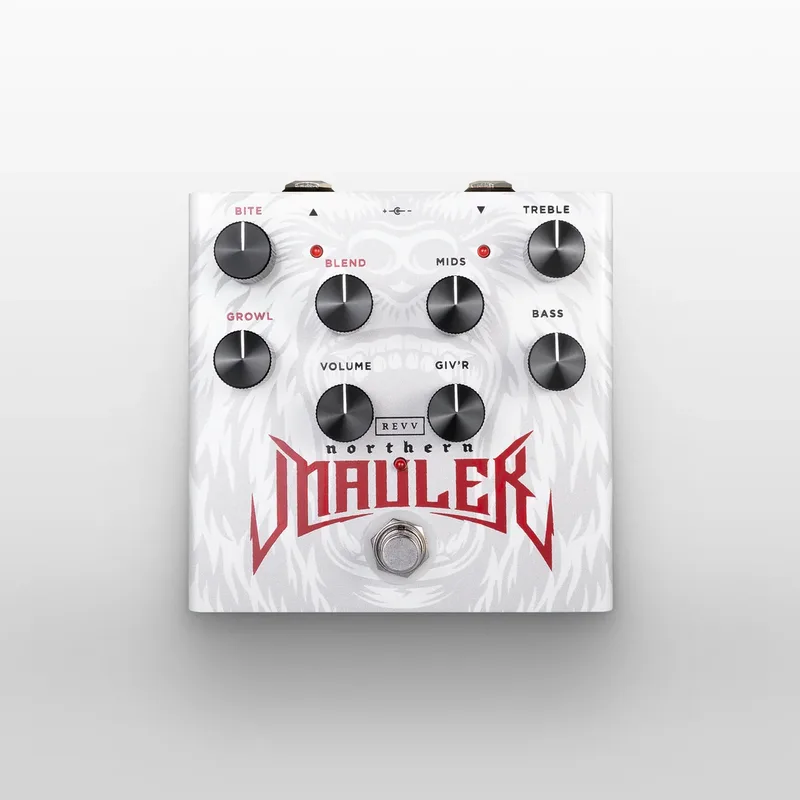
Pricing has held steady across the line: the G-Series pedals are typically $229 on the REVV webstore and £219 at Andertons and Thomann1, with the 2025 Anniversary Edition listed at $22911 and briefly discounted to $19415. The G3 sits between the G2 Crunchy Drive, based on the Green channel, and the thicker, fatter G4 based on the Red channel14, and REVV has since extended the family with pedals like the Northern Mauler.
The G3 V2 runs on a 9V center negative external supply only, with no battery option7. At 14mA it is light on power, so a standard pedalboard supply handles it easily2.
Videos
Questions
Can the REVV G3 do clean tones?
No. Delicious Audio's buying guide lists "doesn't do clean" among the pedal's cons, and the G3 is aimed squarely at high-gain distortion. With the Aggression switch off the gain is low and smooth, but it is still a drive pedal rather than a clean platform. Players who need clean boost and active EQ from the same family would look at the G2, whose Off position removes the clipping diodes entirely.
Where is the REVV G3 made?
Canada. REVV states the G3 V2 is manufactured in Canada with a two year limited warranty upon registration, and Delicious Audio describes the original G3 as built by hand in Canada, calling it a truly boutique pedal. Guitar.com's 2018 review also lists the pedal as made in Canada.
What changed in the REVV G3 V2?
The V2, released in May 2025, carries circuit updates over the original. Delicious Audio reports the changes make it sound more open and amp-like, with a wider tone range that is also usable for lead parts. Guitar Pedal X found the updated version punchier, more cutting, tighter and a notch or two louder than the previous one.
Does the REVV G3 run on 9V?
Yes. REVV specifies 9V DC power at 14mA for the G3 V2, center negative, and the original ran on standard 9V power as well. It is an external supply only, so there is no battery option, but the low current draw makes it easy to run from a typical pedalboard power supply.
How much does the REVV G3 cost?
The G-Series pedals, including the G3, are typically $229 on the REVV Amps webstore, with UK pricing around £219 at Andertons and Thomann. Guitar Pedal X reported the Anniversary Edition discounted to $194 in late 2025, and an earlier mostly black Anniversary edition sold at £169 against £219 for the full color editions.
Does the Revv G3 V2 take a battery?
No. REVV specifies a 9V center negative external supply only, with no battery operation. At 14mA it draws little power, so a standard isolated pedalboard supply or a daisy chain with adequate headroom will run it without trouble.
Sources (15)
- Guitar Pedal X, Guitar Pedal X, 2025-09-19
- Revv G3 V2, Revv Amplification
- Revv Amplification G3 Distortion Pedal Review, Guitar.com, 2018-12-21
- REVV G4 Distortion, Delicious Audio, 2024-11-21
- Updated Pedal: REVV G3 Distortion V2, Delicious Audio, 2025-05-28
- Revv Amplification G3 Overdrive Distortion, Pedal of the Day, 2021-09-29
- G3 V2 | Clear & Precise Distortion Tones - Revv Amplification, Revv Amplification
- Revv G3 Distortion Pedal Review, Sweetwater, 2018-08-31
- REVV G3 DISTORTION demo by Pete Thorn, Pete Thorn (YouTube channel), 2018-09-06
- 2024 UPDATE! The Best Distortion Pedals, Delicious Audio, 2024-05-03
- Guitar Pedal X, Guitar Pedal X, 2025-12-05
- Guitar Pedal X, Guitar Pedal X, 2019-06-13
- Best distortion pedals: dirty up your tone, GuitarPlayer (www.guitarplayer.com), 2022-08-26
- Guitar Pedal X, Guitar Pedal X, 2024-06-19
- Guitar Pedal X, Guitar Pedal X, 2025-11-27