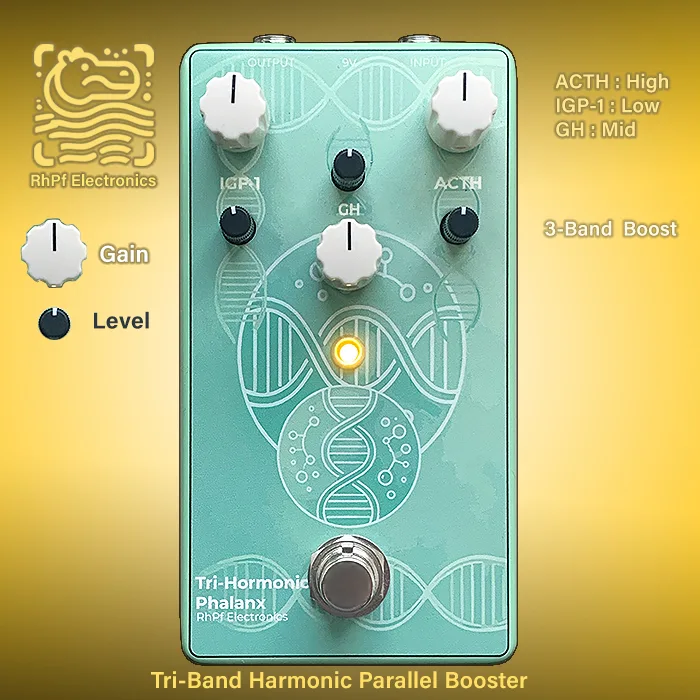


The RhPf Electronics Tri-Harmonic Phalanx is a boost / overdrive / fuzz pedal built around three MOSFET gain stages, one each for the Low, Mid and High frequency bands, running in parallel. Instead of one gain knob shaping the whole signal, you set how hard each band saturates and how much of each stage is blended back, which is what lets it cover everything from a clean harmonic boost to a full fuzz1.
What it does and how it is controlled
Each of the three bands has a gain control and a mini level control. The gain controls are named after guitar models, a RhPf habit, and each band is centered on a fixed frequency1:
| Band | Gain control | Center frequency | Level control |
|---|---|---|---|
| Low | IGF-1 Low Band Gain | c. 200Hz | Mini Low Band Gain Level |
| Mid | GH Mid Band Gain | c. 632Hz | Mini Mid Band Gain Level |
| High | ACTH High Band Gain | c. 4kHz | Mini High Band Gain Level |
Because the stages run in parallel rather than in series, each band saturates on its own slice of the signal and the three are then combined. Guitar Pedal X's Stefan Karlsson found that balancing six controls is fiddly, but that it delivers precise harmonic textures from Boost to Fuzz1. As a starting point, his review gives one suggested setting, the "Everyday Harmonic Drive": Low Band Gain at 11 o'clock with its level at 2 o'clock, Mid Band Gain at 10 o'clock with its level at noon, and High Band Gain at 2 o'clock with its level at noon1.
Where it came from
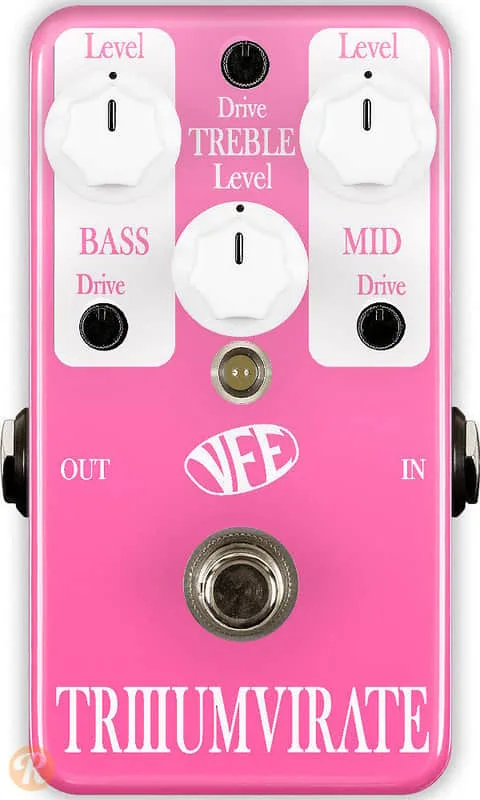
The design recalls the VFE Triumvirate Multi-Band Distortion, which Karlsson describes as the first device he encountered that split the incoming signal into three different frequency band gain stages that you could adjust and combine in parallel1. The difference is the gain device: where the Triumvirate used op-amp ICs, the TLE2074 quad amp with two per build, the Phalanx uses MOSFET gain stages3. The Triumvirate's build documentation, published through Madbean Pedals, also records that the final version of that circuit added a 10uF BiPolar cap in series with R4 to prevent DC offset on the TLE2074 being amplified through the bass section3.
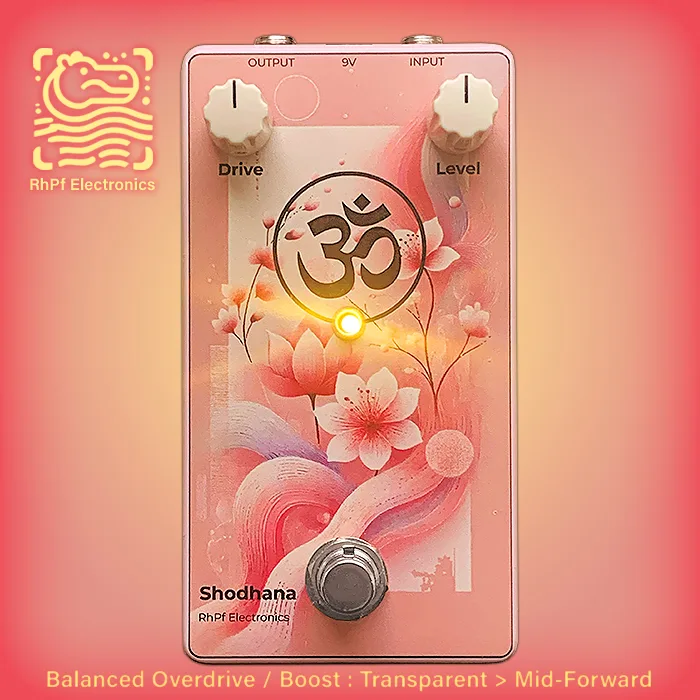
Thomas @ RhPf has built a small family of MOSFET-based drives. The Mosphoros overdrive is another, which Karlsson reviewed as a touch-sensitive, dynamic MOSFET design4, and the two-knob Shodhana balanced overdrive sits elsewhere in the range. For simpler takes on gain staging, see the site's pages on Boost Pedals, Overdrive Pedals, Distortion Pedals and Fuzz Pedals.
What reviewers said
In his September 2025 review, Karlsson summed up the trade-off this way:
"Balancing six controls is fiddly, but delivers precise harmonic textures from Boost to Fuzz."
In Guitar Pedal X's December 2025 roundup of the year's boost and overdrive pedals, the verdict was warmer still:
"RhPf's most versatile Overdrive / Distortion / Fuzz - capable of the best tones, but can be a little tricky to dial in."
The same roundup named it Karlsson's own favorite sounding of the RhPf drives overall2.
Videos
RhpF Electronics
Philip Czarnecki and RhpF Electronics
Questions
Who designed the RhPf Tri-Harmonic Phalanx?
The pedal was designed by Thomas of RhPf Electronics. Guitar Pedal X's Stefan Karlsson, who has reviewed several of the builder's pedals, describes Thomas as a master of MOSFET gain stages and counts the Phalanx among his MOSFET-based designs, alongside the Mosphoros overdrive.
What are the center frequencies of the three bands?
The three gain stages are centered at approximately 200Hz for the Low band (the IGF-1 control), approximately 632Hz for the Mid band (the GH control), and approximately 4kHz for the High band (the ACTH control). Each band also has its own mini level control to set how much of that stage is blended into the output.
Is the Tri-Harmonic Phalanx a fuzz or an overdrive?
It is all three. Guitar Pedal X describes it as a Boost / Overdrive / Fuzz, and in a later roundup called it RhPf's most versatile overdrive, distortion and fuzz pedal, capable of the best tones of the builder's drives, though it can be a little tricky to dial in. Where it lands depends on how hard you push each band's gain control.
How does the Tri-Harmonic Phalanx differ from the VFE Triumvirate?
Both split the guitar signal into three adjustable frequency-band gain stages combined in parallel. The difference is the gain device: the Triumvirate used op-amp ICs, the TLE2074 quad amp, two per build, while the Phalanx uses MOSFET gain stages for each band.
How much does the RhPf Tri-Harmonic Phalanx cost in the US?
Guitar Pedal X priced it at $190 on the RhPf webstore in September 2025. In a December 2025 roundup of the year's boost and overdrive pedals, the same publication listed it at $179.
Sources (4)
- Guitar Pedal X, Guitar Pedal X, 2025-09-23
- Guitar Pedal X, Guitar Pedal X, 2025-12-04
- Microsoft Word, Madbean Pedals, 2019
- Guitar Pedal X, Guitar Pedal X, 2026-03-05