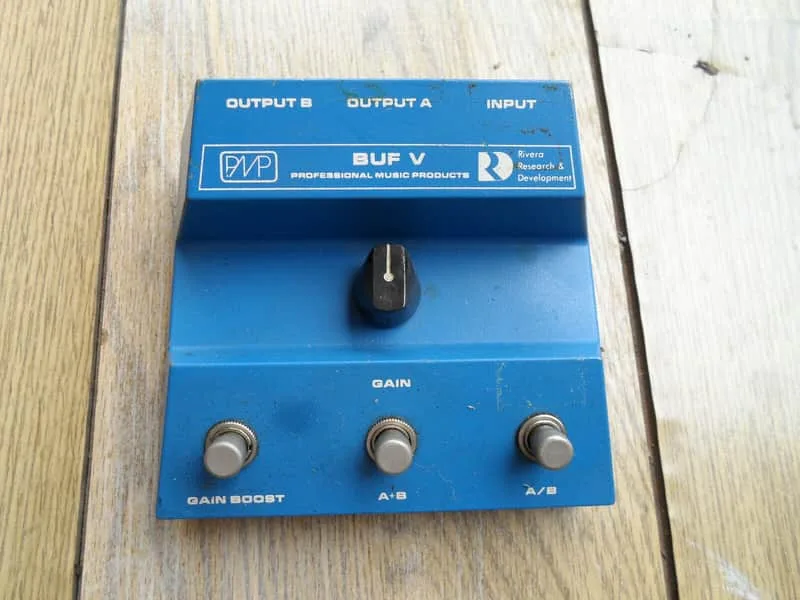
The Rivera Buf V is a buffer and clean boost pedal from Rivera, a design that dates back to the 70s or 80s, with most sources placing it in the 80s. It puts three functions in one box: buffer, booster and looper. As the Guitar FX Layouts analysis puts it, "Paul Rivera was quite a precursor by offering all three functions into one pedal"1. The circuit came to market in several disguises: the PMP buffer E945, the PMG buffer E945, and the Rivera Buf IV and V1.
A buffer and clean boost on one op-amp
The circuit is very simple: a single op-amp takes care of both the buffering and the boosting duties, while the loop sits after the buffer and booster1. The design runs an internal symmetrical supply of +/-12 volts, and the analysis describes the result as "the amount of ultra-clean boost is quite staggering with an internal symmetrical supply of +/-12 volts"1. For a player, that means headroom for a loud, clean volume lift rather than any added color.
Switching and the gain knob
What sets the design apart from a straightforward booster is its switching. The analysis describes it as "somewhat similar to a Microamp, but with clever switching which effectively turned the booster into a buffer for bypass"1. In bypass mode, the inverting input and output of the op-amp are linked by the switch, which makes the pedal a unity gain buffer rather than a hard-wired true bypass path1.
The gain control works with that switching:
- A 250K gain pot sets the boost gain level and is linked to the bypass switch1
- When the pedal is switched on, the link is removed, putting the 250K pot back in circuit1
- With the pot back in circuit, the pedal becomes a booster with the pot setting the boost level1
- In bypass, the op-amp is instead linked as a unity gain buffer1
The original unit also included A/B switching at the output and a simple loop, so the published stripboard layout includes a simple A/B wiring configuration to reproduce that switching1.
Versions and op-amp swaps
The same circuit appeared under several names, as noted above: PMP buffer E945, PMG buffer E945, and the Rivera Buf IV and V1. The original op-amp is an LF351. A builder who verified the layout reported good results with a substitution: "I have had a very good result putting in a JRC741D, instead of the original LF351. The sound was simply fuller, also richer in harmonics"1.
The Rivera Buf V is an older design: it dates back to the 70s or 80s, with most sources placing it in the 80s1. A builder who put the circuit together verified it working and called it a "simple nice clean booster with plenty of volume on tap"1.
Questions
Is the Rivera Buf V true bypass?
No. According to the technical analysis published on Guitar FX Layouts, when the pedal is in bypass mode the inverting input and output of the op-amp are linked by the switch, which turns the circuit into a unity gain buffer. So instead of true bypass, the pedal keeps acting as a buffer when switched off, which is why the design is described as clever switching that effectively turned the booster into a buffer for bypass.
How is the Rivera Buf V different from a MicroAmp?
The Guitar FX Layouts analysis describes the circuit as somewhat similar to a MicroAmp, but with clever switching that effectively turned the booster into a buffer for bypass. In bypass the op-amp becomes a unity gain buffer rather than passing the signal through a mechanical bypass path, and the original unit also added A/B switching at the output and a simple loop.
What does the gain knob on the Rivera Buf V do?
The 250K gain pot sets the boost gain level and is linked to the bypass switch. When the pedal is switched on, the link is removed, which puts the 250K pot back in circuit and makes the pedal a booster with the pot setting the amount of boost. In bypass, the op-amp is instead linked as a unity gain buffer.
Does the Rivera Buf V have an effects loop?
Yes, on the original unit. The Guitar FX Layouts write-up notes that the original included A/B switching at the output and a simple loop, alongside the buffer and boost functions. The stripboard layout published on the site includes a simple A/B wiring configuration to reproduce that switching.
What op-amp does the Rivera Buf V use?
The original circuit uses an LF351 op-amp, according to the Guitar FX Layouts analysis. A builder who verified the layout reported a very good result substituting a JRC741D for the original LF351, saying the sound was simply fuller and also richer in harmonics.
Sources (1)
- Guitar FX Layouts: Rivera Buf V, tagboardeffects.blogspot.com (Guitar FX Layouts), 2014-02-19