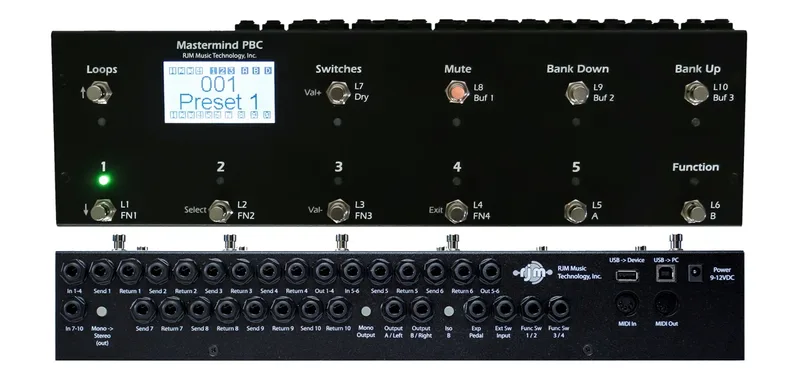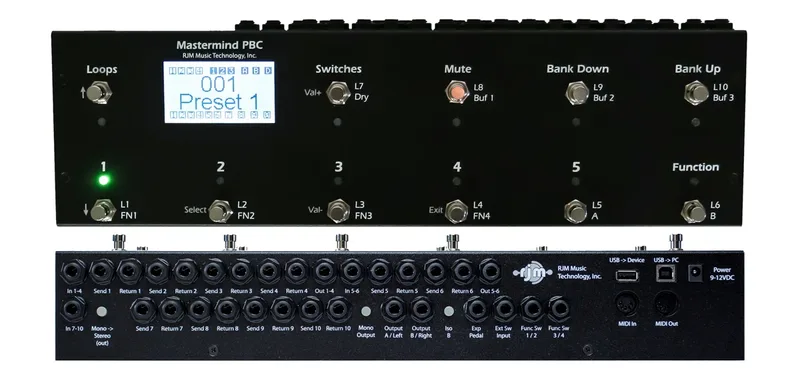


The RJM Mastermind PBC/10 is a switching unit designed for use on a pedalboard, built around ten true bypass audio loops and a full MIDI controller. RJM Music describes it as designed for players who have outgrown traditional switchers and need a central brain for their entire system: one button press can activate audio loops, control amps and send multiple MIDI commands12.
The Mastermind PBC/10 is RJM Music's first switching unit designed for use on a pedalboard, built to get the most out of pedalboards by combining audio loop switching, buffering and MIDI control in one unit3. It carries a sale price of £948.00 GBP as listed by the maker3. The last four of its loops are stereo capable using TRS jacks, and each of those four loops can be switched between series and parallel routing using an internal line mixer12.
What the PBC/10 does
The unit combines analog loop switching and MIDI control. Its ten audio loops are arranged in a group of four loops, a group of two loops and another group of four loops, with insert points in between the groups13. All loops are true bypass and relay switched, which RJM describes as being "for maximum transparency"1. The Mastermind PBC uses relays to perform its switching, as MusicPlayers.com's reviewer noted in the original PBC review4.
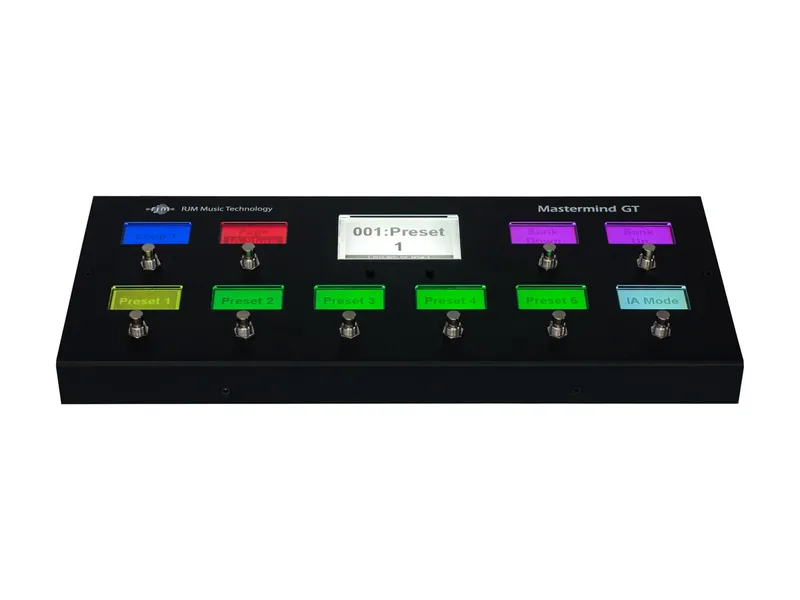
On the MIDI side, the PBC/10 can control up to 16 MIDI devices, and 20 MIDI messages can be assigned per button, including PC, CC, Note and Sysex messages1. The MIDI section is powered by the MIDI "brain" of RJM's Mastermind GT controller3. A single button press can activate audio loops, control amps and send multiple MIDI commands2.
The loops, buffers and outputs
The loop layout gives a player three groups to organize effects around, with insert points between them for volume pedals or other always-in-line gear13. The last four loops, loops 7 to 10, are stereo capable using TRS jacks, and each of those four loops can be switched between series and parallel routing using an internal line mixer13.
| Feature | Detail |
|---|---|
| Loop count | 10 audio loops1 |
| Layout | Group of 4, group of 2, group of 4, with insert points between1 |
| Stereo loops | Last four, using TRS jacks1 |
| Routing | Last four loops switchable series or parallel via internal line mixer1 |
| Buffers | Three, before loop 1, before loop 7 and after loop 103 |
| Click Stopper | Noise reduction circuit, switchable before loop 7 or after loop 101 |
Three audio buffers sit in the signal path, one before loop 1, one before loop 7 and one after loop 10, and each can be enabled or disabled by an IA (instant access) button or as part of a preset3. The original PBC shipped with the buffers on by default, though they can be turned off4. The Click Stopper noise reduction circuit can be switched between two positions, before loop 7 or after loop 10, so it can be placed where switching noise is most likely to appear1.
The two outputs can be used as left and right outputs for a stereo signal, or as A and B outputs to A/B switch a mono signal between two amps3. The B output has a switchable isolation transformer and a programmable phase switch, useful when running two amps that hum or cancel each other's low end13.
The buttons, display and expression input
The PBC/10 has 11 buttons, each with a multi-color LED indicator, and the buttons are user configurable: any button can be set to any function and LED color13. The backlit LCD display can show preset and song names plus other status13.
An expression pedal input can be programmed to generate MIDI messages, so one pedal can drive parameters on MIDI-equipped pedals in the loops3. The original PBC also carried an assignable external switch input capable of adding two additional switches to a setup4, and a built-in tuner, which guitarist Ross Chapman's Strymon pedalboard feature noted in his rig5.
Power and connections
Power requirements are 9VDC at 500mA, or 12VDC or 9VAC at 400mA3. RJM states the unit can be powered with Voodoo Lab power supplies that have a 12VDC 400mA output1. MusicPlayers.com's reviewer of the original PBC noted that because it runs off 9V (500mA) or 12V (400mA) DC, powering it from a typical high-current pedalboard supply should not be a problem, and that an AC power supply is included4.
The 9VDC option draws 500mA, which is more than a standard 100mA isolated output provides. The 12VDC and 9VAC options draw 400mA3.
Connections include MIDI input and output3, a USB device port for connection to a PC or Mac to send MIDI commands to a computer or communicate with the editor software1, and a USB host port for use with a USB thumb drive to back up and restore settings and perform firmware upgrades1. The original PBC line also offered a flash storage option and the PBC Editor for Mac or PC, as Premier Guitar's reviewer noted6.
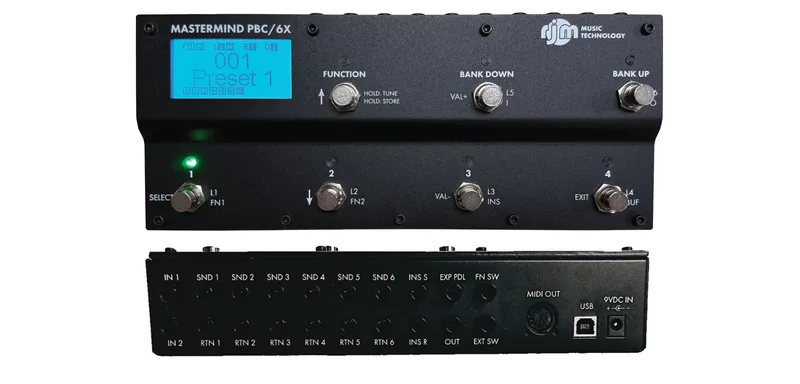
How it differs from the PBC/6X
What defines the PBC/10's loop architecture is its ten-loop layout with configurable routing and buffering. The last four loops are stereo capable using TRS jacks, and each of those four loops can be switched between series and parallel routing using an internal line mixer, so time-based effects can sit in parallel paths rather than chained in series12. Three audio buffers, placed before loop 1, before loop 7 and after loop 10, can each be enabled or disabled by IA button or as part of a preset, giving control over where the signal is buffered12.
| PBC/10 | PBC/6X | |
|---|---|---|
| Audio loops | 101 | 6 plus insert loop7 |
| Stereo loops | Last four, TRS jacks1 | Last three plus insert loop7 |
| MIDI devices | Up to 161 | Up to 167 |
| Power | 9VDC @ 500mA, 12VDC or 9VAC @ 400mA3 | 9VDC or 12VDC, 220mA, center negative Boss-type barrel7 |
| Matrix switching | Not listed | Reorders loops per preset without rewiring7 |
The PBC/6X also draws less current, 220mA at 9VDC or 12VDC on a Boss-type center negative barrel connector, making it easier to run from a conventional pedal power supply7. Both units share the USB device port for the Mastermind Editor software17.
What reviewers said
RJM Music describes the Mastermind PBC/10 as its first switching unit designed for use on a pedalboard, built to get the most out of pedalboards3. The maker's own pages detail the unit's configuration: 11 buttons each with a multi-color LED indicator, with buttons user configurable so any button can be set to any function and LED color, and 625 presets for storing setups3.
"Pros: Excellent, versatile design. USB editing option greatly increases functionality. Cons: A little pricey. Editor has a moderate learning curve"6
The maker's pages also note that the three audio buffers can be enabled or disabled as part of a preset, so buffer states are stored alongside loop routing12. The last four loops are stereo capable using TRS jacks, and each of them can be switched between series and parallel routing using an internal line mixer, which allows stereo effects to be placed in parallel paths12.
The PBC/10's maker page lists a sale price of £948.00 GBP3.
Videos
Sweetwater
RJM Music Technology Inc
Ruben Roeh
Questions
Are the RJM PBC/10 loops true bypass?
Yes. All ten loops are true bypass and relay switched, which RJM describes as providing maximum transparency. The unit also has three audio buffers, placed before loop 1, before loop 7 and after loop 10, and each buffer can be enabled or disabled by button or as part of a preset.
Can the PBC/10 run stereo effects?
Yes. The last four loops, loops 7 to 10, are stereo capable using TRS jacks. Each of those four loops can also be switched between series and parallel routing using an internal line mixer. The two main outputs can serve as left and right outputs for a stereo signal, or as A and B outputs to switch a mono signal between two amps.
Can the Mastermind PBC/10 run on a Voodoo Lab supply?
Yes. RJM states the PBC/10 can be powered with Voodoo Lab power supplies that have a 12VDC 400mA output. Its full power requirements are 9VDC at 500mA, or 12VDC or 9VAC at 400mA, so a supply needs to meet one of those ratings.
How many MIDI devices can the PBC/10 control?
Up to 16 MIDI devices. It has MIDI input and output connections, powered by the MIDI brain of RJM's Mastermind GT controller, and up to 20 MIDI messages can be assigned per button, including PC, CC, Note and Sysex messages.
What is the Click Stopper on the RJM PBC/10?
The Click Stopper is a noise reduction circuit that can be switched between two positions: before loop 7 or after loop 10. It addresses switching noise in the signal path, and its position lets a player place it where it best suits the effects in those loop groups.
What is the difference between the PBC/10 and PBC/6X?
The PBC/10 has ten audio loops, six mono and four stereo capable, in a unit measuring 17.5 inches wide. The PBC/6X is a smaller unit with six audio loops plus an insert loop, of which the last three loops and the insert loop are stereo capable, and it adds matrix switching that reorders loops per preset without rewiring.
Sources (7)
- Mastermind PBC/10, RJM Music Technology (rjmmusic.com)
- RJM Music Technology Unveils the Mastermind PBC, Premier Guitar, 2014-12-24
- RJM Mastermind PBC, RJM Music
- RJM Music Technology Mastermind PBC Audio Loop Switcher, MusicPlayers.com, 2015-08-15
- Pedalboard Feature: Ross Chapman, Strymon, 2015-11-23
- The New Switcheroo: Three Loop Switchers Reviewed, Premier Guitar, 2016-01-08
- Mastermind PBC/6X, RJM Music