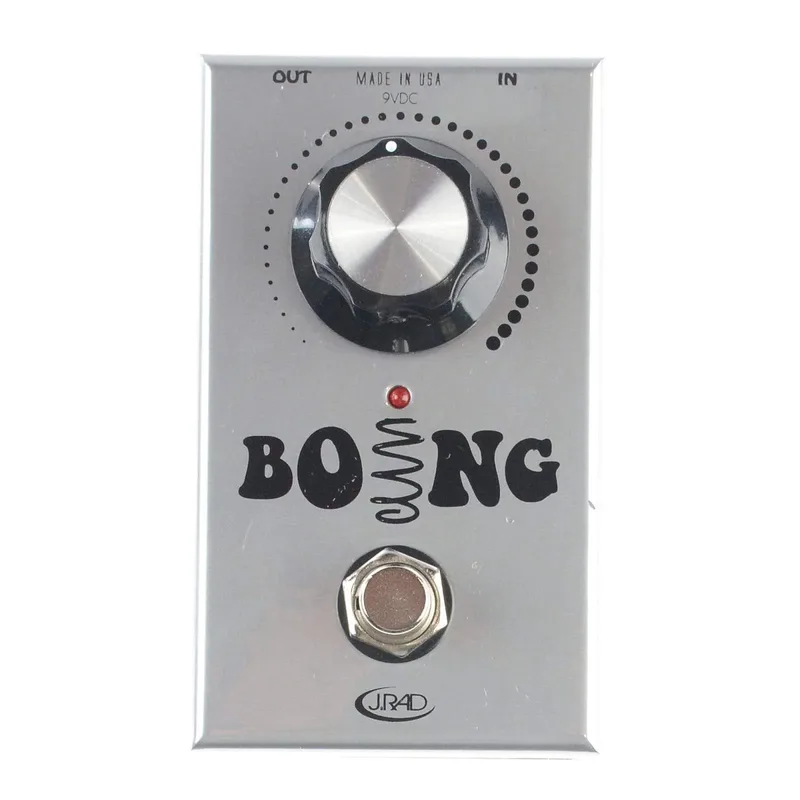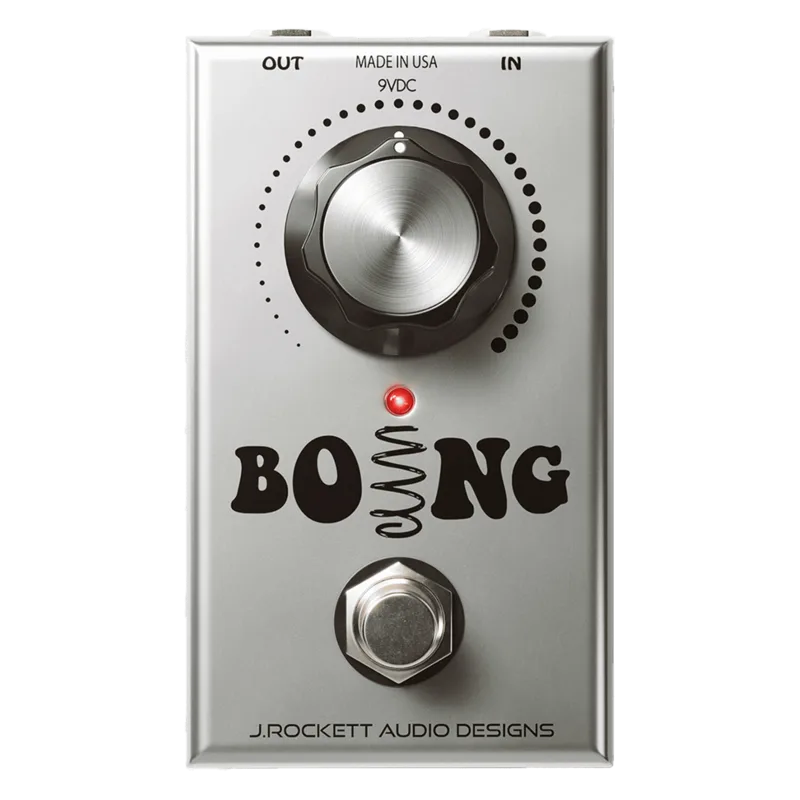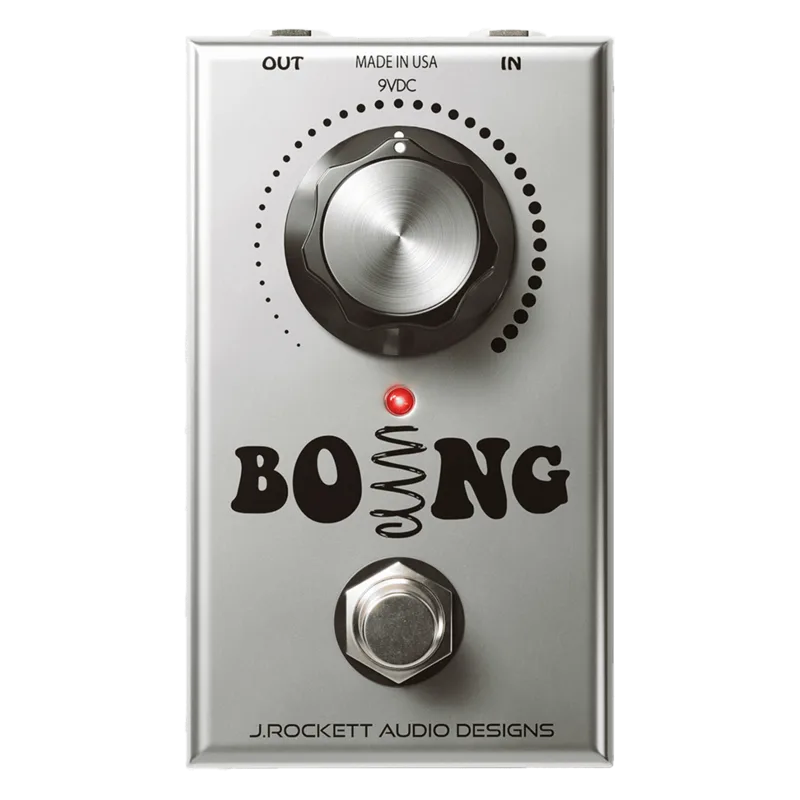


The Rockett Pedals Boing Reverb is a compact reverb pedal built to do one thing: put the spring reverb of a classic Fender Deluxe Reverb amp on a pedalboard. Rockett Pedals describes it as "a simple one knob recreation of the classic Deluxe Reverb," and like the reverb control on those amps, it offers a single knob that turns the effect up or down1. There are no modes, no presets and no tone shaping to dial in, which is the whole point of the design.
The pedal was announced in May 2015 as the BOING Spring Reverb, the second release in J. Rockett Audio Designs' Tour Series line2. Premier Guitar reported the launch, noting that in contrast to most reverb pedals the Boing takes a simple approach "aiming at recreating amp reverb and not studio reverb"2. It is made in the USA3.
A one-knob Deluxe Reverb recreation
The Boing's design brief comes straight from the amps its designers grew up with. Guitar.com's reviewer, Huw Price, described the pedal as "styled after the spring reverbs that were integral to the sounds of the amps the designers grew up" playing3. Rather than offering the long, ambient hall and plate sounds of many modern reverb pedals, it targets the shorter, splashy spring character of a built-in amp reverb, the sound Delicious Audio described as "the spring reverb effect available through guitar amps"5.
Inside, the pedal is a hybrid. Rockett Pedals lists it as an analog/digital hybrid design1, and Price found more detail in his review: "Its circuit is based around the Accutronics PT2399 digital chip, and an analogue treble circuit has been added" to shape the spring character3. The PT2399 is the same delay chip many budget reverb and delay pedals use, and here it does the reverb work while the analog treble circuit sits in the path to keep the top end sounding like a real spring tank.
How it sits in a review chain matters too. Price's verdict on the sound was that "it seems to gel with the core tone of the amp seamlessly, rather than sounding like a separate effect"3, which is what a player usually wants from an amp-style spring: reverb that behaves like part of the amp rather than an obvious add-on.
The control
There is exactly one control.
| Control | What it does |
|---|---|
| Reverb knob | More or less reverb, like the single reverb control on a classic amp1 |
Rockett's own wording: "Like many of the classic amps, it is just a single knob reverb for either more or less"1. A footswitch turns the effect on and off, using true bypass switching, so with the pedal disengaged the dry signal passes through untouched1. For a player who finds multi-knob reverb pedals more adjustment than the job needs, this is the entire interface.
Power and connections
The Boing runs on a 9 volt negative tip (center negative) adaptor with a 5.5mm x 2.1mm jack, and it also takes a 9 volt battery1. Current draw is 60mA1, low enough that it will not strain a typical isolated power supply, though a battery will drain faster than in a simple analog boost.
Guitar.com's review noted that the Boing ships with a warning about the power supply3. As with any center negative pedal, matching the polarity and voltage of the supply matters; the wrong adaptor can damage the circuit.
Size and weight
The enclosure measures 4.00" x 2.30" and weighs 1 lb1, a small footprint that fits easily on a crowded board.
Versions and pricing
The current list price from Rockett Pedals is $199.991. A B-stock version was listed at $119.994. At launch in 2015 the street price was $1592, and Delicious Audio listed the same $159 price in 20186. In the UK, Guitar.com's 2015 review gave the price as £1493.
Videos
ProGuitarShopDemos
Reverb
Mike Hermans
Questions
Does the Rockett Boing Reverb take a battery?
Yes. Rockett Pedals lists a 9 volt battery among the pedal's power options, alongside a 9 volt negative tip adaptor with a 5.5mm x 2.1mm jack. A player can run it either way.
Is the Rockett Boing Reverb true bypass?
Yes. Rockett Pedals specifies true bypass switching, and Guitar.com's review also lists a true bypass footswitch. With the effect off, the signal passes through without processing.
Is the Boing Reverb analog or digital?
Rockett Pedals describes it as an analog/digital hybrid. Guitar.com's reviewer found the circuit is based around the Accutronics PT2399 digital chip, with an analog treble circuit added to shape the spring character.
What amp is the Boing Reverb based on?
The classic Deluxe Reverb. Rockett Pedals calls the Boing a simple one-knob recreation of the classic Deluxe Reverb, aiming at amp reverb rather than studio reverb.
How much current does the Boing Reverb draw?
Rockett Pedals lists a 60mA current draw. That is modest by reverb pedal standards, so it will not strain most isolated power supplies.
How much does the Rockett Boing Reverb cost?
Rockett Pedals lists the Boing Reverb at $199.99. At launch in 2015 the street price was $159.
Sources (6)
- Boing - Classic Deluxe Spring Reverb Guitar Pedal, Rockett Pedals, 2026-03-17
- J. Rockett Launches New Boing Spring Reverb Pedal, Premier Guitar, 2015-05-28
- J Rockett Audio Designs Boing Reverb review, Guitar.com, 2015-09-04
- Boing - Classic Deluxe Spring Reverb Guitar Pedal, Rockett Pedals, 2026-04-01
- J. Rockett Boing Spring Reverb, Delicious Audio, 2015-05-29
- J. Rockett Audio Designs Boing, Delicious Audio, 2018-03-04