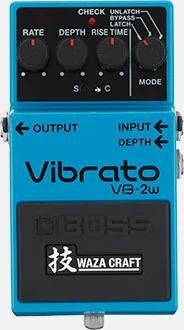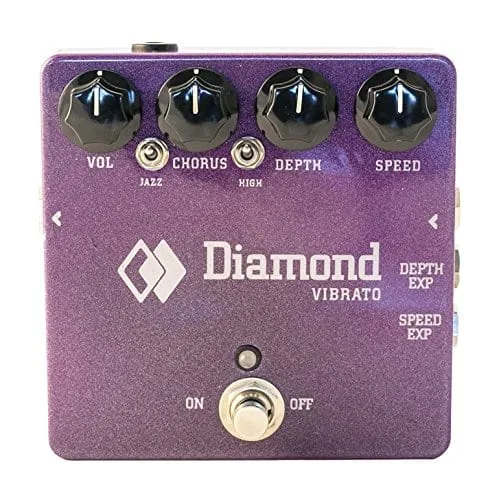


The Runoffgroove Tri-Vibe is not a pedal you buy: it is a free DIY project from Runoffgroove, a circuit you build yourself on stripboard or PCB. Runoffgroove describes it as "a versatile modulation effect that offers true vibrato," and it does that through three modes on a three-way switch: Vibe, Whirl and Swirl1. In Swirl mode the circuit is arranged as a phaser, so the same build covers vibrato, phaser and rotary-style territory1. It sits in a different corner of the vibrato pedal world from finished units like the Boss VB-2 or the Diamond Vibrato: the design is published, not sold.
True vibrato from a phaser circuit
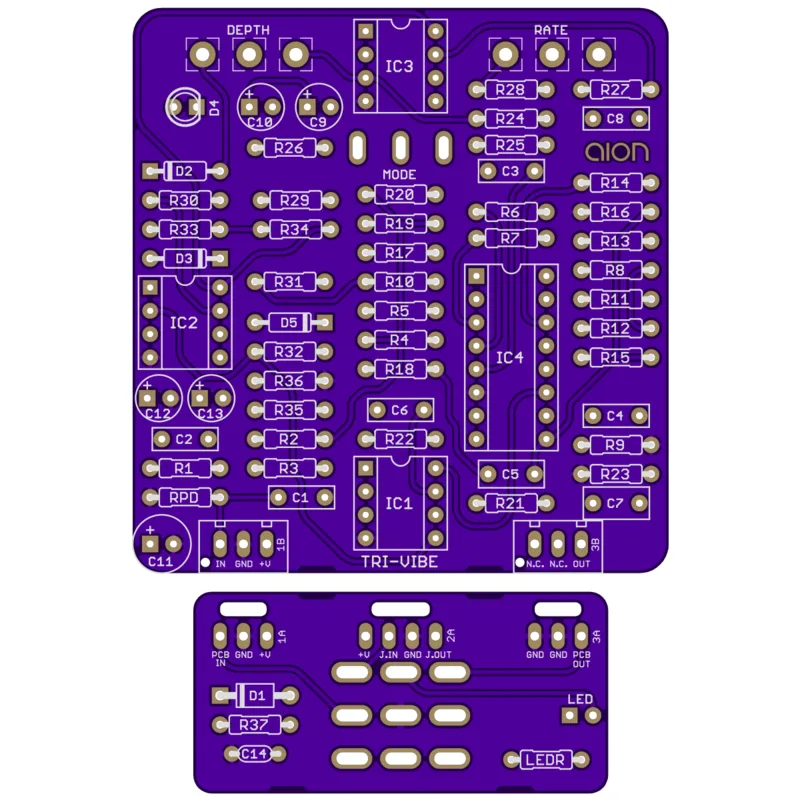
Most circuits sold as vibrato, including the Univibe, are really deep phasers. Aion FX's project page, which documents a Tri-Vibe build, puts the difference plainly: "The result is true pitch vibrato, not just the deep phasing that is often called vibrato in circuits like the Univibe."2 The Tri-Vibe shifts actual pitch rather than just sweeping a filter, which is what separates it from the phaser-adjacent vibe pedals many players know.
The trade runs the other way too. Aion FX notes that when the dry signal is mixed back in, the circuit reaches phaser tones similar to two-stage phasers such as the Phase 452. Runoffgroove sums up the three modes as "an elegantly refined modulation effect"1.
Circuit and parts: OTAs, no BBDs
Runoffgroove considered several routes to vibrato before settling on the design. Delay chips such as the MN3007 or PT2399 were dismissed "mainly due their limited bandwidth and the intrinsic delay" they introduce, and a Wurlitzer-style vibrato was considered but needed too many components1. What they landed on is a phaser topology: "the Tri-Vibe's topography is much more similar to a phaser using OTAs, but with an LFO that has been optimized for the vibrato effect"2. As few as two all-pass stages are used, optimized for linear phase variation across the guitar's frequency range1.
The phase shift stages use the LM13600 operational transconductance amplifier. Runoffgroove chose it over alternatives like the CA3080 and CA3094 "since it includes the output buffers and contains a pair of linearizing diodes"13.
The LFO is built from simple parts: a pseudo-sinusoidal control signal is derived from a triangle waveform generator by means of a 4k7 resistor, the 10k DEPTH pot, and two back-to-back diodes, then shaped further by the nonlinear diode and biasing arrangement in opamp stage U2b1.
| Control | What it does |
|---|---|
| DEPTH | 10k pot that sets the modulation depth; part of the pseudo-sinusoidal LFO network1 |
| RATE | Sets the modulation rate; ideally a rev-log or "C" taper pot, a log or "A" taper works with lugs 3 and 1 swapped (reversed rotation), linear or "B" taper not recommended1 |
| Mode switch | Three-way: Vibe, Whirl and Swirl1 |
The RATE pot's taper matters: a linear ("B") taper is not recommended, and a log taper must be wired with lugs 3 and 1 swapped so rotation works in reverse1.
Building it and the license
Because the Tri-Vibe is a published design rather than a product, there is no list price, no power spec sheet and no maker's manual: the circuit document at runoffgroove.com is the reference. Guitar FX Layouts, the stripboard layout blog, posted a vero (stripboard) layout for the Tri-Vibe on 19 March 2014, drawn by John K, alongside Runoffgroove's project description3. That gives home builders a ready-made parts placement without designing their own board.
The design carries a Creative Commons Attribution-NonCommercial-ShareAlike 3.0 Unported License1. In practice that means you can build one for yourself and share the design onward under the same terms, but the non-commercial clause rules out selling pedals built from it.
Runoffgroove's own pitch for the project is that "it produces a unique vintage vibrato sound not readily found in other DIY pedals"1, and Aion FX describes it as "a vibrato & phaser circuit that is a great deal simpler than the comparable vintage circuits"2, which is the practical appeal for a builder: vintage-style true vibrato without a vintage-scale parts count.
Videos
DIY Guitar Pedals
Fernando Ruz RGG
iarnerich
Sources (3)
- Tri-Vibe, runoffgroove.com, 2024
- Runoffgroove Tri-Vibe Vibrato/Phaser, Aion FX, 2020-06-05
- Guitar FX Layouts: Runoffgroove Tri-Vibe, tagboardeffects.blogspot.com (Guitar FX Layouts), 2014-03-19