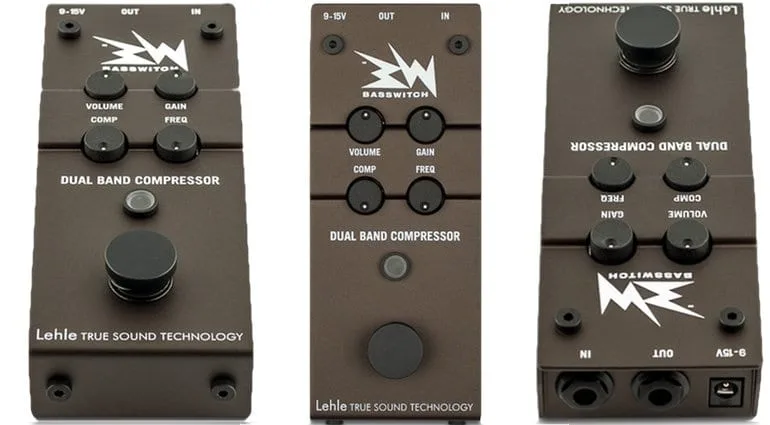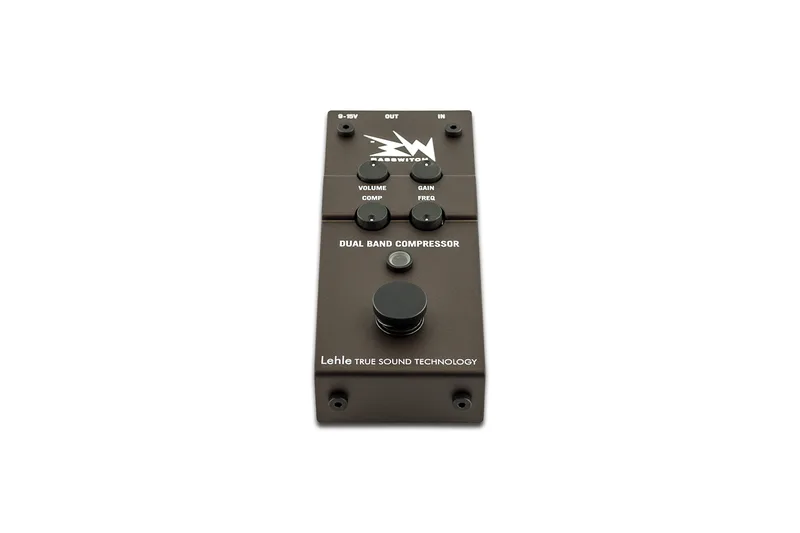


The RMI Basswitch Dual Band Compressor is a compressor pedal for bass, made by Ruppert Musical Instruments of Luxembourg and manufactured, assembled and tested in Germany1. Inside its housing are two high-end compressors: the incoming signal is split into two frequency bands, and each band gets its own compression. The idea is that the low end of a bass and the upper mids and treble need different treatment, so a single compressor working across the whole signal has to compromise. Here, the two bands are set independently1.
Gearnews described it at its 2016 announcement as a pedal "specifically designed to place studio quality compression into a pedal format and exclusively for bass guitars," with "two studio quality compressors in one compact pedal"2.
What it does: compression split across two frequency bands
The core of the pedal is a crossover. The FREQ control sets the point where the signal is split into two bands and assigns each to one of the two compressors. It works logarithmically from 250 Hz (around 2 o'clock) to 12 kHz (around 11 o'clock), so you can keep the split low and compress only the fundamentals, or push it up so the mids and highs get their own treatment1.
Each compressor is an RMS, feedforward design with a VCA gain cell and soft-knee characteristics, which the manual credits with "effective and melodious compression of your bass sound"1. Gearnews likewise noted the soft knee character as something that "should complement a bass"2. The compression ratio runs from 1:1 up to 10:112.
Controls
| Control | What it does |
|---|---|
| COMP | Sets the compression ratio. Low settings give a punchy sound; at maximum (around 11 o'clock) the pedal behaves similar to a limiter1 |
| FREQ | Sets the crossover frequency where the two bands are split, logarithmically from 250 Hz to 12 kHz1 |
| VOLUME | Matches output volume between the on and off states, so loudness stays equal whether the compressor is engaged1 |
| Footswitch | Activates the compressor and is also used to change the bypass mode1 |
The status LED lights blue when the compressor is on and white in bypass mode, and it also signals when the compressors begin to operate1.
Attack and release set by the bass signal
There are no attack and release knobs. Instead, the pedal continually and automatically adapts those parameters to the bass signal itself, which keeps the control panel down to three knobs1. Gearnews saw this as a deliberate simplification, "attaching controls like attack and release to one dial, therefore making it easier to dial in your compressed bass tones"2.
The times are signal dependent, and the two bands differ:
| Parameter | Low Band | High Band |
|---|---|---|
| Attack time | 20 ms to 40 ms | 2.5 ms to 5 ms |
| Release time | 100 ms to 200 ms | 10 ms to 20 ms |
The slower low-band times let the attack of a note through before the compressor clamps down, while the faster high-band times catch the transients of strings and pick attack1.
Power: 9 to 15V AC or DC, stepped up to 18V
The pedal takes 9 to 15 V AC or DC through a standard 5.5 x 2.1 mm connector. Whatever comes in is internally rectified, filtered, stabilized and brought up to 18 V, and the polarity of the supply is not relevant1. Lehle's own product pages for the Basswitch line state the same: "Either alternating (AC) or direct current (DC) sources can be used and the polarity is not relevant"3. Current consumption is max. 100 mA at 9 V DC and max. 110 mA at 12 V DC1.
Because the pedal accepts AC or DC of either polarity, you do not need to match a center-negative or center-positive supply the way most 9 V pedals require. An external power supply is required; there is no battery.
The 18 V internal rail is what gives the pedal its headroom: maximum input and output levels are both +14 dBu at under 1 percent THD (100 Hz), with input gain of +/- 12 dB and output gain of +/- 28 dB. Input impedance is 2.8 MegaOhm at 1 kHz and output impedance 100 Ohm at 1 kHz, so it presents a light load to passive pickups and drives long cable runs easily1.
Bypass: true or buffered, your choice
The pedal can be set to either of two bypass modes. In True-Bypass mode the input and output are linked with zero losses via a relay with gold-plated contacts; in Buffered-Bypass mode the signal passes through a totally neutral line-driver1. Gearnews called the choice a good thing: "So it is good to have the option of choosing either"2.
To switch modes, hold the footswitch while connecting power. The LED flashes once for True-Bypass and twice for Buffered-Bypass, and the selected mode is retained even when the pedal is disconnected from power1.
Who uses it
The manual documents a favorite setup from RMI endorser Florian Friedrich (Sugarbabes, Julio Iglesias et al) for basses with what it calls "muthucker" pickups, covering the Gibson EB2, EB2D, EB1, EBO, EB3 and their Epiphone equivalents1. It also suggests a fretless application: with a little more gain and a chorus effect placed before the compressor, "an 80s Pino Paladino Sound is easy to create"1.
Related pedals
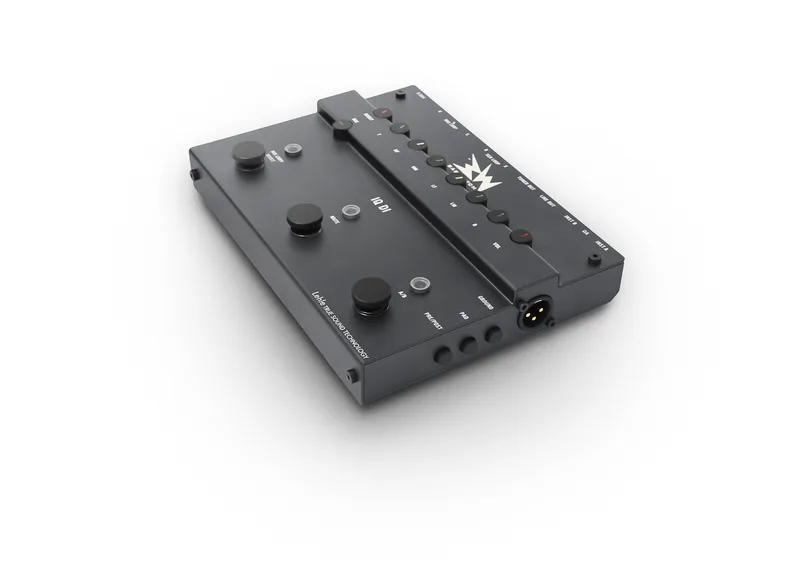
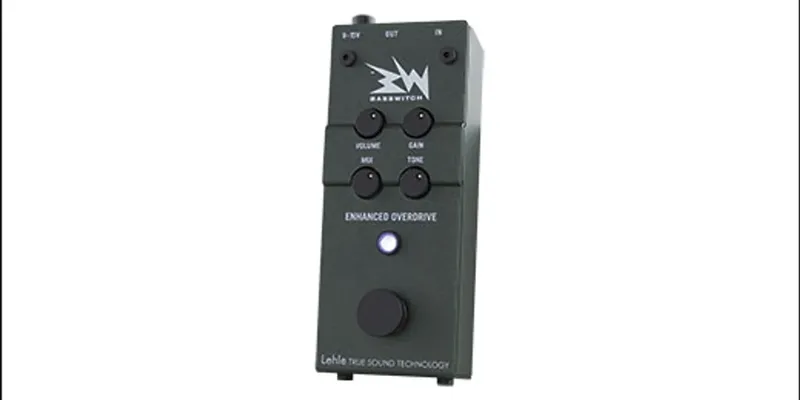
The Dual Band Compressor sits in the wider Basswitch family from the same maker, alongside the Basswitch IQ DI preamp/DI and single-effect pedals such as the RMI Basswitch Enhanced Overdrive and Classic Boost, which share the same 9 to 15 V AC/DC power scheme stepped up to 18 V internally1. For players comparing approaches, it is one of the few bass pedals that splits compression by frequency band rather than compressing the whole signal at once.
Videos
Max Dommers
Jacques channel
Jacques channel
Questions
Is the RMI Basswitch Dual Band Compressor true bypass?
It can be. The pedal offers two bypass modes: True-Bypass, which links input and output through a relay with gold-plated contacts for zero losses, and Buffered-Bypass, which uses a neutral line-driver. You choose which one you want, and the setting is remembered even when the pedal is disconnected from power.
How do you switch between true bypass and buffered bypass on the RMI compressor?
Hold the footswitch down while connecting the power supply. The status LED flashes once for True-Bypass mode and twice for Buffered-Bypass mode. The selected mode stays stored even without power, until you change it again the same way.
Does polarity matter when powering the RMI Basswitch Dual Band Compressor?
No. The pedal runs on 9 to 15 V AC or DC, and the polarity of the supply is not relevant. The voltage is internally rectified, filtered, stabilized and brought up to 18 V inside the pedal, so a standard 5.5 x 2.1 mm power supply of either polarity works.
Does the RMI Basswitch Dual Band Compressor work with active basses?
Yes. The manual states the pedal is built to process signals from both passive and active pickup systems, and its input stage handles a maximum input level of +14 dBu at under 1 percent THD, so hot active signals are within its range.
Is the Lehle RMI Basswitch compressor the same pedal as the Ruppert one?
The Basswitch line was made by Ruppert Musical Instruments of Luxembourg, and gearnews reported its announcement in 2016 under the Lehle RMI name, since Lehle distributed the RMI Basswitch products. The manual itself is published by Ruppert Musical Instruments, and the pedal is manufactured, assembled and tested in Germany.
Sources (3)
- Lehle-RMI-Basswitch-Dual-Band-Compressor_Manual_EN.pdf, Ruppert Musical Instruments, 2023
- Lehle RMI Basswitch Dual Band Compressor pedal, gearnews.com, 2016-09-15
- RMI BASSWITCH IQ DI (DISCONTINUED), Lehle GmbH