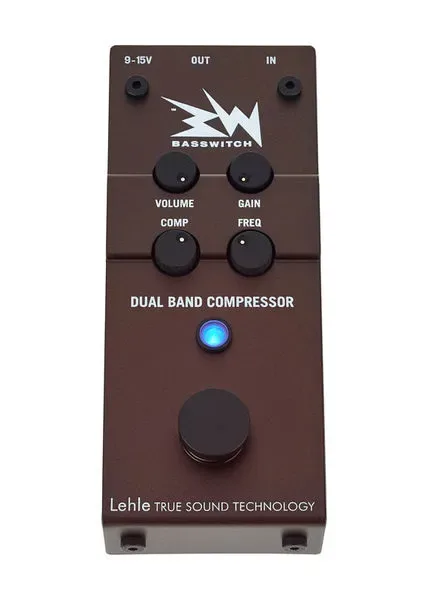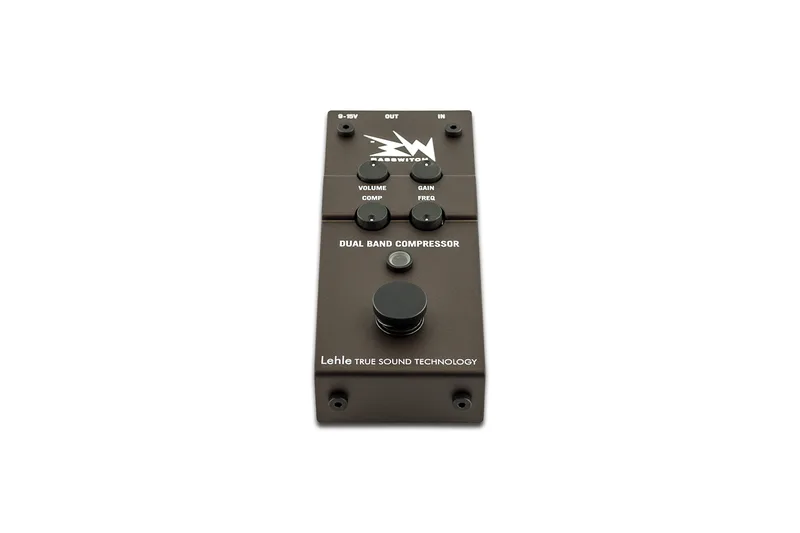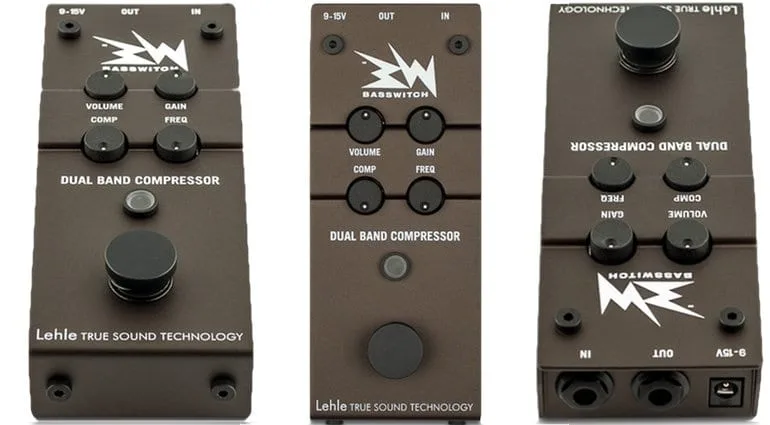


The Lehle RMI Basswitch Dual Band Compressor is a compressor pedal built specifically for bass, announced in September 2016. Inside its housing are two compressors, and the signal is split into two frequency bands so the low and high parts of your bass sound are compressed separately. Lehle describes it as delivering "effective and melodious compression of your bass sound" in a pedal-size format suitable for live performance as well as studio use12. Gearnews called it "two studio quality compressors in one compact pedal," designed "exclusively for bass guitars"2.
The pedal is made by Ruppert Musical Instruments (RMI), based in Luxembourg, and is manufactured, assembled and tested in Germany1. Lehle builds the RMI Basswitch line in Germany on behalf of RMI3.
Two compressors in one bass pedal
Most bass compressors treat the whole signal at once, which can mean the attack of the low fundamental pumps the rest of the spectrum along with it. The Basswitch Dual Band Compressor instead splits the signal at a crossover point you choose, from 250 Hz to 12 kHz, and runs each band through its own compressor1. That lets the deep end be controlled gently while the higher harmonics are handled faster, or any balance in between.
The design is built around a VCA gain cell with an RMS, feedforward compressor design and a soft knee characteristic1. Gearnews noted that "the RMI Basswitch Dual Band compressor has a soft knee character which should complement a bass"2. The input is built to process signals from both passive and active pickup systems, so it works whether your bass has a vintage-style passive output or a hot onboard preamp1.
Specifications
| Specification | Value |
|---|---|
| Compression ratio | 1:1 to 10:11 |
| Compression characteristics | Soft knee1 |
| Threshold range | -38 dBu to -8 dBu1 |
| Crossover frequency | 250 Hz to 12 kHz1 |
| Input gain | +/- 12 dB1 |
| Output gain | +/- 28 dB1 |
| Maximum input level | +14 dBu, < 1% THD, 100 Hz1 |
| Maximum output level | +14 dBu, < 1% THD, 100 Hz1 |
| Residual noise | < 80 dBu, 22 Hz to 22 kHz, unweighted, Output Gain = +6 dB1 |
| Gain cell | VCA1 |
| Compressor design | RMS, feedforward1 |
The controls: one dial for attack and release
The front panel keeps things simple, with four controls and a footswitch. Notably, there is no separate attack and release knob: those time constants are signal dependent and fixed per band, which Gearnews saw as a deliberate trade, "attaching controls like attack and release to one dial, therefore making it easier to dial in your compressed bass tones"2.
| Control | What it does |
|---|---|
| GAIN | Selects the point where the compressor starts working; at low settings the compressors act on peak levels only, higher settings make them active sooner and for longer1 |
| COMP | Adjusts the compression ratio; low rates give a punchy sound, at maximum (around 11 o'clock) the pedal behaves similarly to a limiter1 |
| FREQ | Sets the crossover frequency logarithmically from 250 Hz (2 o'clock) to 12 kHz (11 o'clock)1 |
| VOLUME | Matches output volume between engaged and bypassed states for equal loudness either way1 |
| Footswitch | Activates the compressor; also used to change the bypass mode1 |
The attack and release times differ by band, which is what makes the dual band approach work in practice1:
- Low band attack: 20 ms to 40 ms, signal dependent
- High band attack: 2.5 ms to 5 ms, signal dependent
- Low band release: 100 ms to 200 ms
- High band release: 10 ms to 20 ms
A blue LED on the front glows brighter the harder the compression is pushed, so you can see how hard the pedal is working at a glance2.
Levels, bypass and power connections
The rear panel is straightforward: an instrument input, an output for your amp or preamp, and a power socket1.
The bypass is switchable between two modes. In True-Bypass mode the input and output are linked "with zero losses to one another via a relay with gold-plated contacts"; in Buffered-Bypass mode the pedal acts as a totally neutral line driver1. You select the mode by holding the footswitch while connecting power: the LED flashes once for True-Bypass and twice for Buffered-Bypass, and the setting is retained even when the pedal is disconnected from power1. Gearnews confirmed the pedal "can be switched between either a buffered or a true bypass setting when the pedal" is not engaged2.
Power comes in at 9 to 15 V AC or DC through a standard 5.5 x 2.1 mm connector, and the internal circuitry rectifies, filters and stabilizes the supply and brings it to 18 V1.
The Lehle power supply, item no. 7014, with its DIN 45323 connector is not suitable for this pedal, according to the manual's warning1.
What reviewers said
Gearnews covered the pedal at its announcement in September 2016, at a list price of EUR €2692. The reviewer's overall take on the simplified control set:
"However, I welcome a simplified front end as long as it works."
Gearnews, September 20162
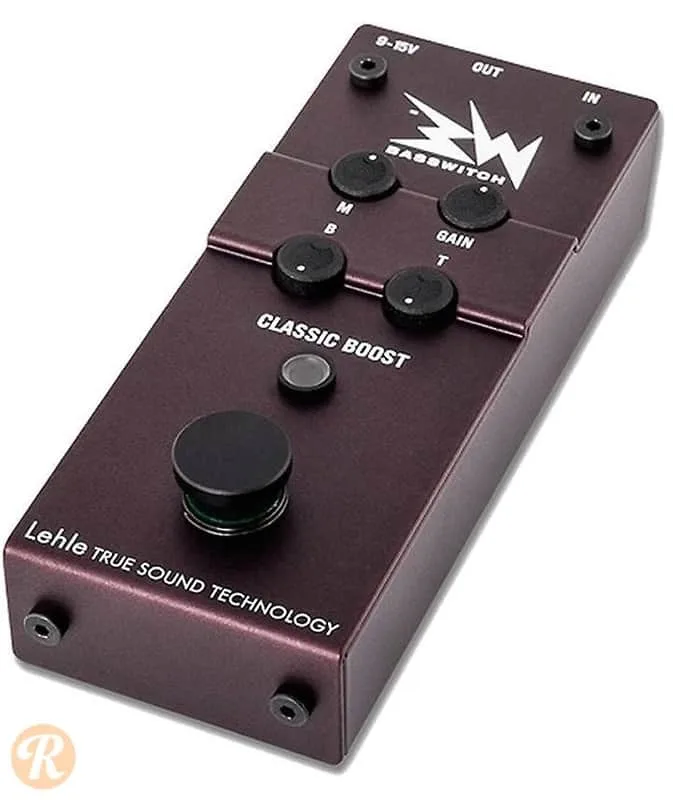
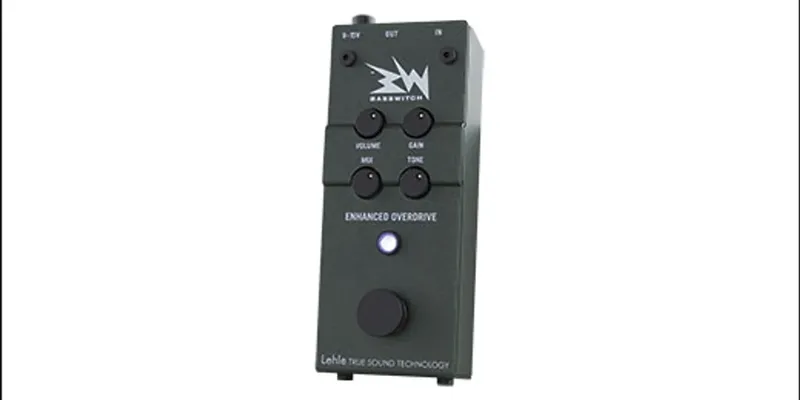
The Basswitch family
The Dual Band Compressor sits in RMI's Basswitch range, which Lehle manufactures in Germany on behalf of RMI3. Siblings include the Basswitch Classic Boost, a high-end bass preamp and booster voiced for passive P, JJ and PJ type basses, and the Basswitch Enhanced Overdrive, a drive pedal. Both share Lehle's True Sound Technology, using gold-plated contact relays and switches rather than conventional true bypass switching45.
Videos
session
Guitar Interactive Magazine
Max Dommers
Questions
What does dual band compression mean on the Lehle RMI Basswitch?
The pedal splits your bass signal into two frequency bands at a crossover point you set between 250 Hz and 12 kHz, then runs each band through its own compressor. The low band gets slower attack and release times, the high band faster ones, so the fundamental and the harmonics are controlled independently rather than the whole signal being squeezed together.
What compression ratios does the Basswitch Dual Band Compressor offer?
The ratio is variable from 1:1 up to 10:1, set with the COMP control. Lehle describes low settings as producing a punchy sound, while at the maximum setting, around 11 o'clock on the dial, the pedal behaves similarly to a limiter. The compression characteristic is soft knee throughout.
Is the Lehle RMI Basswitch true bypass or buffered?
It can be either. You choose between a True-Bypass mode, which uses a relay with gold-plated contacts to link input and output with zero losses, and a Buffered-Bypass mode that acts as a neutral line driver. You switch modes by holding the footswitch while connecting power, and the setting is retained even without power.
Can I power the Basswitch with a Lehle power supply?
No. The manual warns that the Lehle power supply, item no. 7014, with its DIN 45323 connector is not suitable. The pedal takes 9 to 15 V AC or DC through a standard 5.5 x 2.1 mm connector, and the internal circuitry rectifies, filters and stabilizes the supply up to 18 V.
How does the Basswitch show how hard it is compressing?
A blue LED on the front of the pedal glows brighter the harder the compression is pushed, giving you a simple visual indication of how much gain reduction is happening while you play.
Who makes the RMI Basswitch Dual Band Compressor?
The pedal is made by Ruppert Musical Instruments, based in Schouweiler, Luxembourg, and is manufactured, assembled and tested in Germany. Lehle builds RMI Basswitch products in Germany on behalf of RMI, and the range also includes the Classic Boost preamp and the Enhanced Overdrive.
Sources (5)
- Lehle-RMI-Basswitch-Dual-Band-Compressor_Manual_EN.pdf, Ruppert Musical Instruments, 2023
- Lehle RMI Basswitch Dual Band Compressor pedal, gearnews.com, 2016-09-15
- RMI BASSWITCH IQ DI (DISCONTINUED), Lehle GmbH
- Lehle-RMI-Basswitch-Classic-Boost_Manual_EN.pdf, Ruppert Musical Instruments, 2023
- Lehle-RMI-Basswitch-Enhanced-Overdrive_Manual_EN.pdf, Ruppert Musical Instruments, 2023