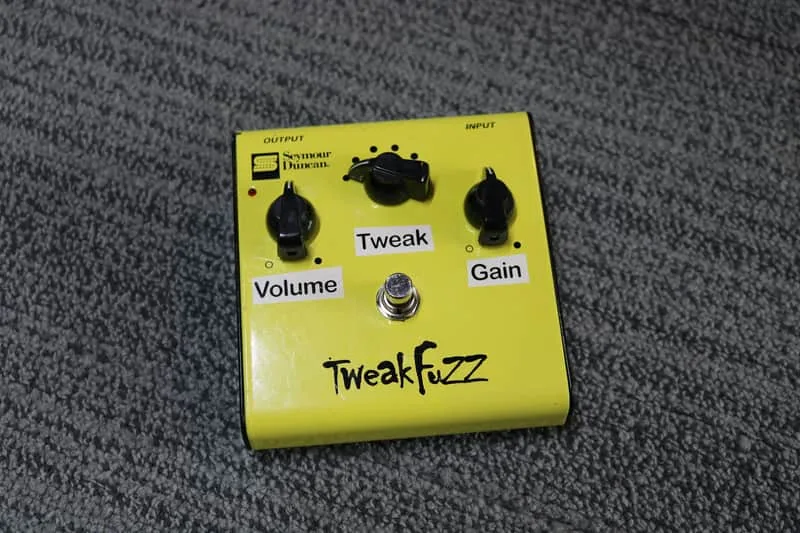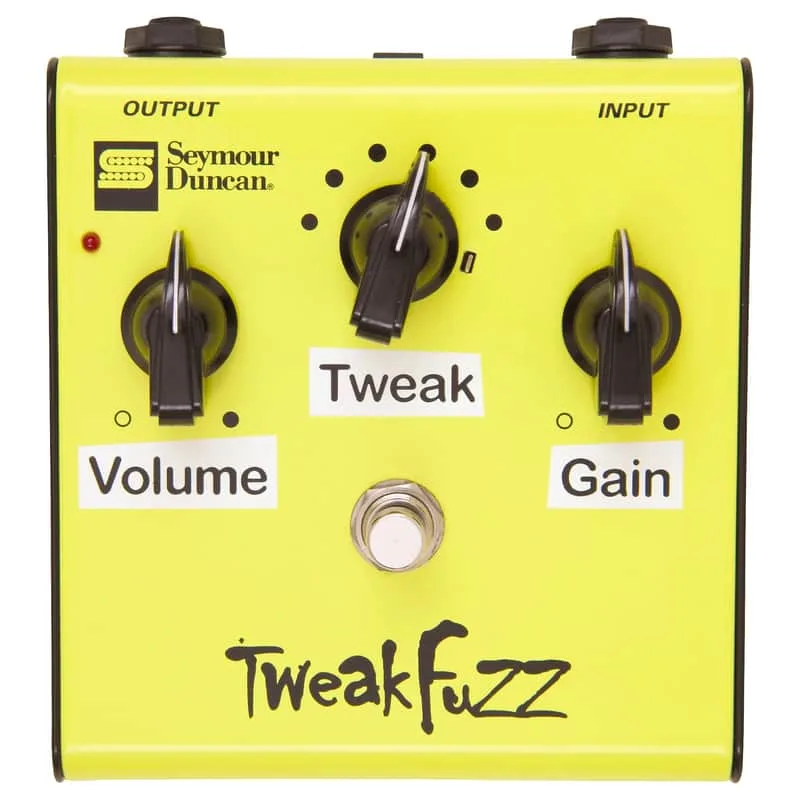


The Seymour Duncan SFX-02 Tweak Fuzz is a fuzz stompbox released in 2005, produced in collaboration with guitarist Blues Saraceno and designed by his father, Alex Saraceno, who licensed the circuit from his Dirty Boys Pedals Afro Fuzz to Seymour Duncan123. Its distinguishing feature is a six-position Tweak switch that stands in for a conventional tone control, offering preset voicings that range from bass-heavy to bright treble-boost flavors23.
What the Tweak switch does
Instead of a tone knob, the Tweak Fuzz uses a rotary switch with six preset voicings. Guitar Player's Barry Cleveland, reviewing the pedal in October 2005, described it this way2:
"the pedal features a rotary Tweak switch that selects one of six preset voicings, each of which interacts with the Gain"2
Sound and controls
MusicRadar's reviewer placed the pedal firmly in the vintage camp: "The basic character of the Tweak Fuzz is reminiscent of a number of classic sixties fuzz pedals," describing a spongy, compressed proper fuzz sound rather than tight metal distortion1. The pedal has three controls, and it is slightly larger than the average stompbox1.
| Control | What it does |
|---|---|
| Volume | Output level1 |
| Gain | Sets the amount of distortion1 |
| Tweak | Six-position rotary selecting preset voicings, each interacting differently with the Gain2 |
One use the reviewers highlighted goes beyond fuzz: MusicRadar noted that "the Tweak Fuzz also works well on relatively clean settings, providing some interesting EQ tweaks," as shown in Blues Saraceno's video demo for the pedal1.
Circuit and build
The pedal uses discrete class-A circuitry, which Guitar Player reported results in low-noise operation, and its true-bypass switching "eliminates tone sucking" when the pedal is off2. MusicRadar's review likewise confirms the pedal features Class A circuitry1.
The enclosure is built for the road. Guitar Player described it in detail2:
"The unit's 1.6mm steel casing makes it as sturdy as the proverbial tank (and nearly as heavy), while a ribbed plastic pad"2
That ribbed plastic pad on the bottom keeps the unit from sliding on slippery wood stages2.
Context in Seymour Duncan's fuzz line
The Tweak Fuzz was one of Seymour Duncan's early stompboxes, part of the SFX series, released in 200531. It sits apart from later Seymour Duncan fuzz designs as a straightforward three-knob fuzz whose character is shaped by its preset voicing switch, with bassier settings and more bright treble boost settings among its options3.
Videos
ProGuitarShopDemos
Seymour Duncan
Seymour Duncan
Questions
Is the Seymour Duncan Tweak Fuzz true bypass?
Yes. Guitar Player's Barry Cleveland reviewed the pedal in October 2005 and noted its true-bypass switching, saying it eliminates tone sucking when the pedal is off. That means the guitar's signal passes through the pedal untouched until the footswitch is engaged, which matters on a pedalboard where several effects sit in line.
How much does the Seymour Duncan Tweak Fuzz cost?
Guitar Player's October 2005 review listed the Tweak Fuzz at $149 retail and $99 street in US dollars. As a pedal from 2005 it is no longer a current catalog item, so used and remaining new stock prices vary.
Who designed the Seymour Duncan Tweak Fuzz?
The Tweak Fuzz was designed by Alex Saraceno, father of guitarist Blues Saraceno, and based on the circuit from the Dirty Boys Pedals Afro Fuzz. Alex licensed the circuit to Seymour Duncan, and the pedal was produced in collaboration with Blues Saraceno.
What does the Tweak knob do?
The Tweak control is a rotary switch that selects one of six preset voicings rather than sweeping a tone control continuously. Guitar Player described each voicing as interacting with the Gain control differently, and JHS Pedals describes the rotary as dealing with the low-mid content, with some settings bassier and others closer to a bright treble boost.
Is the Tweak Fuzz a class-A circuit?
Yes. Both MusicRadar's Guitarist review and Guitar Player describe class-A circuitry. Guitar Player specifies discrete class-A circuitry and reports that it results in low-noise operation.
Sources (3)
- Seymour Duncan Tweak Fuzz review, MusicRadar, 2007-12-05
- FUZ-1 | Guitar Player (October 2005) | Demeter Amplification, Guitar Player, 2005-10
- 3 GUITAR PEDALS THAT SHOULD HAVE BEEN FAMOUS, JHS Pedals