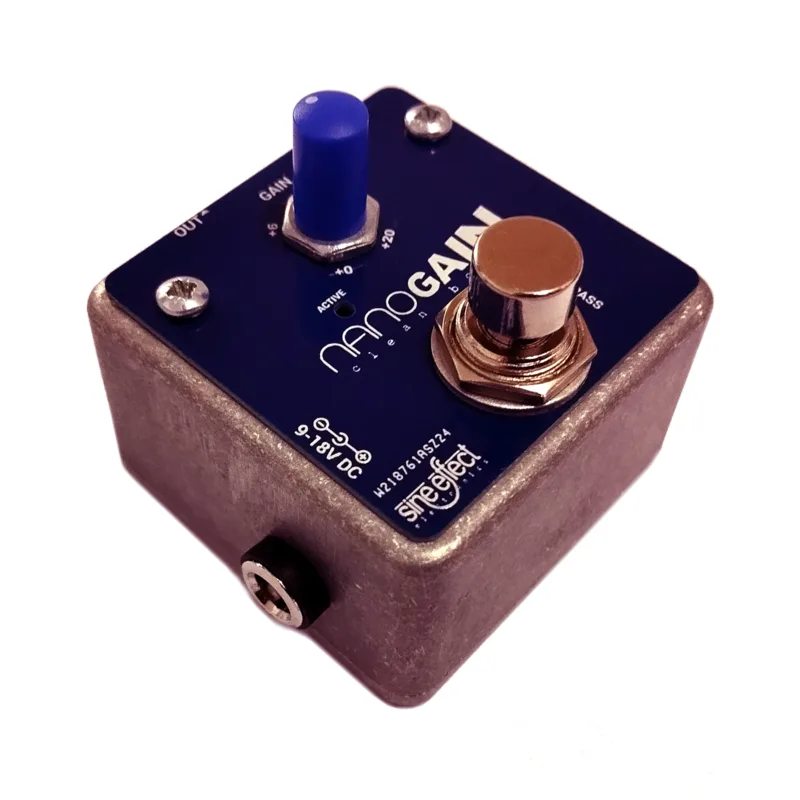
The Sine Effect Electronics nanoGain is a small, no-nonsense clean boost pedal: an analog circuit that raises your guitar's signal level by up to +20dB without adding overdrive or distortion of its own. Sine Effect describes it as using a low-noise op-amp circuit for reliable, precise signal boosting, and the pedal is hand made in Scotland1.
What it does to your signal
A clean boost sits at the simplest end of the gain family: unlike an overdrive or distortion pedal, it does not clip the signal itself. Players use one to push an amp harder, to lift a solo above the band, or to drive the front end of other pedals. The nanoGain's frequency response is listed as 3Hz to 31KHz, which covers everything a guitar or bass puts out and then some1.
Headroom is the figure that matters most on a boost, because it sets how hot a signal the pedal can accept before it clips. Sine Effect lists two figures, and the supply voltage you choose decides which one you get:
| Supply voltage | Headroom |
|---|---|
| 9V | 7dBu |
| 18V | 16dBu |
Running the pedal at a higher supply voltage gives it noticeably more room for hot pickups or an already-loud signal chain1.
Specifications
| Specification | Value |
|---|---|
| Circuit | Analog, low-noise op-amp1 |
| Maximum gain | +20dB1 |
| Frequency response | 3Hz to 31KHz1 |
| Bypass | True bypass1 |
| Input impedance | 1 mega-ohm1 |
| Output impedance | 100 ohm1 |
| Power | 9-18V DC, center-negative, ~10mA1 |
| Enclosure | 5x5cm (1.97")1 |
| Overall dimensions | 5x5x4cm1 |
Power and practical details
The nanoGain runs on a 9-18V DC, center-negative supply and draws about 10mA. That is a light load, easy on any standard pedalboard power supply, and the 9-18V range means you can run it at 18V where your supply supports it to get the higher headroom figure above1.
The pedal accepts 9-18V DC only, center-negative. As with any pedal, do not feed it a center-positive supply or an AC adapter.
The 1 mega-ohm input impedance is high enough that the pedal will not load down passive pickups, and the 100 ohm output impedance is low, which helps the signal drive the rest of a chain without losing top end1.
Size, build and availability
The pedal is built into a 5x5cm (1.97") enclosure with overall dimensions of 5x5x4cm, so it takes up about as much board space as other mini pedals1. Sine Effect Electronics has been hand-building pedals for musicians and producers in Glasgow, Scotland since 20141.
As of 26 October 2026, the maker's store listed the nanoGain as available1:
- Price: £66.00 GBP1
- Stock: one unit ready to ship1
- Lead time: zero weeks1
- US orders: tariff paid upfront, no extra brokerage fees1
- Shipping: orders ship the next working day1
The maker's page states that this product was available for sale in the EU prior to December 13th 2024, which affects how EU customers can buy it1.
Questions
Is the Sine Effect nanoGain true bypass?
Yes. The maker lists the nanoGain as true bypass, so when the pedal is switched off your guitar's signal passes straight through without passing through the boost circuit. That matters on a pedalboard where several pedals in a row can each load down the signal, and it is one reason a clean boost is often kept on a board even when it is not switched on.
Is the nanoGain an analog or digital pedal?
It is analog. Sine Effect describes the nanoGain as using a low-noise op-amp circuit for reliable, precise signal boosting. There is no digital conversion in the signal path, which suits a clean boost, where the aim is to raise the level of your guitar's signal without changing its character.
How big is the Sine Effect nanoGain?
The nanoGain is built into a 5x5cm (1.97 inch) enclosure, with overall dimensions of 5x5x4cm. That makes it one of the compact pedals you can fit several of on a small board, and it is sized like other mini boost and buffer pedals rather than a full-size stompbox.
Where is the nanoGain made?
The nanoGain is hand made in Scotland. Sine Effect Electronics is based in Glasgow and has been hand-building pedals for musicians and producers since 2014, so the pedal comes from a small builder rather than a large production line.
What polarity does the nanoGain power supply need?
The nanoGain needs a 9-18V DC supply with centre-negative polarity, the same standard used by most pedal power supplies and daisy chains. Current draw is about 10mA, which is light enough that it will not strain a typical pedalboard power supply.
Sources (1)
- nanoGain clean boost, Sine Effect Store (sineeffect.com), 2024-12-13