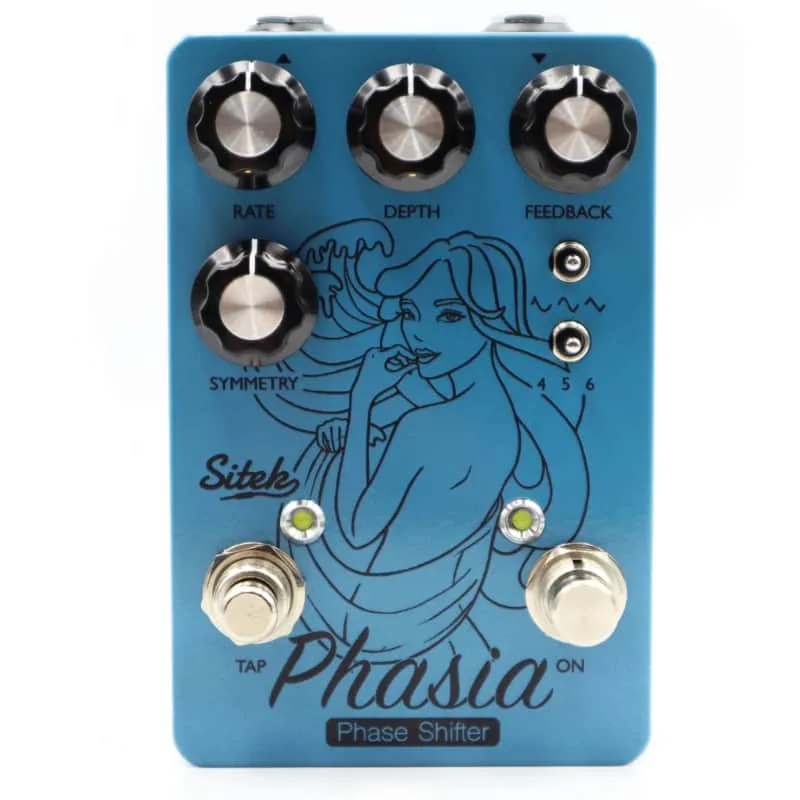



The Sitek Phasia is a multi-stage OTA-based phaser pedal from Sitek Guitar Electronics, part of the maker's line of "Sound Muses" pedals. It combines an all-analog moving filter section with a modern, tap-tempo controllable LFO, and it gives the player unusual control over the character of the sweep: a choice of 4, 5 or 6 filter stages, and a choice of three LFO waveforms1.
Delicious Audio describes the range of the effect as going "from stationary and resonant to fast and swirly," which points at the two extremes the pedal covers: slow, almost static resonant filtering at one end and quick, pronounced phasing motion at the other2. Each unit is built by hand in Poland3.
Circuit and stages
The Phasia's filter section is analog, built on OTA (operational transconductance amplifier) stages, the classic approach to voltage-controlled filtering in phaser design. What makes it unusual is that the number of stages is selectable: 4, 5 or 6 filter stages, which Premier Guitar notes affects "the overall voicing and style of phasing effect"1. More stages generally means a deeper, more complex sweep, so a player can dial the pedal toward a subtle two-notch shimmer or a more pronounced, resonant phase.
The LFO that drives those filters offers three waveforms, selected by a three-way toggle LFO Shape switch: hypertriangular, sine and triangular1. Delicious Audio calls the hypertriangular option "intriguing," and the waveform choice changes how the sweep accelerates and decelerates, which is where much of a phaser's personality lives2.
Controls and tap tempo
The control set is compact, and each control has a clear job:
| Control | What it does |
|---|---|
| Rate | Sets the speed of the LFO2 |
| Depth | Sets the frequency range the filters sweep through2 |
| LFO Shape toggle | Selects hypertriangular, sine or triangular waveform1 |
| Stage selection | Chooses 4, 5 or 6 filter stages1 |
| Tap footswitch | Sets the oscillator speed for quarter-note tempo control2 |
The tap tempo is the feature that separates the Phasia from most analog phasers. Pressing the Tap switch sets the oscillator speed, "allowing easy, 1/4 note tempo control while playing"2. That means the sweep can be locked to the tempo of a song rather than nudged by ear with a Rate knob.
A detail players will notice on a dark stage: the flashing LED acts as a visual indicator for the LFO, reflecting the Rate, Depth and LFO Shape controls, and it keeps flashing even when the effect is in bypass mode2. Sitek has also used premium DeMont Smooth-Click footswitches, which MusicRadar highlighted as a build-quality point3.
What reviewers said
Premier Guitar reviewed the pedal in December 2021 and was positive about its range and ease of use, calling it4:
"this subtle-to-robust wave-shaping power and the easy, intuitive means of accessing the breadth of those sounds"
The same review found it "a joy to use, with subtle-to-robust wave-shaping power and easy, intuitive access to a broad range of sounds," while noting the price: "At 250 bucks it's not an inexpensive solution"4.
Videos
Sitek Guitar Electronics
AndyDemos
R.J. Ronquillo
Questions
Is the Sitek Phasia analog?
Yes. The Phasia uses an all-analog moving filter section built on an OTA-based circuit design. The modern part is the LFO, which is tap-tempo controllable, so the sweeping filters stay analog while the speed control is up to date.
Does the Sitek Phasia have tap tempo?
Yes. A dedicated Tap Tempo footswitch sets the oscillator speed for easy quarter-note tempo control while playing. The flashing LED also acts as a visual indicator for the LFO, reflecting the Rate, Depth and LFO Shape controls, even when the effect is in bypass.
How many stages does the Sitek Phasia have?
The Phasia offers a choice of 4, 5 or 6 filter stages, selectable on the pedal. The stage count affects the overall voicing and style of the phasing effect, from a lighter sweep to a deeper, more resonant one.
Is the Sitek Phasia true bypass?
Yes, the Phasia is true bypass. When the effect is off, the guitar signal passes through without the pedal's circuitry in the path.
Where is the Sitek Phasia made?
Each unit is built by hand in Poland by Sitek Guitar Electronics. The pedal has been sold direct from Sitek and through Reverb.com.
Sources (4)
- Sitek Electronics Unveils the Phasia, Premier Guitar, 2021-08-19
- Sitek Phasia Phaser, Delicious Audio, 2022-04-14
- Sitek seeks out new depths of phase shifting with the super-versatile Phasia, MusicRadar, 2021-08-20
- Sitek Phasia Review, Premier Guitar, 2021-12-19