
The Skreddy Swirl is a phaser and vibe pedal from Skreddy Pedals, built around the 1969-era optical vibe circuit associated with the Univibe. Rather than copying that circuit outright, Skreddy's Marc describes it as an improved take on it: "I did not limit myself to just trying to copy a historic circuit but sought to improve on it to my tastes and my ear"1. The maker pitches it as a "1969 era optical vibe optimized for lush, wet sound with a great balance so it doesn't overwhelm"1.
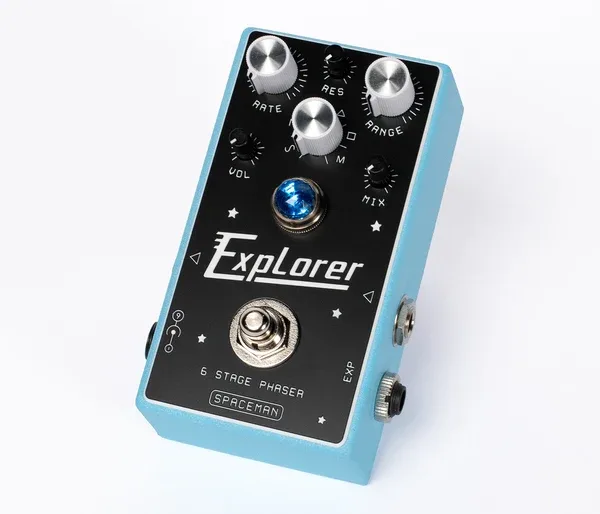
Function f(x)'s technical analysis of phaser types groups the Swirl with pedals using optical-based phase shifting, alongside the Mutron Phasor III and Spaceman Explorer2. For a player, that places it in the vibe corner of the phaser family rather than the more common op-amp or bucket-brigade phaser camp.
What it does to your sound
Skreddy describes the Swirl's character as "Thick, vocal modulation, sweet, other-worldly, moving phase shift, and rotating speaker emulation," summed up on the maker's site as a watery 60's vibe14. In practice that means the throbbing, rotary-speaker-flavored sweep players associate with the original optical vibe circuits, rather than the tighter, more jet-like sweep of a standard phaser.
How the circuit works
The Swirl is analog throughout, using op-amp gain stages in a configuration very similar to the historic circuit, paired with optical electronics1. Two design choices set it apart from a straight reproduction:
- LEDs instead of a light bulb. The original optical vibe used a lamp and light-dependent resistors to sweep the phase shift; the Swirl uses LEDs for the same job1.
- Degree of phase shift varied, not intensity. Skreddy varies how far the signal is phase-shifted rather than how much of the shifted signal is blended in, and mixes the dry signal at the output1.
The circuit has four phase-shifting stages, and Marc cites lower noise and higher input impedance as improvements over the historic design1. Higher input impedance means it loads the guitar less, which matters if you run it first in a chain or after low-output pickups.
Controls and power
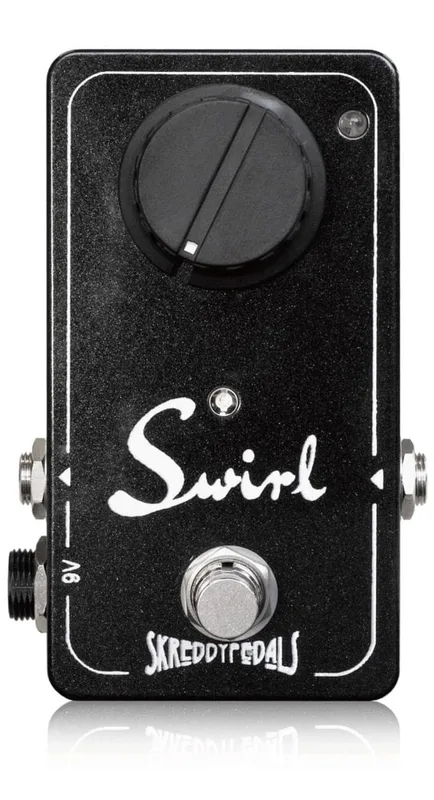
The Swirl keeps it simple: one big speed knob, sized for easy foot control, sweeping from almost standing still to super fast rotary spin1.
| Control | What it does |
|---|---|
| Speed | Sets the modulation rate, from almost standing still to super fast rotary spin; large knob for foot adjustment1 |
Power is 9 volts only, from a DC adapter with a standard 5.5mm barrel x 2.1mm center coax plug, negative center polarity, which is the industry standard1.
The Swirl has no battery option, and an AC power supply must not be used. A standard 9V DC center-negative pedal supply is required, and one is not included with the pedal1.
Buying one and the wait
The Swirl is sold as a preorder, built by hand to order, with a current wait time of approximately 2 weeks to 1 month1. The list price is $301, with a sale price of $270.90 USD as of October 20263. Marc confirms each order and sends a PayPal invoice for the total due, including shipping1.
Videos
musictoyznetwork rasch
Questions
Does the Skreddy Swirl take a battery?
No. The Swirl requires a DC adapter and has no battery option. It runs on 9 volts only, through a standard 5.5mm barrel x 2.1mm center coax connector with negative center polarity. An AC power supply must not be used, and the power supply is not included with the pedal.
Is the Skreddy Swirl true bypass?
Yes. Skreddy describes the pedal as being off when in true-bypass, so the signal passes around the circuit when the effect is disengaged. Like any true-bypass pedal, it drops out of your signal chain entirely rather than buffering it.
How long is the wait for a Skreddy Swirl?
The Swirl is sold on a preorder basis, built by hand to order. Skreddy's stated wait time is approximately 2 weeks to 1 month from ordering. The maker confirms the order and sends a PayPal invoice for the total including shipping.
Is the Skreddy Swirl analog?
Yes. The Swirl is an analog pedal built with op-amp gain stages in a configuration similar to the historic 1969-era optical vibe circuit, combined with optical electronics. Instead of the original's light bulb, it uses LEDs, and it varies the degree of phase shift rather than the intensity.
Sources (4)
- Modulation, Skreddy Pedals
- Guitar Phaser Pedal Types: JFET, Optical, OTA, and Others, Function f(x), 2022-03-18
- Modulation, Skreddy Pedals
- Modulation, Skreddy Pedals