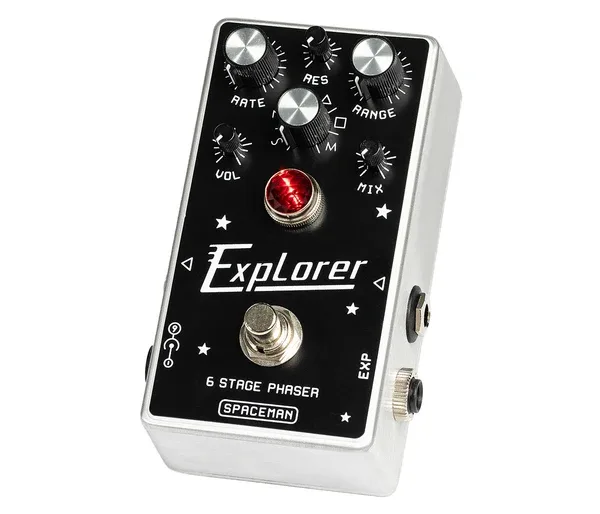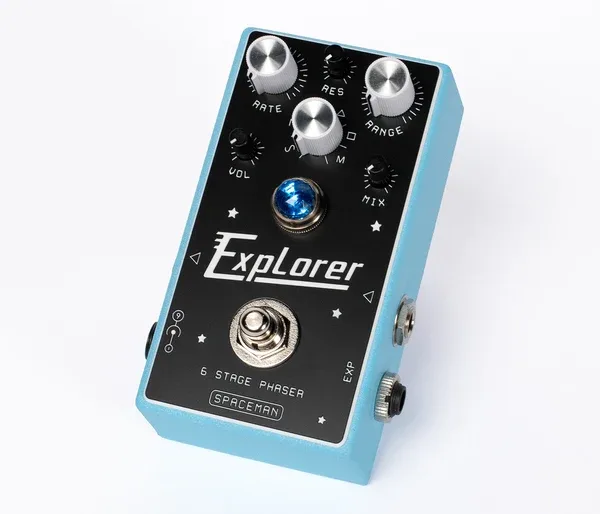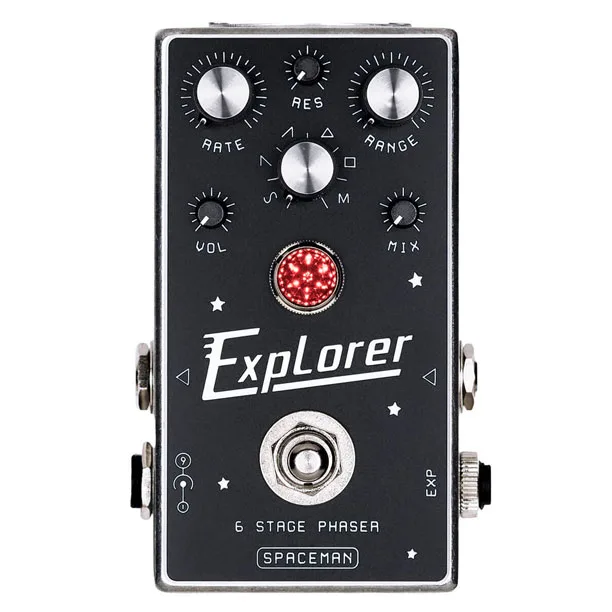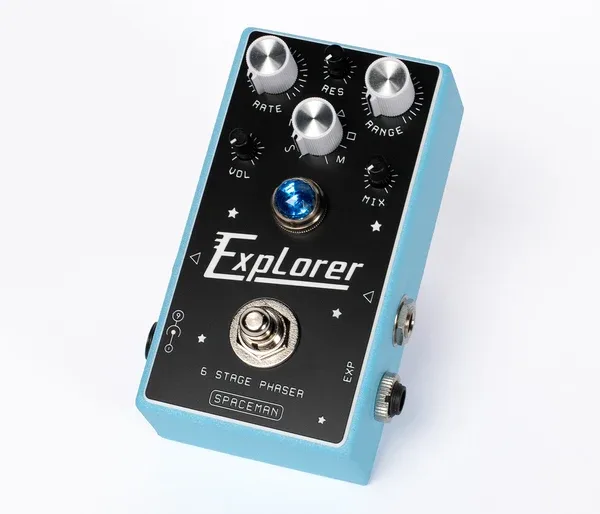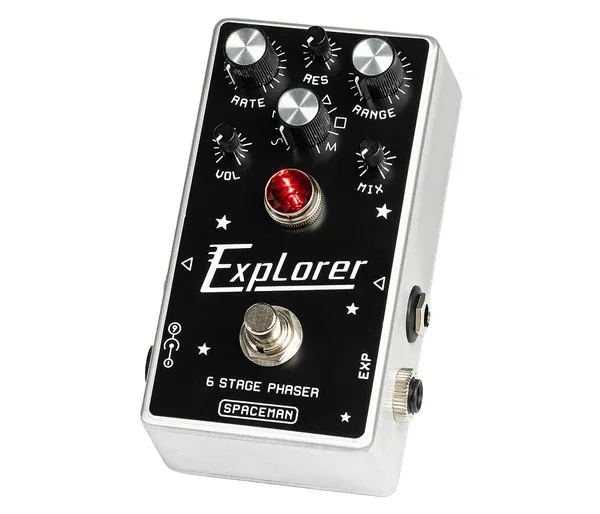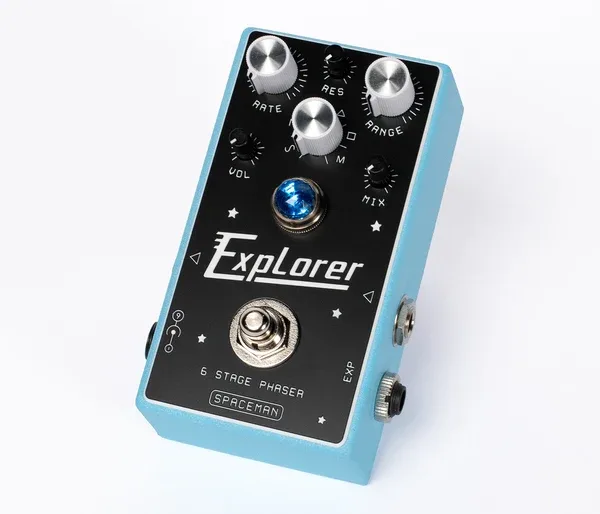


The Spaceman Explorer: 6 Stage Phaser [NOS] is an optical six-stage analog phaser pedal from Spaceman Effects. It uses six stages of optically swept phase shifting, a photocell-based design in which a light-driven element moves the notches of the phasing across the frequency spectrum, and Spaceman describes the result as "sometimes liquidy smooth, sometimes chewy and lush"1. The pedal is a small form factor reissue of the company's first phaser circuit, the Explorer Deluxe, keeping what Spaceman calls "all the deluxe features of the original" in a compact enclosure1.
Spaceman describes the core sound in its own settings examples: "Slow, chewy phasing with a sharp resonant edge that cuts deep" for its Deep Phasing setting, and "Fully wet pitch vibrato, rubbery wiggling whiplash" when the mix is at 100% wet1. The pedal is hand-wired and built in Portland, Oregon, in a cast-aluminum enclosure with an engraved vinyl faceplate and a jewel indicator light1. Note that the maker's page lists it as sold out1.
Six-stage optical phasing
The Explorer's phasing comes from six sweeping analog stages in a photocell-based optical design2. In an optical phaser, the LFO (the low-frequency oscillator that drives the sweep) drives a light source against photocells rather than switching solid-state components directly, which is the approach associated with vintage photocell phasers. Spaceman's page for the Explorer emphasizes the six stages of optically swept phase shifting as the pedal's defining feature1.
The LFO itself offers five wave shapes, selected by the SHAPE control: Sine, Ramp Down, Ramp Up, Triangle, and Square1. A sixth position, the Manual setting, disconnects the LFO entirely and freezes the phase sweep, turning the RATE knob into a manual position control for the notches1. Spaceman's own setting descriptions hint at the range: a "Smooth wah effect, with great detail and swoosh" for one setting, "Simple. Swirly. Sumptuous." for another, and, on the boost side of things, "It's not a Spaceman if it doesn't boost."1
The controls
Spaceman bills the Explorer as full-featured controls in a compact form factor1. The five knobs each do one job:
| Control | What it does |
|---|---|
| VOL | Sets the output volume of the phase tone1 |
| RATE | Wide-range LFO speed, from extremely slow to extremely fast modulation; in Manual mode it sets the position of the sweep, and with an expression pedal it sets the highest point of the sweep1 |
| RANGE | Controls the low frequency extension of the phasing; lower settings phase only higher frequencies for vibrato and rotary speaker tones, higher settings reach very low frequencies for slow, deep phasing; in Manual mode it sets the lowest point of the sweep1 |
| RES | Adds feedback for what Spaceman calls "over-the-top phase tones"1 |
| MIX | Blends in additional dry signal for subtle phasing; at 100% wet the pedal gives pitch modulation1 |
| SHAPE | Selects the LFO wave shape: Sine, Ramp Down, Ramp Up, Triangle, Square, plus the Manual setting1 |
The MIX control deserves a note for players new to phasers. Because the effect is blended rather than fixed, the Explorer can sit anywhere between a barely-there shimmer on top of your dry tone and a fully wet signal, where Spaceman says it produces pitch modulation, effectively vibrato1. The RES control is the feedback or resonance control: more of it sharpens the peaks of the notches. Pedal of the Day, reviewing the original Explorer Deluxe circuit, described its Resonance knob as one that "dials in your feedback properties, getting into crazy, outer-spacey, over-the-top phaser tones"2.
Expression pedal and control voltage
The Explorer carries a CV/EXP pedal input on a 0-5V DC TRS jack, protected against over and reverse voltage1. Its behavior depends on the mode:
- With any of the five LFO wave shapes selected, the expression input controls the speed of the LFO1.
- In Manual mode, the expression pedal sweeps the phaser directly, with RATE setting the highest point of the sweep and RANGE setting the lowest1.
Pedal of the Day used an expression pedal to control the rate throughout its demo video of the Explorer Deluxe and found it practical in use: "it makes it so easy to set the pulse to match the tempo of whatever song you're playing in a second"2. Players shopping for a pedal for this input can look at expression pedals designed for control voltage inputs.
Power
The Explorer runs on 9 to 24V DC, negative center, through a 2.1mm jack1. Current draw is 26mA in bypass and 51mA engaged1, which means the relay switching circuit draws power even when the effect is off, so the pedal needs a powered supply rather than sitting idle on a board. Pedal of the Day noted that the Explorer Deluxe circuit "can even be run all the way up to 24V if desired, for more clean headroom"2. There is no battery option in the specifications.
Where it came from
The Explorer name comes from the first satellite the United States put into orbit, in 1958, and the Explorer was the first phaser launched by Spaceman1. Spaceman presents the current Explorer as a six-stage phaser with an all analog signal path, hand-wired and built in Portland, Oregon, and sold at a list price of $2791. The pedal is now sold out1.
What reviewers said
Published review coverage of this circuit is not held here. What Spaceman's own page describes is the character of the effect: "Sometimes liquidy smooth, sometimes chewy and lush, the fluid frequencies squiggle and flourish like the unrelenting ebb and flow of the sonic tide"1. The page also documents what the Mix control does, blending in additional dry signal for a subtle phasing effect, with pitch modulation at 100% wet1.
Videos
AndyDemos
R.J. Ronquillo
Noise Generator
News
Questions
What does the Range knob do on the Spaceman Explorer?
RANGE controls the low frequency extension of the phasing. At lower settings only the higher frequencies phase, which Spaceman says is useful for vibrato and rotary speaker tones. At higher settings the phasing stretches into very low frequencies for slow, deep phasing. In Manual mode, RANGE sets the lowest point of the sweep while RATE sets the highest.
Can you use an expression pedal with the Spaceman Explorer?
Yes. The Explorer has a CV/EXP pedal input on a 0-5V DC TRS jack that is protected against over and reverse voltage. With the five LFO wave shapes selected, an expression pedal controls the speed of the LFO. In Manual mode it sweeps the phaser directly, with RATE setting the highest point and RANGE the lowest point of the sweep.
Is the Spaceman Explorer true bypass?
Yes. Spaceman Effects specifies true-bypass relay switching with a soft-touch footswitch. The pedal draws 26mA in bypass and 51mA engaged, so the relay circuit is powered even when the effect is off.
What is the difference between the Explorer and the Explorer Deluxe?
The Explorer is a small form factor reissue of the original Explorer Deluxe circuit, carrying over what Spaceman calls the deluxe features of the original. The Explorer Deluxe was Spaceman's first phaser, launched in a larger enclosure and made in small runs. The compact Explorer reissue is priced at $279.00.
Sources (2)
- Explorer Optical Phaser, Spaceman Effects
- Spaceman Effects Explorer Deluxe Optical Phaser, Pedal of the Day (www.pedal-of-the-day.com), 2017-11-27