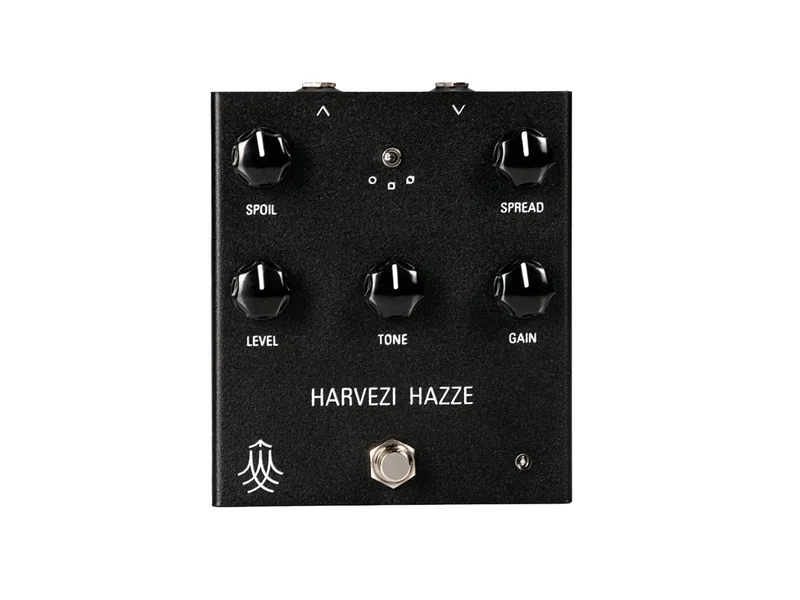


The Harvezi Hazze is a distortion pedal from SOMA Laboratory, and its circuit is unusual: instead of the bipolar transistors or op-amp clipping stages found in most fuzz and distortion boxes, its core is a waveshaper built around a unijunction transistor, a component type from the early days of the semiconductor industry1. SOMA describes that one component as replacing a number of complex devices, and says that depending on the operating mode it can act as a distortion, a limiter, a waveshaper and a generator, with smooth transitions between those roles1.
The name translates from Georgian as "a fault on the transmission line" or "signal jamming", and the transistors themselves were sourced from the e-waste bins of flea markets in Tbilisi, Georgia2. For a player, the practical result is a box that Guitar World's reviewer described as "a vast universe of distortion and fuzz effects and much more"3.
Inside the signal chain: compressor, amplifier, waveshaper
The signal passes through four stages in order12:
- An optical compressor with fixed parameters, always set the same way
- A dual-mode distorting amplifier that offers either softer or harsher clipping
- The waveshaper built around the unijunction transistor
- A tone stack section for EQ shaping
The optical compressor at the front is not a control you dial in: its parameters are fixed, and it is switched in or out from the side of the pedal. Its job is to level the incoming signal before the distorting amplifier, which is where the character of the drive is set. A three-position mini toggle on the top row selects the amplifier's soft clipping, harsh clipping or total feedback mode3. The waveshaper after it is the part of the circuit that produces the tones a typical fuzz or distortion circuit cannot, since the unijunction transistor behaves differently from the bipolar transistors most fuzz pedals use3.
The controls and side switches
On top, the pedal has six control knobs, a three-way switch and a footswitch2. The bottom three knobs are the familiar Level, Tone and Gain controls3:
| Control | What it does |
|---|---|
| Gain | Controls the output amplitude of the signal in the distorting amplifier section; soft distortion with the switch left, more aggressive with an abundance of high harmonics in the middle position2 |
| Tone | Adjusts the brightness of the sound; with higher values, higher harmonics become present in the signal2 |
| Level | Sets the output volume3 |
The remaining knobs, listed by MusicRadar as Spoil and Spread, shape the waveshaper's behavior5. The Tone knob is worth a closer look: Guitar World found it provides "dramatic EQ sweeps rather than the typical 'mush to bright' range of a typical fuzz/distortion box", with its range and characteristics changing depending on which side switches are engaged3.
Turning the pedal on its side reveals six extra controls with switches for each, letting you engage features like the tone stack or compressor and adjust EQ-centric functions like bass boost and high cut5. Premier Guitar's product page details three of them2:
- Compressor: routes the signal through the compressor
- High Cut: attenuates high frequencies
- Tone Mode: changes the behavior of the Tone knob, between tilt or lowpass
The footswitch routes the signal through the effect circuitry or from input to output directly, which is the true bypass2.
The tone stack has to be engaged for the EQ-based switches to work, including the Tone knob5. If the Tone knob seems dead, check that the tone stack is switched in.
There are some useful presets in the manual to start from if you are unsure where to begin with this many interacting controls5.
Power and connections
The pedal runs on a standard 9V DC, 50 mA supply through a 2.1 mm center negative jack, the same arrangement as most modern pedalboard power supplies4. It is a mono pedal throughout: one 1/4 inch mono input, one 1/4 inch mono output4. MusicRadar noted that the lack of stereo might put non-guitarists off5. The enclosure is all-metal with rubber feet and an all-black texture, and MusicRadar found it "very giggable" with decent weight behind it5.
What reviewers said
Guitar World gave the Harvezi Hazze four and a half stars out of five, calling it "an outrageously versatile distortion/fuzz box that generates a huge variety of highly musical dirty tones and textures that users can fine tune to their discriminating taste"3. Their listed pros included "truly unique distortion/fuzz tones and textures" and "excellent dynamics and note definition", and they credited the side-mounted switches with providing detailed tone shaping capabilities3. On the downside, they noted there is no memory for saving settings3.
MusicRadar's reviewer called it "a genuinely fun take on the classic distortion-slash-fuzz pedal", praising its versatile control set and calling it great fun experimenting with its myriad settings overall5. In terms of voicing, they placed it "very much in the vein of a fuzz pedal or RAT-style distortion", and found it responds brilliantly to picking dynamics5.
Videos
SOMA Laboratory
SOMA Laboratory
SOMA Laboratory
Questions
What does Harvezi Hazze mean?
The name translates from Georgian as "a fault on the transmission line" or "signal jamming". SOMA Laboratory founder Vlad Kreimer is based in Tbilisi, Georgia, where the unijunction transistors at the heart of the circuit were sourced from flea market e-waste bins.
Why doesn't the Tone knob work on the Harvezi Hazze?
The Tone knob is part of the pedal's tone stack section, and the tone stack has to be engaged for the EQ-based controls, including the Tone knob, to work. If the tone stack is switched out, the Tone knob has no effect. When engaged, it gives dramatic EQ sweeps rather than the usual mush-to-bright range.
Is the Soma Harvezi Hazze true bypass?
Yes. The maker's spec sheet lists true bypass, and the footswitch routes the signal either through the effect circuitry or directly from input to output. Guitar World's review also confirms true bypass.
Does the Harvezi Hazze have stereo outputs?
No. It has a single 1/4 inch mono input and a single 1/4 inch mono output. MusicRadar noted that the lack of stereo might put non-guitarists off, but for a standard pedalboard it works like any mono distortion pedal.
How much does the Soma Laboratory Harvezi Hazze cost?
Premier Guitar listed it at €290 at launch, and MusicRadar gave the launch price as £289 or €329.
Sources (5)
- DESCRIPTION / Harvezi Hazze, SOMA Laboratory
- Unleash Sonic Possibilities with Harvezi Hazze, Premier Guitar, 2025-01-15
- SOMA Harvezi Hazze review, Guitar World, 2025-07-05
- SPECS & MANUAL / HARVEZI HAZZE, SOMA Laboratory
- “A genuinely fun take on the classic distortion-slash-fuzz pedal”: Soma Laboratory Harvezi Hazze review, MusicRadar, 2025-04-28