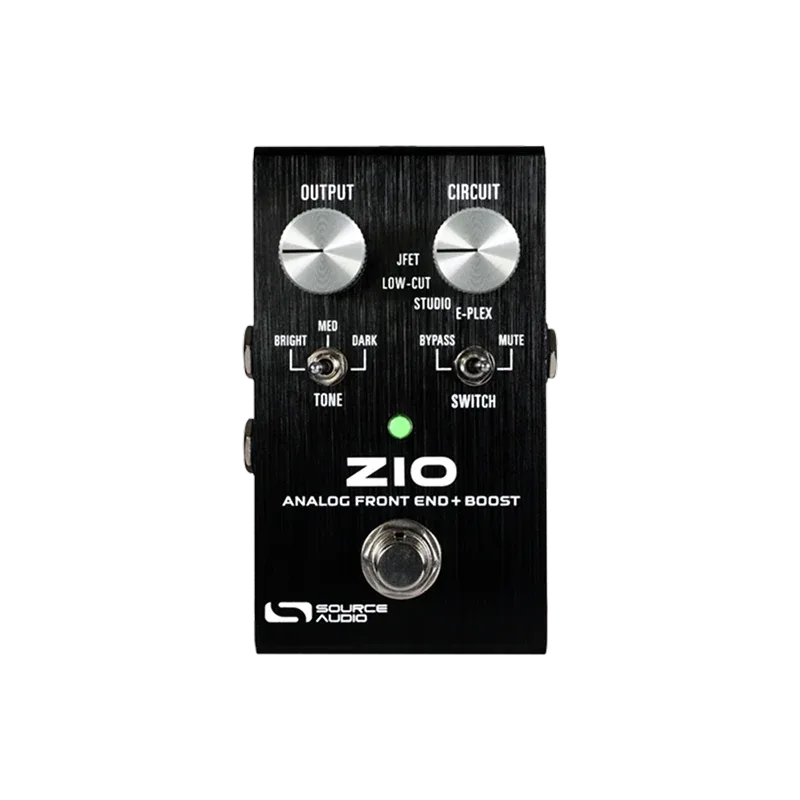


The Source Audio ZIO Analog Front End + Boost is an all-analog preamp and boost pedal that conditions your signal at the front of the chain while giving you up to +20dB of extra output1. It combines four switchable preamp circuits, a Tone switch that simulates different cable lengths, and a separate tuner/line output, all in a compact brushed anodized aluminum housing1. It is Source Audio's first all-analog effects pedal, designed in collaboration with Christopher Venter, the owner and sole engineer at SHOE Pedals1.
The name is functional rather than decorative: ZIO is an acronym for impedance, input and output, with Z being the electrical symbol for impedance2. In practice it works as a buffer, preamp and booster in one box, sitting between your guitar and the rest of your rig2.
What it does: buffer, preamp and boost
The ZIO's job is to make whatever follows it in your chain receive a stronger, better-conditioned signal. Its input impedance of 1 mega ohm is ideal for guitar pickups, and its 150 ohm output impedance is optimal for feeding other pedals or your amplifier2. On top of that, Guitar World's reviewer noted that it acts as a buffer and has a Tone switch offering three different levels of capacitance to simulate different cable lengths3.
The Tone switch is labeled Bright/Med/Dark and offers three capacitor stages that brighten or darken the sound of your guitar2. The MED position, for example, provides additional capacitance and produces the effect of a medium length of cable, roughly 15 feet1. That gives you a way to dial back brightness that a long cable would otherwise cause, without actually coiling up extra cable.
Inside, the pedal uses high-fidelity, noise-free Burr-Brown op amps, which Source Audio credits with the ZIO's clarity and responsive pick dynamics1. Each of the four preamp circuits is an all-original circuit design1.
The four preamp circuits
The Circuit knob selects one of four preamp circuits: JFET, Low-Cut, Studio and E-Plex14. Each offers up to +20dB of additional output boost2.
| Circuit | What it does |
|---|---|
| JFET | Completely transparent signal boost with zero coloring or distortion; similar in character and behavior to a clean tube amp input with very low distortion1 |
| Low-Cut | Reduces "tubby" bottom-end for a tighter sound with added headroom1 |
| Studio | EQ curve based on the famous "Pultec Trick," used on records since the 1950s1 |
| E-Plex | Captures the focused and subtle grit of the preamps found in vintage Echoplex tape delay units1 |
The JFET setting is the most transparent of the four. Guitar World's reviewer Trevor Curwen found it "will retain your core tone but make it louder and more robust," with unity gain sitting at about the 10 o'clock position on the Output knob3. Delicious Audio describes it as a transparent, flat frequency curve option4.
The Studio option drew particular praise. Curwen called it "a real tone-sweetener that combines a mild lower-mid" scoop with a higher boost for clarity and articulation, based on Pultec EQ settings used in studios3. The E-Plex circuit is a recreation of the feel, character and frequency response of a classic early 1970s tape echo unit1, which Source Audio describes as a vintage-style FET buffer/boost tone that is warm, clear, and a little bit dirty1.
Controls and connections
Guitar World lists the full control set as Output, a Circuit switch (JFET, Low Cut, Studio, E-Plex), a Tone switch (Bright/Medium/Dark), and a Bypass/Mute switch3. Beyond the main input and output, there is an extra Tuner/Line output, so you can keep a tuner connected without it sitting in your signal path14.
Power comes from a 9V DC center negative supply drawing 20mA14. That is a light enough draw to share a daisy chain with other standard pedals, and there is no battery option mentioned in the maker's specifications.
History: Source Audio's first all-analog pedal
Source Audio announced the ZIO in January 2022, and it was a first for the company: until then the Boston pedal builder had been known for digital effects, and the ZIO was its first all-analog pedal25. MusicRadar reported it as priced at £/$199 street and available immediately at launch5.
The design came from a collaboration with Christopher Venter, the owner and sole engineer at SHOE Pedals14. Source Audio's stated goal for the pedal was simple but ambitious: "Make Everything Sound Better!"4. Guitar World notes the pedal was designed by Source Audio to "make everything sound better"3. The pedal is made in China3.
What reviewers said
Guitar World's Trevor Curwen reviewed the ZIO and found plenty to work with3:
"Source Audio's ZIO has a plethora of classy options just waiting to be exploited, whether you choose to use it as an always-on tone conditioner or as an on/off booster."3
His overall verdict was that its practicality on a pedalboard "cannot be overstated"3.
Gearnews, covering the launch, called it "a well thought out design with some good tonal choices" and considered it an invaluable tool for players who work with various setups or do a lot of live work2.
The bass version
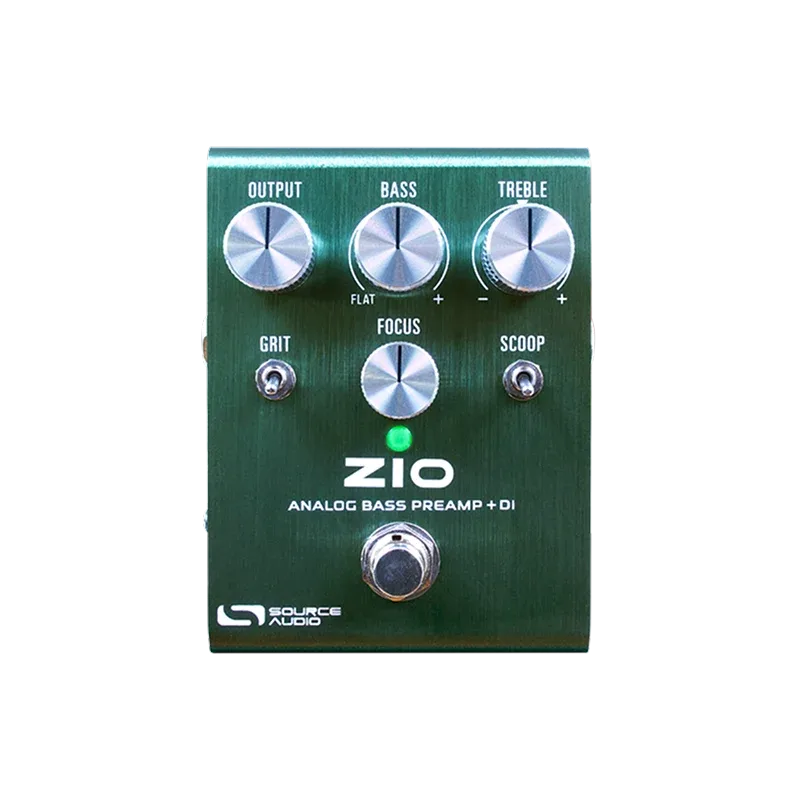
Source Audio also makes the ZIO Analog Bass Preamp + DI, an all-analog bass pedal in the same family6. It works equally well in front of your amplifier or as a preamp and direct box via its balanced XLR output, and its Output knob offers up to +16dB of boost above unity gain or up to -6dB of cut6. Like the guitar version it is true bypass and runs on a 9V power supply6. Both the guitar and bass versions were listed as sold out on Source Audio's pages as of October 202616.
Videos
Sweetwater
sourceaudioeffects
sourceaudioeffects
Questions
Is the Source Audio ZIO true bypass?
Yes. Source Audio lists the ZIO Analog Front End + Boost as true bypass, so with the pedal off the signal passes through without the circuit in the path. When it is on, the pedal also acts as a buffer, with a 1 mega ohm input impedance and a 150 ohm output impedance.
What does ZIO stand for?
ZIO is an acronym for impedance, input and output. The Z is the electrical symbol for impedance, I stands for input, and O stands for output, which fits a pedal whose job is conditioning the signal between your guitar and the rest of your rig.
How much boost does the ZIO give?
The Output control provides up to +20dB of signal boost, and that amount of boost is available on each of the four preamp circuits. The bass version, the ZIO Analog Bass Preamp + DI, offers up to +16dB of boost above unity gain or up to -6dB of cut.
Can I use the ZIO as an always-on pedal?
Yes. Guitar World's reviewer used it both as an always-on tone conditioner and as an on/off booster, and found its practicality on a pedalboard hard to overstate. Its 20mA current draw at 9V DC also makes it an easy pedal to run permanently from a standard power supply.
Is the Source Audio ZIO discontinued?
Source Audio's product page for the ZIO Analog Front End + Boost lists it as sold out as of October 2026, with a sale price of $199.00. The page does not describe it as discontinued, but new units were not available from the maker at that date.
Is there a bass version of the ZIO?
Yes. Source Audio also makes the ZIO Analog Bass Preamp + DI, an all-analog bass pedal that works in front of an amplifier or as a preamp and direct box through its balanced XLR output. It too is listed as sold out on the maker's page.
Sources (6)
- ZIO Analog Front End + Boost, Source Audio
- Zio Analog Front End + Booster, gearnews.com, 2022-01-13
- Source Audio ZIO Analog Front End + Boost, Guitar World, 2022-06-10
- Source Audio ZIO Analog Preamp/Boost, Delicious Audio, 2024-01-09
- Source Audio's ZIO Analog Front End + Boost packs four preamp circuits into one powerful tone-sweetening stompbox, MusicRadar, 2022-01-14
- ZIO Analog Bass Preamp + DI, Source Audio