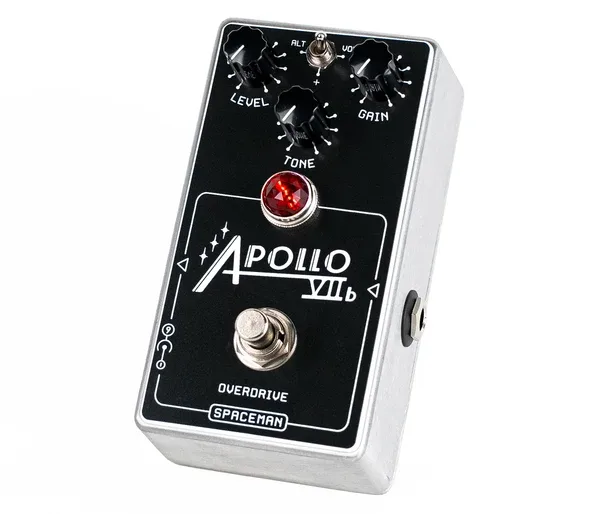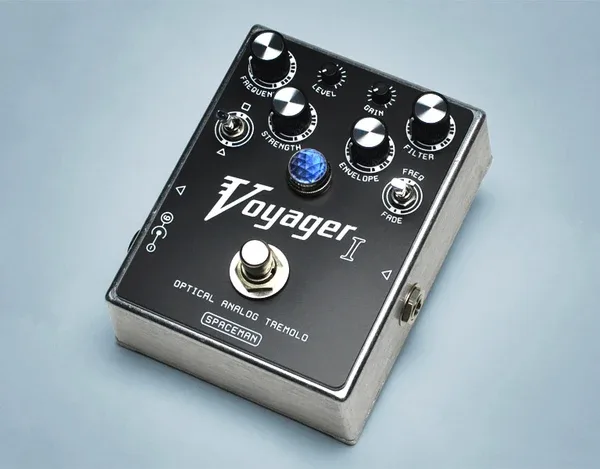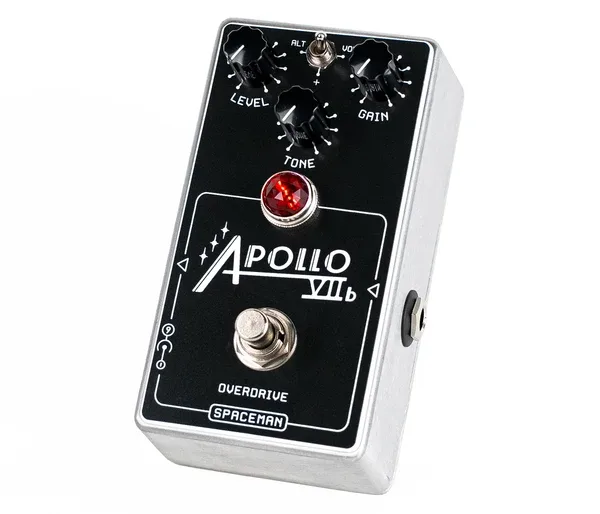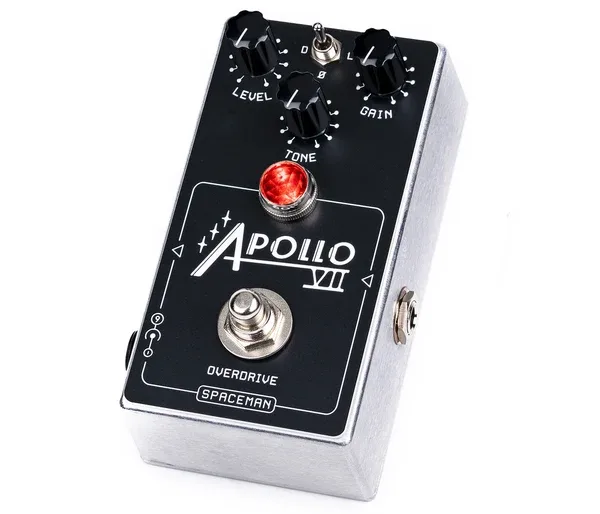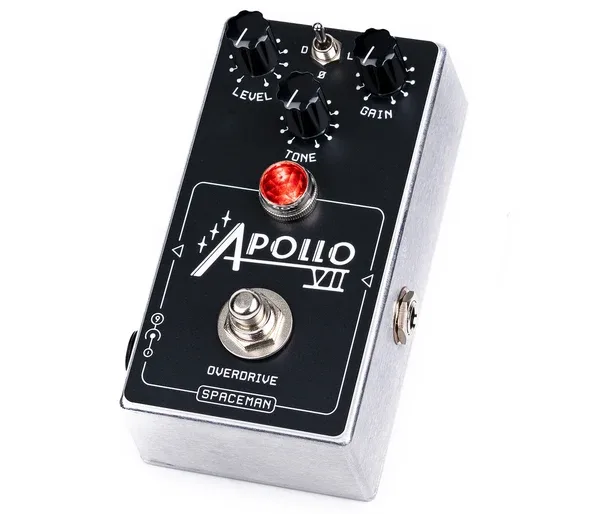


The Spaceman Effects Apollo VII is an overdrive pedal from the Portland, Oregon builder Spaceman Effects, launched in December 2019. Its circuit was extracted from the preamp and gain stage of the company's Voyager I optical analog tremolo, where that stage shaped the signal before the tremolo section; here it stands on its own as a drive pedal12. Spaceman describes the project as a response to player interest in that side of the Voyager I, with the drive and tone-shaping elements carefully pulled out into their own box1.
The pedal offers up to 40dB of gain, three knobs, and a toggle switch that selects between three clipping configurations: LED clipping, silicon diode clipping, or no clipping diodes at all1. Guitar Pedal X's Stefan Karlsson characterized the result as "an Overdrive with an articulate, fuzzy-drive character," noting a distinct fuzzy edge on all modes and a warm fuzzy texture that runs from smooth to raspy2. The Apollo VII is currently listed as sold out on Spaceman's product page1.
Where the circuit came from
The Apollo VII is a direct descendant of the Voyager I, Spaceman's optical analog tremolo. Guitar Pedal X reports that the pedal's core circuit "has actually been extracted from the guts of the Voyager I Optical Analog Tremolo where it acted as the PreAmp"2. Delicious Audio likewise describes the Apollo VII as born from the Voyager I, which it calls the Portland builder's popular optical tremolo3.
For a player, that lineage matters: the LED clipping mode is not a generic diode stage but the same clipping character the Voyager I tremolo used, so players who liked the drive side of that pedal can get it on its own. Guitar Pedal X notes that "the L LED mode exactly matches that which was/is in the Voyager Tremolo"2. Spaceman itself frames the pedal the same way, saying it was inspired by the response to the Voyager I and built from that pedal's drive and tone-shaping elements1.
The three clipping modes
A single toggle switch selects the clipping configuration, and each option changes the pedal's character considerably1.
| Mode | Clipping | Character |
|---|---|---|
| L | LED clipping | Mid-range focused grit; Delicious Audio calls this "the sound of the Voyager I"3 |
| D | Silicon diode clipping | A more compressed and aggressive sound with a smoother decay tail3 |
| 0 | No clipping diodes | Much more touch-sensitive; the pedal "will growl and bark with astounding dynamic variation"3 |
The three modes give the pedal a wide practical range. LED clipping sits closest to the Voyager I's voice, silicon diodes push toward a tighter, more aggressive overdrive, and the diode-free setting leans on the op-amp itself for clipping, which is where the touch response and dynamic variation come in3. Guitar Pedal X lists the original three options as symmetrical silicon, none, and semi-symmetrical LEDs4.
The controls
The control set is minimal: three knobs, Level, Gain and Tone, each of which Spaceman says has been optimized to offer a wide variety of sounds1. Delicious Audio echoes the maker's description, noting the three controls were optimized to deliver a wide variety of tones3. Guitar Pedal X singles out the Tone control as wide-ranging, capable of delivering noticeably different tonalities across its rotation2.
There is no separate presence, bass, or mid control, and no second footswitch. The clipping toggle is the only other control on the pedal, which keeps the surface area small and the signal path short1.
Switching, power and build
The Apollo VII uses true-bypass relay switching with a soft-touch footswitch1. Guitar Pedal X describes the 2019 version's switching as digitally controlled relay bypass, and notes that it has no battery snap, so the pedal runs on external power only4.
At launch the pedal came in two tiers of build. The Raw Steel Standard Edition was an unlimited SMD build, while the limited editions were hand-made24. Spaceman's current product page still presents the pedal in two build variations, a Limited Edition and a Standard Edition1.
The 2019 Standard edition of the Apollo VII is an SMD build, built with surface-mount components rather than hand-wired parts. The hand-made Purple Sparkle edition was the hand-built alternative, at $3194.
Launch editions and prices
The Apollo VII arrived in December 2019 in five editions, with the limited hand-made finishes priced above the unlimited Standard Edition2.
| Edition | Price (2019) | Notes |
|---|---|---|
| 22 Purple Sparkle | $319 | Hand-made edition2 |
| 44 Blue Starlight | $309 | 2 |
| 55 Black | $299 | 2 |
| 66 White | $299 | 2 |
| Raw Steel Standard | $199 | SMD build2 |
Guitar Pedal X also noted the UK price of the Standard Edition at launch, £1794.
What reviewers said
Guitar Pedal X's Stefan Karlsson reviewed the pedal at launch and came away positive, particularly on its core voicing. He placed it in what he calls his Fuzzy-Drive ballpark and called it "A pretty decent return to form all-round!"2. For context, he was frank about the preceding release: "I wasn't overly enamoured with Spaceman's previous release, the Saturn VI Harmonic Booster, which wasn't quite as pede..."2. Against that, the Apollo VII's fuzzy-drive character landed well with him, and he wrote that he would wait for stock to reach the UK rather than pass on it2.
"A pretty decent return to form all-round!"
The Apollo VII and the Apollo VIIb
The Apollo VII story did not end with a single version. The 2019 Standard edition was an SMD build, while a hand-made Purple Sparkle edition went for @ $3194. The pedal is an overdrive, presented with an articulate, fuzzy-drive character and up to 40dB of gain on tap21.
The differences between the editions are in how they were built and priced. The 2019 Standard edition was an SMD build, while the hand-made Purple Sparkle edition carried the higher @ $319 price4. A 66 White Edition of the Apollo VII Overdrive was listed at $2992.
A player comparing the two today should treat them as different circuits that share a name and a Voyager I lineage, not as two editions of the same pedal.
Videos
SpacemanEffects
AndyDemos
R.J. Ronquillo
Questions
How much gain does the Apollo VII have?
Spaceman Effects specifies up to 40dB of gain on tap, which the maker describes as a considerable amount of headroom. That range lets it run from light drive through to heavily clipped overdrive, depending on where the Gain control is set and which clipping mode is selected.
Does the Apollo VII take a battery?
No. The 2019 version has no battery snap, so it runs on external power only. Players building a pedalboard around it will need a power supply rather than a 9V battery.
Is the Apollo VII true bypass?
Yes. Spaceman Effects fits the Apollo VII with true-bypass relay switching and a soft-touch footswitch. Guitar Pedal X describes the 2019 version's switching as digitally controlled relay bypass.
What is the difference between the Apollo VII and Apollo VIIb?
The original Apollo VII uses fully symmetrical diode clipping with three toggle options: LED, silicon diode, or no diodes. The Apollo VIIb, released in 2025, adds a distinct asymmetrical clipping option, and Spaceman says its circuit is 80% different from the 2019 original after founder Zak Martin returned to the brand in 2024.
Is the Spaceman Apollo VII still available?
No. Spaceman Effects lists the Apollo VII as sold out on its product page. The design line continues in the Apollo VIIb and the Apollo VIIb Cadet, which are separate products.
Sources (4)
- Apollo VII, Spaceman Effects
- Guitar Pedal X, Guitar Pedal X, 2019-12-13
- Spaceman Effects Apollo VII Overdrive, Delicious Audio, 2022-03-30
- Guitar Pedal X, Guitar Pedal X, 2025-04-11